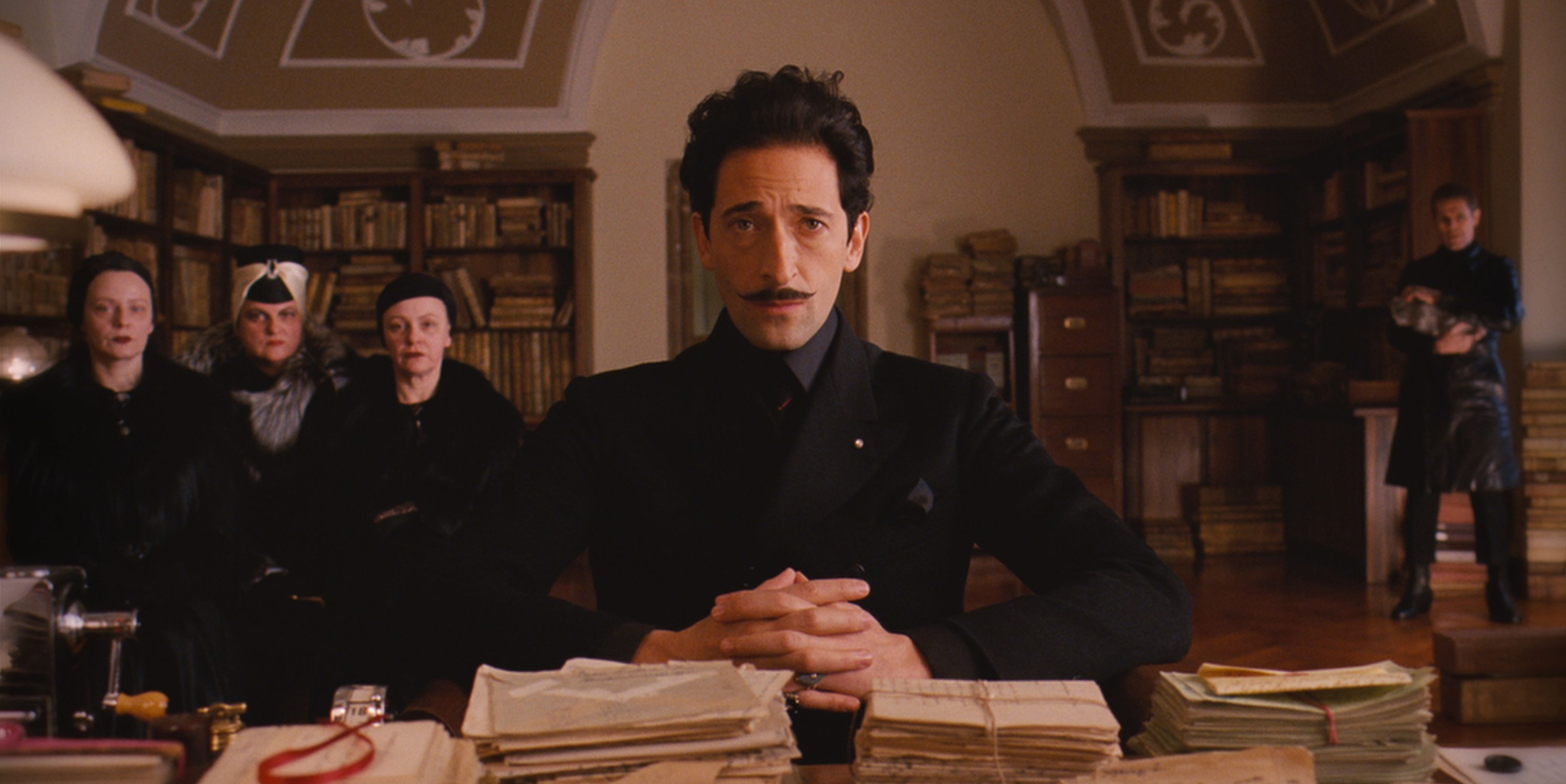
Wes Anderson movies are basically dollhouses for grown-ups. Every tea cup, every symmetrical rug, and every twitch of a mustache is curated until it’s almost painful. But in 2014, when The Grand Budapest Hotel hit theaters, something felt a little sharper than usual. That sharpness had a name: Dmitri Desgoffe-und-Taxis.
Played by Adrien Brody, Dmitri wasn't just another quirky ensemble member. He was the engine of the plot. He was the guy who brought a sneering, cigarette-flicking darkness to a world otherwise made of pink frosting and Mendl’s pastries. Honestly, if you look back at Adrien Brody in Grand Budapest Hotel, you realize he wasn't just playing a villain. He was playing the ultimate Wes Anderson antagonist—a man who hates the very whimsy the rest of the characters live for.
The Man in Black (and Fur)
Dmitri is the grieving, yet mostly greedy, son of Madame D. After his mother is found dead under suspicious circumstances, he doesn’t exactly go into a state of mourning. Instead, he goes into a state of "where is my inheritance?"
Brody plays him with this incredible, high-strung intensity. You’ve seen Brody do "intense" before—the man won an Oscar for The Pianist, after all. But here, that intensity is funneled into a character who looks like he stepped out of a 1930s silent film about a cruel oil tycoon. He’s draped in black. He has a mustache that looks like it was drawn on with a very expensive piece of charcoal.
That Iconic Look
The costume design by Milena Canonero (who won an Oscar for this, by the way) tells you everything you need to know about Dmitri before he even opens his mouth. While M. Gustave is all lavender and civet, Dmitri is a wall of black.
- The Coat: A massive, intimidating fur-collared overcoat.
- The Hair: Slicked back with enough product to survive a blizzard in the Alps.
- The Vibe: Pure, unadulterated "I will sue you, then I will kill you."
It’s a contrast that works because it’s so stark. In a movie filled with pastel colors and polite conversation, Dmitri is a middle finger to the establishment.
Why the Performance Works (It’s the Comedy, Stupid)
People often forget how funny Adrien Brody can be. He’s usually the guy we turn to for soulful, tragic eyes. But in The Grand Budapest Hotel, his comedic timing is surgical. Think about the scene where he’s reading the will. Or better yet, the moment he realizes "Boy with Apple"—the priceless painting—is missing.
He doesn’t just get mad. He explodes with a sort of refined vitriol.
"You’re a bisexual!" he screams at Ralph Fiennes’ M. Gustave. It’s a ridiculous line, delivered with such genuine, shaking rage that it becomes one of the funniest moments in the entire film. Brody understands the assignment: in a Wes Anderson world, you don't play the joke. You play the character’s reality, no matter how absurd it is. To Dmitri, the fact that a "faggot concierge" might inherit a masterpiece is the greatest tragedy of the 20th century.
Real Locations and Surreal Dinners
Working on a Wes Anderson set isn't like working on a Marvel movie. There are no green screens. The cast of The Grand Budapest Hotel actually lived together in a small town called Görlitz in Germany.
Brody has talked in interviews about how surreal the experience was. Every night, the entire cast—we’re talking Bill Murray, Jeff Goldblum, Willem Dafoe, Edward Norton—would sit down for a communal dinner. It was like a summer camp for the world’s most talented actors. This "tribalism," as Brody called it, is what gives the movie that lived-in feel.
When you see Dmitri and his henchman Jolping (Willem Dafoe) on screen, there’s a weirdly specific chemistry there. That comes from spending months in a cold German border town, eating dinner together every night, and obsessing over the "animatics" (the animated storyboards) that Wes uses to plan every single frame.
The Specificity of Wes
Wes Anderson is famous for his "takes." He’ll do thirty, forty, fifty takes of a single shot. Not because the actor is doing it wrong, but because he wants to tweak the speed of a hand gesture or the angle of a head tilt by half an inch. Brody thrived in this. He’s an actor who loves the craft of the "minute detail."
The Villain We Needed
Dmitri represents the encroaching darkness of the 1930s. While M. Gustave is a relic of a more "civilized" age—an age of poetry and perfume—Dmitri is the face of the new, fascistic order. He’s selfish, he’s violent, and he doesn’t care about the "old ways."
But because it’s a Wes Anderson movie, that darkness is filtered through a lens of absurdity. Dmitri is scary, sure. He’s responsible for some pretty grim stuff (RIP Serge X). But he’s also a petulant child. He’s the guy who brings a gun to a fistfight and still manages to look slightly embarrassed when things go sideways.
Lessons from the Desgoffe-und-Taxis Playbook
If you’re a fan of cinema or just someone who appreciates a good villain, there are some genuine takeaways from Brody’s performance:
- Commitment is everything. If you’re going to be a villain in a comedy, you have to be the most serious person in the room. The moment you wink at the camera, the tension dies.
- Visuals do the heavy lifting. Dmitri’s silhouette is as much a part of the character as his dialogue. In your own life, remember that how you "frame" yourself matters.
- Collaborate with people who challenge you. Brody and Anderson have worked together multiple times (from The Darjeeling Limited to Asteroid City), and it’s because they speak the same language of precision.
Adrien Brody in Grand Budapest Hotel remains a masterclass in how to be an ensemble player who steals every scene he’s in. He didn't need the most screen time to leave the biggest impression. He just needed a fur coat, a bad attitude, and a painting called "Boy with Apple."
To really appreciate the nuance, go back and watch the scene where Dmitri confronts Gustave in the hotel lobby near the end. Pay attention to Brody's eyes—they aren't just angry; they're the eyes of a man who realizes the world he wants to control is slipping through his fingers. It’s a small, human moment in a movie that’s often accused of being "style over substance."
Next time you’re scrolling through streaming services, put it on again. Focus specifically on the "villainous" trio of Brody, Dafoe, and their cold, calculated pursuit. It’s a reminder that even in a dollhouse, the shadows can be very real.