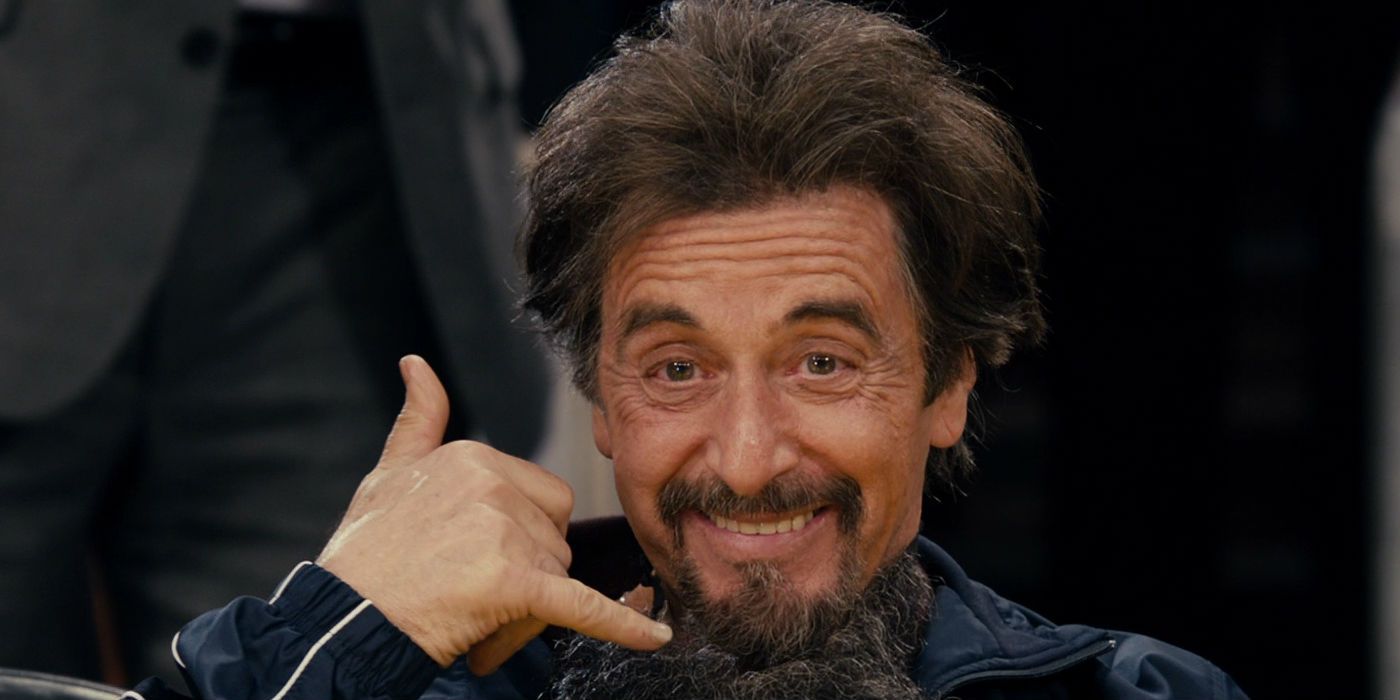
It’s almost weird to think there was a time when Al Pacino and Quentin Tarantino hadn’t worked together. For decades, they felt like two ships passing in the night—one the king of 1970s gritty realism and the other the hyper-literate heir to the New Hollywood throne. Then came 2019. When Al Pacino in Once Upon a Time in Hollywood finally happened, it wasn't some grand, three-hour epic showdown.
He’s barely in it.
Honestly, if you blink during the first act, you might miss the nuance of what he’s doing. Pacino plays Marvin Schwarz (spelled with a 'z', as he pointedly notes), a high-powered Hollywood agent who basically functions as the catalyst for the entire movie’s existential crisis. He’s the guy who has to tell Rick Dalton (Leonardo DiCaprio) that his career is, well, dying.
It’s a masterclass in "less is more" from an actor who, let’s be real, spent most of the 2000s doing a lot of "more."
The Meeting at Musso & Frank
The scene at Musso & Frank Grill is arguably the most important piece of world-building in the film. You’ve got Rick Dalton, a man vibrating with insecurity, sitting across from Schwarz, who is draped in a camel-hair coat and radiating the kind of old-school industry power that doesn't need to shout.
Pacino plays Schwarz with this gravelly, almost predatory kindness. He isn't there to insult Rick. He actually loves Rick’s work. He’s seen 14 Fists of McCluskey and he thinks the shooting is "terrific." But Schwarz is the audience's window into the brutal logistics of the 1969 film industry. He explains the "diminishing returns" of being the heavy on every weekly TV show.
"You're the guy the new guy beats up to show how tough he is," Schwarz says. It’s a gut punch.
What’s fascinating is how Pacino uses his hands. Watch him handle that cigar. He’s not just an actor playing an agent; he’s an actor playing a man who has spent forty years selling dreams and killing them in the same breath. Tarantino has mentioned in interviews—specifically on the 2 Bears, 1 Cave podcast—that Pacino actually came in with a deep understanding of the real-world agents of that era, guys like Stan Kamen or Paul Kohner.
Why Marvin Schwarz Had to Be Al Pacino
Could someone else have played this? Maybe. But it wouldn't have carried the same weight.
When Al Pacino in Once Upon a Time in Hollywood appears on screen, he brings fifty years of cinematic history with him. When he tells DiCaprio’s character that he’s becoming a "has-been," the irony is thick. Pacino survived the transition that Rick Dalton is terrified of. Pacino was the New Hollywood that replaced the guys like Rick.
There’s a specific kind of meta-commentary happening here. Tarantino loves casting legends in roles that comment on their own careers. Think about it. Schwarz is trying to convince Rick to go to Italy to make Spaghetti Westerns. In real life, those Italian productions were often seen as a graveyard for American stars whose luck had run out. Pacino, of course, became a god-tier icon largely because of an Italian-American epic (The Godfather). The layers are everywhere.
The chemistry between DiCaprio and Pacino is surprisingly tender. Schwarz seems genuinely concerned about Rick's trajectory. He doesn't want to see the "Double M" (The Big Mac of movies) go to waste.
The Accuracy of the 1969 Industry Shift
The movie gets a lot of grief for its pacing, but the Schwarz scenes are historically airtight regarding how the studio system was crumbling. By 1969, the old guard was terrified.
- The big-budget musicals were flopping.
- European cinema was suddenly "cool."
- Independent films like Easy Rider were changing the math.
Schwarz represents the bridge. He knows that the future isn't in Hollywood—at least not for a guy like Rick—it’s in Rome. He mentions Sergio Corbucci, calling him "the second-best director of spaghetti westerns in the whole world." That’s a real guy. Corbucci directed the original Django. Tarantino isn't just making up names; he's using Pacino to deliver a history lesson.
Schwarz is based on a composite of several "super-agents" of the era. These guys were the architects of the "package deal." They didn't just represent an actor; they represented the writer, the director, and the star, and then sold the whole thing to a studio as a finished product. Schwarz’s office, adorned with posters and industry trade papers, is a shrine to a way of doing business that was about to be obliterated by the 1970s "Me" decade.
Breaking Down the "Hoo-Ah" Energy
For a long time, the "late-stage Pacino" trope was all about the shouting. Scent of a Woman, Any Given Sunday, Heat. We love the yelling. But in Once Upon a Time in Hollywood, he’s remarkably subdued.
There’s a moment where he’s watching Rick’s pilot, Lancer, and he’s just reacting. Tiny nods. Small smiles. A little "bang-bang" gesture with his fingers. It’s some of the most relaxed acting Pacino has done in twenty years.
He’s having fun.
You can feel the joy of two icons finally meeting. According to production notes and behind-the-scenes accounts from cinematographer Robert Richardson, Pacino was incredibly collaborative on set, often riffing on his dialogue to make the "agent-speak" feel more authentic to the period. He understood that Schwarz isn't a villain. He’s a realist.
The Impact of the "Italian" Suggestion
The second half of the film only works because of Pacino’s setup. When Rick finally goes to Italy and makes Nebraska Jim, we see him return with a new wife, a new haircut, and a slightly more refined (if still fragile) ego.
Without Schwarz’s intervention, Rick would have likely stayed in the Hollywood Hills, drinking whiskey sours by his pool until the money ran out or he ended up in a guest spot on The Love Boat a decade too early. Schwarz saved him.
It’s a weirdly optimistic role for Pacino. He’s the catalyst for Rick’s survival. While the Manson family is lurking in the shadows representing the "death of the sixties," Marvin Schwarz represents the survival of the industry.
The industry always survives. It just changes its suit.
What Most People Get Wrong About This Role
A common criticism is that Pacino was "wasted" in such a small part.
That’s a misunderstanding of how Tarantino uses stars. Tarantino uses actors like colors on a palette. You don't need a gallon of neon red if you're just painting a small flower. Pacino is the "neon red" of this movie. He provides the burst of energy and authority needed to set the stakes.
If a lesser actor had played Schwarz, the Musso & Frank scene would have felt like exposition. With Pacino, it feels like an audience with the Pope.
Also, can we talk about the outfit? The jewelry? The glasses? The costume design by Arianne Phillips for Schwarz is impeccable. He looks like he smells like expensive tobacco and old leather. Every detail reinforces that this is a man who has seen every trend come and go.
Taking Action: How to Appreciate the Performance
If you want to really "get" what Al Pacino was doing here, you have to look at it through the lens of 1960s Hollywood history.
- Watch the Musso & Frank scene again, but ignore DiCaprio. Just watch Pacino’s eyes. He is "reading" Rick Dalton like a script. He knows exactly when Rick is about to cry before Rick does.
- Look up Sergio Corbucci. Watch The Great Silence or the original Django. You’ll see why Schwarz was actually giving Rick a great career tip, not just an insult.
- Check out Pacino’s other "quiet" roles. Compare Marvin Schwarz to his work in Donnie Brasco or The Irishman. He’s at his best when he’s playing men who are slightly tired but still incredibly sharp.
Al Pacino in Once Upon a Time in Hollywood isn't just a cameo. It’s the connective tissue between the Golden Age and the New Hollywood. It’s a reminder that even in a town built on make-believe, you still need someone like Marvin Schwarz to tell you the truth.
To really understand the context of Rick Dalton's career "decline" that Schwarz describes, it is worth researching the real-life transition of stars like Ty Hardin or Edd Byrnes. These were the real-world inspirations for the character Rick Dalton, and their move to European "B-movies" followed the exact roadmap laid out by Pacino's character in the film. Viewing the film with this historical context transforms Schwarz from a mere plot device into a historically accurate representation of the 1969 industry power brokers.