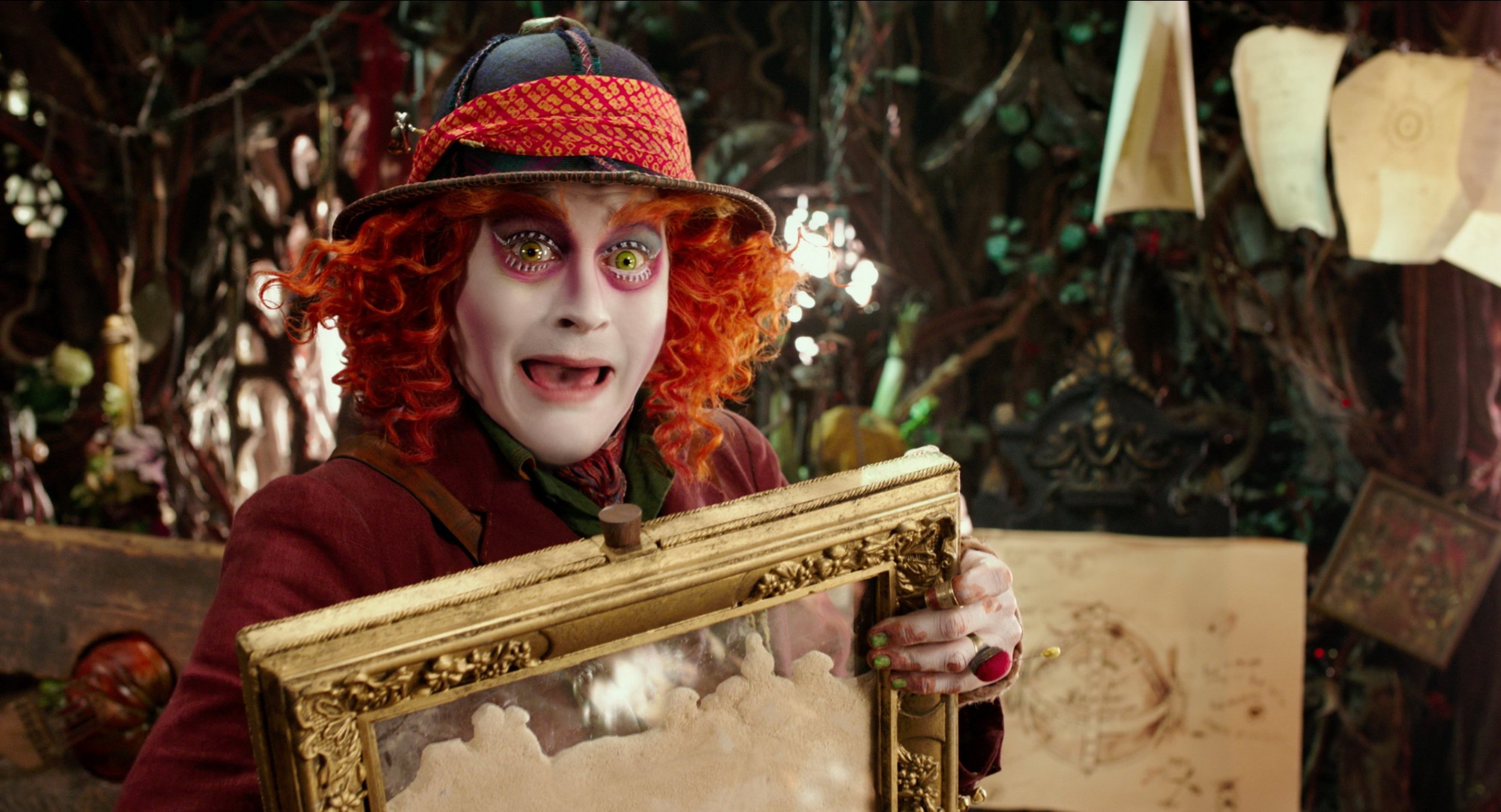
Disney took a massive gamble. When you look back at Alice in Wonderland Through the Looking Glass 2016, you're seeing the tail end of a very specific era of filmmaking. Tim Burton had stepped away from the director's chair, handing the reins to James Bobin. It was a weird time for sequels. People wanted more of the neon-soaked, gothic whimsy that made the 2010 film a billion-dollar juggernaut, but the spark was... different. It was lighter. Maybe a bit too literal?
Honestly, the movie is a bit of a visual fever dream. It’s colorful. It’s loud. It tries really hard to give us a backstory we didn't necessarily ask for regarding the Mad Hatter's family. While the first film felt like a cultural event, this one felt like a high-budget reunion that couldn't quite remember why everyone was friends in the first place.
The Time Problem and Sacha Baron Cohen
The biggest addition to the cast was Sacha Baron Cohen as Time. Not just the concept of time, but a literal person. He lives in a clockwork castle. He’s got these tiny "Seconds" robots that merge into "Minutes." It’s clever. It’s very Lewis Carroll in spirit, even if the plot has almost nothing to do with the original book.
Cohen plays it with this strange, Werner Herzog-esque accent. It works. He’s the best part of the movie because he brings a sense of stakes that the previous film lacked. In the 2010 version, the stakes were "kill the dragon." Here, the stakes are "don't break the universe by trying to fix the past."
The plot kicks off because Alice, played by Mia Wasikowska, returns from years at sea to find her life in London is a mess. She escapes back to Underland (or Wonderland, depending on how pedantic you want to be) through a literal looking glass. She finds Tarrant Hightopp—Johnny Depp’s Mad Hatter—dying of sadness because he thinks his family is alive.
Alice steals the Chronosphere.
That’s the inciting incident. She goes back in time to save the Hatter's family from the Jabberwocky attack. But the movie keeps hitting you over the head with the central theme: You can't change the past, but you can learn from it. It's a bit on the nose.
Visuals vs. Substance
James Bobin, who did the Muppets movies, brought a much brighter palette than Burton. Burton’s Wonderland was gray, gnarled, and soot-covered. Bobin’s is saturated. It looks like a candy store exploded. For some, this was a relief. For others, it lost that "edge" that made the 2010 version stand out during the peak of the "gritty reboot" trend.
The CGI is everywhere. It’s relentless. Sometimes it’s breathtaking—like the scene where Alice "sails" through the ocean of time. Other times, it feels like the actors are drowning in a green-screen soup. You can see it in their eyes. They’re looking at tennis balls on sticks, and sometimes the connection between the human and the digital environment just... snaps.
Why Alice in Wonderland Through the Looking Glass 2016 struggled at the box office
We have to talk about the numbers because they tell a story of their own. The first movie made over $1 billion. This one? About $299 million. That is a staggering drop-off. Why?
- Timing: It came out six years after the first one. In "franchise years," that's an eternity.
- Competition: It opened against X-Men: Apocalypse.
- The Depp Factor: Johnny Depp was going through a very public, very messy personal crisis right as the movie launched. It cast a shadow over the press tour.
- Critical Fatigue: Critics weren't kind. Rotten Tomatoes had it sitting in the high 20s. They called it "tiring" and "over-stuffed."
But if you watch it today, away from the 2016 news cycle, it’s actually a decent family film. It’s better than people remember. The relationship between the Red Queen (Helena Bonham Carter) and the White Queen (Anne Hathaway) gets some much-needed depth. We find out why Iracebeth’s head is so big. It’s actually a tragic story involving a lie and a fallen grandfather clock. It’s small-scale and human, which contrasts weirdly with the "end of the world" ticking clock plot.
The Lewis Carroll Connection (or lack thereof)
If you’re a fan of the books, you're going to be disappointed. Period.
The movie shares a title with Carroll’s second Alice book, and that’s about it. There’s no Chess theme. There’s no Humpty Dumpty (well, he makes a brief cameo). There’s no "Lion and the Unicorn." Instead, it’s a time-travel adventure. It feels more like Back to the Future than a Victorian nonsense novel.
But does that make it bad? Not necessarily. It just makes it a Disney blockbuster using a famous name as a coat of paint.
The Tragic Passing of Alan Rickman
There is a heavy layer of sadness over Alice in Wonderland Through the Looking Glass 2016 because it features the final performance of Alan Rickman. He voiced Absolem, the Blue Caterpillar (who is now a butterfly).
Hearing that iconic, gravelly voice one last time is moving. The film is dedicated to him. When Absolem leads Alice to the mirror at the beginning, it feels like a passing of the torch. It’s a reminder of the caliber of talent Disney threw at these movies. Stephen Fry, Michael Sheen, Timothy Spall—the voice cast is essentially a "Who's Who" of British acting royalty.
Breaking Down the Plot Logic
Alice goes back to the "Horunvendush Day." She tries to stop the Red Queen from being mean. She fails. She realizes that time is a thief, but also a teacher.
The movie tries to be philosophical. It asks: Is Time a person or a thing? Can we forgive those who hurt us if we understand their trauma? These are heavy themes for a movie where a guy wears a hat made of tea sets.
The climax is a "rust" that starts consuming the world because Alice met her past self. It's a standard sci-fi trope. If you touch your past self, the universe explodes. It's called the Grandfather Paradox, though the movie doesn't name it. Seeing the world turn to literal rust and freeze in place is a cool visual, I’ll give them that.
The Legacy of the 2016 Sequel
Looking back from 2026, we can see this movie for what it was: the end of the "Live-Action Remake" gold rush's first phase. It proved that you couldn't just slap a famous title and some CGI on a screen and expect a billion dollars every time. Audiences wanted a reason to care.
The film's strongest suit is Alice herself. Mia Wasikowska plays her with a stubborn, modern energy. She’s not a damsel. She’s a captain. She’s a scientist. She’s a dreamer. In an era where "strong female leads" can sometimes feel like a checklist, Alice in this film feels genuinely independent. She rejects a boring marriage and a boring job to sail the world. That’s a cool message for kids.
Technical Achievements
- Costume Design: Colleen Atwood. She won an Oscar for the first one and was nominated for this one. The costumes are spectacular. The "sea captain" outfit Alice wears is a masterclass in embroidery and color theory.
- Production Design: The transition from the real world (drab, gray London) to Wonderland is less jarring than in the first film, but the clockwork elements in Time's castle are incredibly detailed.
- Music: Danny Elfman returned. His score is reliably "Elfman"—lots of bells, choral swells, and driving percussion. It keeps the energy up even when the plot sags.
Was it actually a failure?
Financially? Yes. Compared to its predecessor, it was a disaster.
Creatively? It’s a mixed bag.
It’s a movie that tries to do too much. It wants to be a steampunk adventure, a family drama, a prequel, and a philosophical treatise on the nature of existence. It’s messy. But honestly, I’d rather watch a messy movie with big ideas than a boring, safe one.
The film's failure basically killed the "Alice" franchise at Disney. We haven't seen a third one, and we likely won't. This was the "Looking Glass" through which Disney saw the limits of their remake strategy.
What to take away from the film today
If you're going to watch it, go in with the right expectations. Don't expect Lewis Carroll. Don't expect the dark, moody Burton vibe of the 2010 film.
Expect a vibrant, somewhat chaotic story about how we deal with regret. It’s a movie about saying goodbye—to parents, to friends, and to the past.
Next Steps for the Viewer:
- Watch for the details: Pay attention to the background characters in Time's castle. The "Seconds" are genuinely funny and well-animated.
- Compare the Queens: Watch Helena Bonham Carter’s performance closely. She manages to make a character with a giant CGI head feel vulnerable.
- Check out the "making of" features: The practical sets they built for the London scenes are actually quite impressive and show the scale of the production.
- Listen to the soundtrack: Danny Elfman's "Alice" theme remains one of the best pieces of fantasy film music from the last 20 years.
There's a lot of craft in this movie. Even if the story doesn't always hold water, the artistry is undeniable. It's a loud, proud, weird sequel that deserved a slightly better fate than the one it got.
If you've got a couple of hours and a big screen, give it another look. Just don't try to change the past while you're at it. It doesn't end well.
Practical insights for fans:
If you are looking to collect physical media, the Blu-ray 3D version of this film is actually one of the better-produced 3D home releases from that era. The depth of the "Time" sequences is particularly striking. For those interested in the lore, the tie-in book "Alice in Wonderland: The Visual Guide" offers a deeper look at the clockwork mechanics of Time's realm that the movie only skims over.