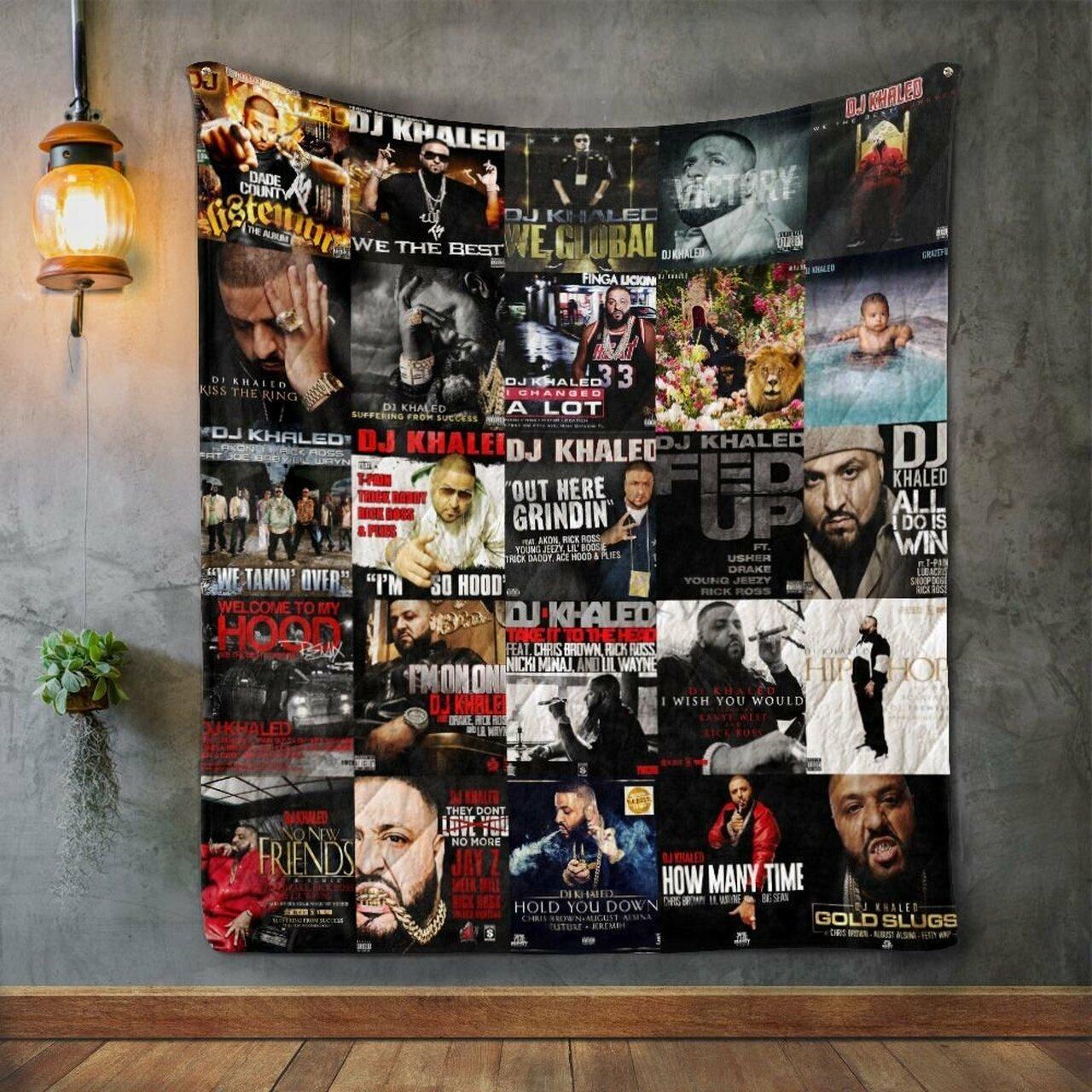
You’ve seen them. You might have even laughed at them. Whether it’s a tiny baby sitting in a miniature throne or a grown man shedding a single, crystalline tear while looking toward the heavens, DJ Khaled album covers are impossible to ignore. They aren’t just "pictures" for a Spotify tile. They’re basically high-budget manifestos of his soul. Honestly, in a world where most artists try to look "cool" or "mysterious," Khaled goes the opposite way. He goes full-blown, unadulterated drama.
It’s easy to dismiss it all as meme bait. But if you look closer, there is a weird, fascinating strategy behind the madness. Every lion, every prayer mat, and every matching Versace outfit tells a story about how he wants the world to see him: as a mogul, a father, and a spiritual giant.
The Evolution of the "Mogul" Look
Back in 2006, when Listennn... the Album dropped, the vibe was very different. It was peak Pen & Pixel era—that hyper-saturated, busy, "Bling Era" aesthetic. You had the stacks of cash, the cars, the loud fonts. It was standard. But as Khaled grew, so did the ego (in the most entertaining way possible).
By the time we got to Kiss the Ring in 2012, he wasn't just a DJ anymore. He was a Don. The cover features a comically large ring and a look of absolute authority. It’s "The Godfather" if it was filmed in a Miami recording studio. This was the moment he realized that his face—and his specific brand of "rich guy confidence"—was the product.
Then came the pivot.
When Asahd Took Over the Brand
If you want to talk about the most iconic DJ Khaled album covers, you have to talk about his kids. Specifically, Grateful (2017). Putting his newborn son, Asahd, in a tuxedo sitting on a miniature throne next to a lion cub was a stroke of marketing genius. It changed the narrative. Suddenly, Khaled wasn't just a loud guy shouting his name over Drake tracks; he was a legacy builder.
He even listed Asahd as the Executive Producer. Like, the kid was literally in diapers and supposedly "going over the business part of it." We all know the baby wasn't clearing samples or mixing snares, but that’s the magic of Khaled. He commits to the bit so hard it becomes reality.
Father of Asahd (2019) followed suit, but with a more "Lion King" vibe. It was shot in a lush garden, featuring Khaled and his son in matching blue suits. It’s vibrant. It’s opulent. It’s basically a family portrait that costs more than your house.
The Spiritual Shift and That Infamous Tear
In 2022, things got emotional. God Did gave us the "Thug Tear."
The cover is a tight close-up of Khaled’s face, looking up at the sky, with a single tear rolling down his cheek. He later explained that these were "tears of joy from God’s blessings." It was a huge departure from the lions and the jewelry.
Interestingly, Khaled actually lets Jay-Z help him choose these things. He’s gone on record saying he usually gives Hov two options and lets him pick the winner. For God Did, Jay-Z was the one who signed off on the tear. When the biggest rapper alive tells you the crying photo is the one, you go with the crying photo.
Behind the Scenes of the "Major Key" Lion
Speaking of lions, the Major Key (2016) cover is probably his most famous. It was shot by the legendary Jonathan Mannion. You’ve got Khaled sitting in a floral throne with a literal, full-grown lion at his feet.
- Is the lion real? Yes.
- Was it dangerous? Probably.
- Is it "authentic"? According to Khaled, 100%.
He told Jimmy Kimmel that the cover represents him as a "positive king." It’s meant to be the visual representation of his "keys to success" that were blowing up on Snapchat at the time. It’s one of those rare moments where a piece of album art perfectly captures a specific internet era.
Why This Works (And Why It’ll Continue in 2026)
As we move through 2026, the "Khaled Aesthetic" hasn't slowed down. His upcoming project, Aalam of God, is expected to double down on these themes of faith and family. Why? Because it works.
Most people get it wrong—they think he’s just being extra for the sake of it. In reality, he’s building a visual language. When you see a garden, a lion, or a prayer mat on a cover now, you think of Khaled. That is branding 1001.
He’s moved past the "Suffering from Success" memes (though that 2013 cover of him holding his head in his hands remains a classic) and into something more "legacy" focused. He’s Palestinian-American, a devout Muslim, and a father. He puts all of that—literally—on the sleeve.
Actionable Takeaways for Fans and Designers
If you’re looking at these covers and wondering how to apply that energy to your own brand or just want to appreciate the art more, keep these points in mind:
- Visual Consistency is King: Notice how he uses the same motifs (lions, thrones, flowers) across decades. Pick your symbols and stick to them.
- Lean Into the Meme: Khaled doesn't fight the internet; he feeds it. If people find something funny, he does it bigger next time.
- The Power of Association: By putting his kids or high-level mentors (like Jay-Z's influence) into the visual story, he elevates his own status.
- High Production Value Matters: Even if the concept is "silly," the execution is always top-tier. He uses the best photographers in the world, like Jonathan Mannion, to ensure the "joke" looks like a masterpiece.
Whether you think he’s a genius or just a guy with a great gardener, you can’t deny that DJ Khaled has turned the album cover into a high-stakes art form. He doesn't just drop music; he drops a lifestyle. And usually, that lifestyle involves a lot of matching silk shirts and very expensive landscaping.