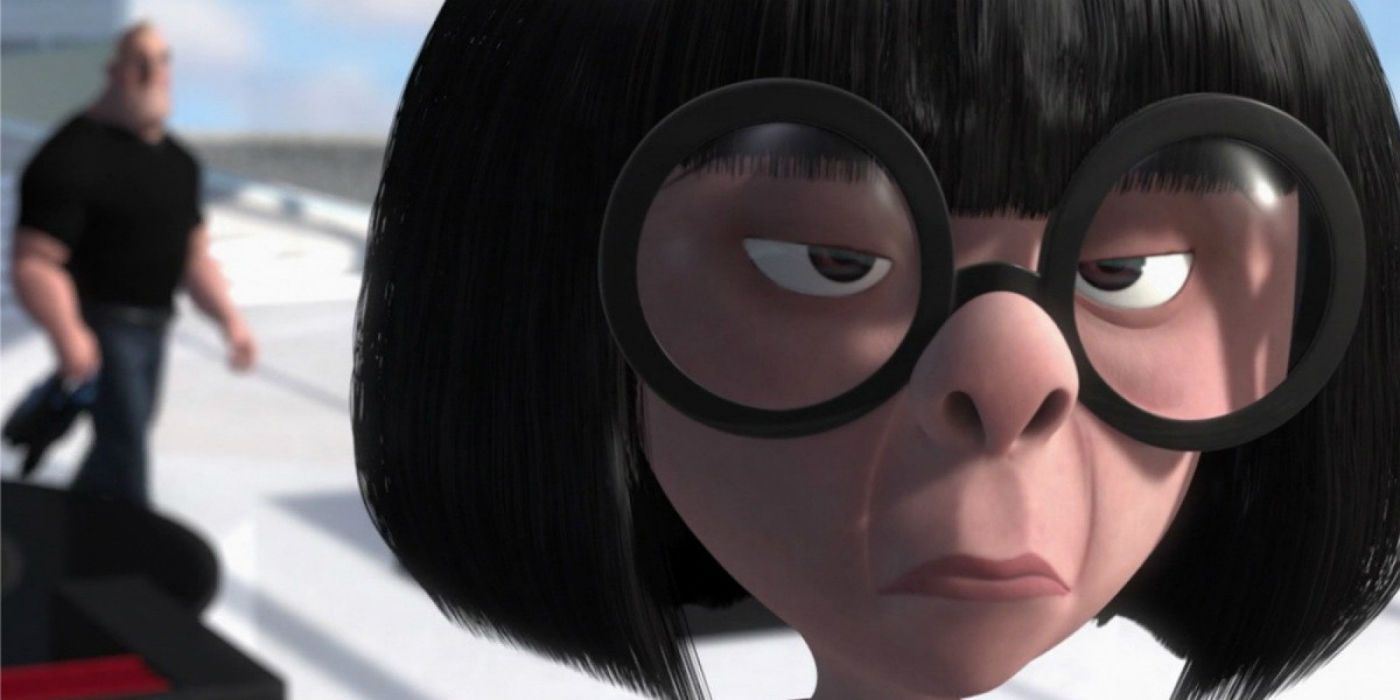
If you close your eyes and think of The Incredibles, you probably don’t think of Bob Parr’s mid-life crisis first. You hear a voice. It’s sharp. It’s demanding. It’s "Dahling."
Edna Mode, the iconic costume designer from Incredibles, is arguably the most influential fashion mogul in cinema history, even if she only exists in a computer. When Brad Bird—the film's director and, surprisingly, the voice of Edna herself—conceived of her, he wasn't just looking for a comic relief character. He was solving a massive narrative problem. How do you explain why superheroes wear spandex without it looking ridiculous?
You make the clothes the most functional, high-tech piece of equipment they own. And you give the person making them a personality that could intimidate a god.
The Genius Behind the Goggles
Edna isn't just a "cartoon character." Pixar’s creative team actually looked at real-world giants like Edith Head and Rei Kawakubo to find her soul. Edith Head won eight Oscars for costume design, and if you look at photos of her—the signature glasses, the blunt fringe—the resemblance is unmistakable. But Edna is more than a tribute. She represents the bridge between high fashion and military-grade engineering.
In the world of The Incredibles, being a costume designer isn't about the runway. It’s about survival.
Think about the scene where she's showing Helen the new suits. She doesn't talk about "silhouette" or "color palettes" in a vacuum. She talks about heat resistance. She talks about a suit that can stretch and breathe while someone is turning into a ball of fire. Honestly, it’s one of the few times a superhero movie actually treats the logistics of "the suit" with any respect. Most Marvel movies just handwave it away with "nanotech" now. Edna did it first, and she did it with more style.
Why the "No Capes" Rule Changed Everything
You can’t talk about the costume designer from Incredibles without talking about the capes. It’s the ultimate deconstruction of the superhero myth.
For decades, we just accepted that heroes wore capes because they looked cool in the wind. Then Edna shows up and lists off a literal body count. Stratogale? Sucked into a jet turbine. Thunderhead? Snagged on a missile fin. It’s dark. It’s hilarious. But most importantly, it’s a brilliant piece of screenwriting.
By having Edna ban capes, Brad Bird gave the Parr family a streamlined, modern look that felt "new" in 2004. It wasn't just a fashion choice; it was a plot point. It established Edna as an expert who values function over form, even though her form is impeccable.
She's the only character who can tell Mr. Incredible he’s "fat" and get away with it. Why? Because she’s the one who has to make sure his seams don't burst when he's punching a giant robot. That kind of professional authority makes her feel real. You’ve probably met someone like Edna—someone so good at their job they’ve lost the ability to be polite to amateurs.
The Technical Wizardry of Pixar's Tailoring
Let’s get into the weeds for a second. Making clothes for digital characters in the early 2000s was a nightmare.
Back then, "cloth simulation" was still in its infancy. For the costume designer from Incredibles to look right, the team had to invent ways for fabric to fold, wrinkle, and react to light. If you watch the scene where Edna leans against her desk, the way her black dress moves is subtle but revolutionary for its time.
Pixar’s technical directors actually had to build a "virtual tailoring" system. They didn't just wrap skins around 3D models. They cut patterns. They "sewed" them together in the software. This is why the Parrs' suits look like they have weight. When Dash runs, you see the tension in the fabric. That’s Edna’s influence manifesting through the animators.
What People Get Wrong About Edna’s Voice
There’s a common myth that Edna was meant to be played by a famous actress.
Lily Tomlin was actually approached for the role. However, when Brad Bird performed a temp track of the dialogue to show her what he wanted, Tomlin allegedly told him, "Why do you need me? You've got it."
Bird’s performance is legendary. He captures that specific brand of "Euro-trash meets Japanese minimalist" perfectly. It’s a voice that sounds like it’s been shouting over sewing machines and jet engines for forty years. It’s weary but energized by its own genius.
Edna’s Role in The Incredibles 2
When the sequel finally rolled around in 2018, fans were worried. Would she still have that edge?
The costume designer from Incredibles returned with a vengeance, but this time, her challenge was Jack-Jack. Designing for a baby who can turn into lead, fire, or a literal demon is the ultimate "flex" for a designer.
What’s interesting is how Edna’s relationship with Jack-Jack humanizes her. She starts the movie hating the idea of "babysitting." By the end, she’s fascinated by him. He’s a muse. He’s a challenge she hasn't faced in years. It’s a subtle bit of character growth that doesn't ruin her trademark cynicism. She’s still the same woman who thinks "supermodels are spoiled, stupid little stick figures with poofy lips who think only about themselves."
Lessons in Brand Authority from Edna Mode
If you look at Edna through a business lens, she’s a masterclass in branding.
- She knows her worth. She doesn't work for just anyone.
- She is the product. You aren't buying a suit; you’re buying an "E" original.
- She solves problems. She doesn't just make clothes; she solves the "my family keeps dying because of their capes" problem.
She’s basically the Steve Jobs of the superhero world. Minimalist, demanding, and always three steps ahead of the consumer.
The Lasting Legacy of the Costume Designer from Incredibles
Why do we still care about her twenty years later?
Because Edna Mode represents the "adult" side of being a hero. We all want to be the person with the powers, but deep down, we know we’d actually be the person trying to figure out how to wash the spandex without shrinking it. She grounds the fantasy.
She also represents a specific type of creative integrity. She refuses to look back. "I never look back, dahling! It distracts from the now." That line isn't just a catchphrase. It's a philosophy. It’s why Pixar movies from that era felt so fresh. They weren't trying to be like other movies. They were trying to be the best version of themselves.
Honestly, the costume designer from Incredibles is the reason that movie feels "timeless." The 1960s retro-futurism aesthetic she champions doesn't age the way "modern" styles do. By leaning into a specific, high-fashion niche, the creators ensured she would always be in style.
Taking Action: How to Channel Your Inner Edna
If you’re a creator, designer, or just someone trying to get through a Monday, there are actual takeaways from Edna’s "design-first" mentality.
- Audit your "capes." Identify the things in your life or business that look cool but actually hold you back or cause "jet turbine" level disasters.
- Focus on the "Now." Stop obsessing over past failures or "the glory days." If Edna can move on from the golden age of Supers, you can move on from last year's project.
- Invest in Quality. Edna doesn't do cheap. Whether it's the tools you use for work or the clothes on your back, prioritize things that are built to withstand the "heat" of your specific life.
- Find Your Uniform. Edna’s look is consistent. It saves brainpower. Find what works for you and own it completely.
The next time you watch the film, pay attention to the background of Edna’s mansion. The architecture is brutalist, cold, and massive. It reflects her personality. She is a small woman who occupies a massive space. That’s the real secret of the costume designer from Incredibles: she doesn't need powers because her talent makes her the most powerful person in the room.
If you're looking to dive deeper into the world of film design, check out the work of real-world designers like Ruth E. Carter or the late Eiko Ishioka. They bring that same "Edna energy" to every frame they touch, proving that fashion in film is never just about clothes—it’s about who the characters are underneath.