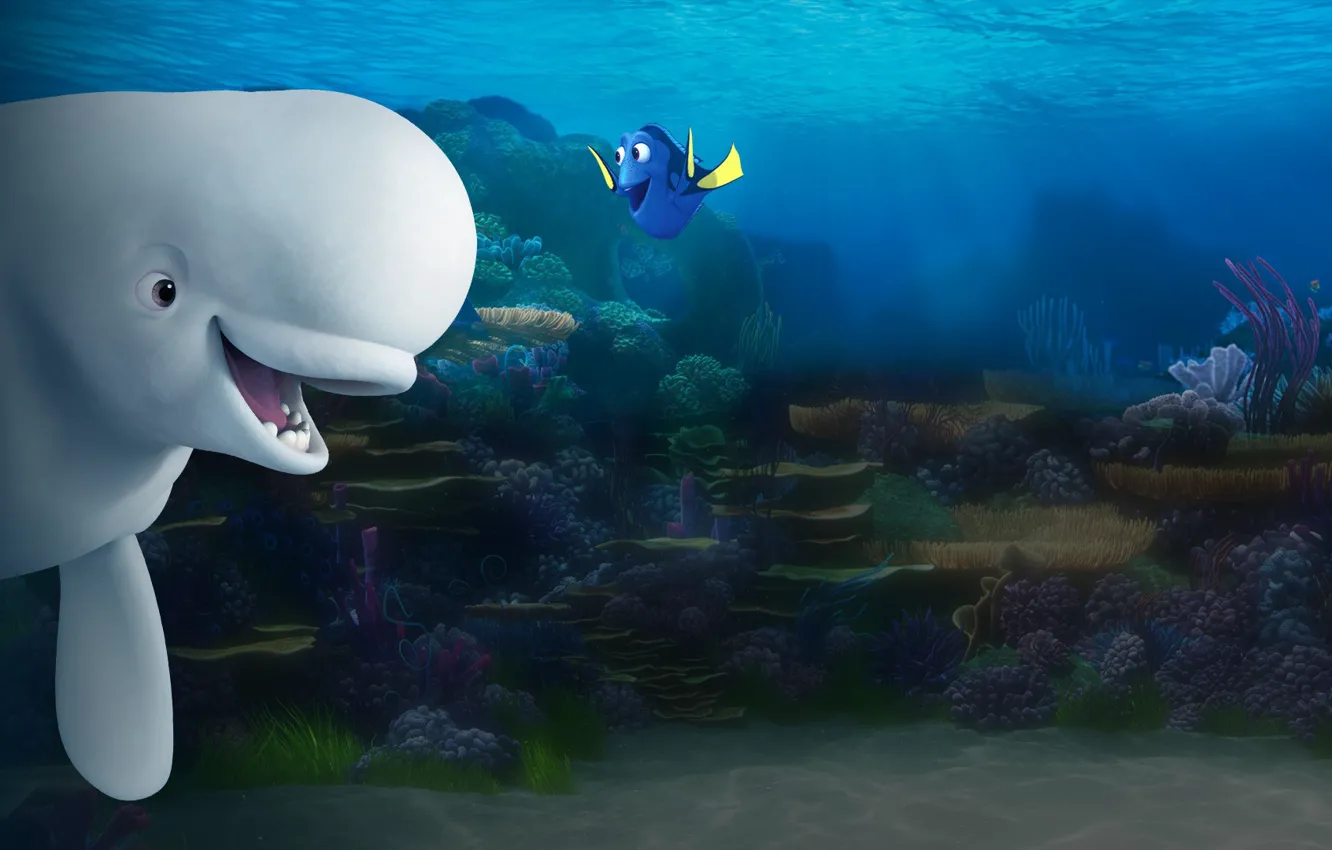
You remember the scene. Dory and Hank are stuck, lost in the pipes of the Marine Life Institute, and suddenly this giant, anxious white forehead pops up on a monitor. That’s Bailey. Most people just see the Finding Dory beluga whale as the comic relief—the guy who thinks his brain is broken—but if you actually look at the marine biology behind his "broken" sonar, he's the most scientifically fascinating part of the whole sequel.
Honestly, it’s kinda funny how Pixar handled him. He’s voiced by Ty Burrell, who basically plays the same lovable, slightly neurotic dad energy he brought to Modern Family. But Bailey isn't just a plot device to help Dory find her parents. He’s a look into how cetaceans actually perceive the world, even if the movie plays it for laughs with his "Ooooooo" sound effects.
The "Broken" Sonar That Wasn't Actually Broken
Bailey spends half the movie convinced he has a head injury. He’s got this massive bump on his head—the melon—and he tells Destiny the whale shark that he can't use his echolocation.
Here’s the thing: belugas are known as the "canaries of the sea" for a reason. They are incredibly vocal and have perhaps the most sophisticated sonar of any whale species. In the film, Bailey’s struggle is framed as a psychological block rather than a physical one. When he finally "finds" his gift, he’s able to track a moving truck on a highway from miles away through walls and pipes.
Is that realistic? Sorta.
In real life, a beluga’s melon is a fatty organ that focuses sound waves. It’s squishy. If you’ve ever seen those viral videos of people gently pressing a beluga’s head (which, by the way, you probably shouldn't do), you see it deform like lime-flavored Jell-O. That’s because the whale is actually changing the shape of that organ to direct sound. Pixar’s animators nailed the physics of the melon’s movement, even if they exaggerated the range of his "vision."
Why the Pairing with Destiny Actually Makes Sense
The dynamic between the Finding Dory beluga whale and Destiny (the whale shark) isn't just a random comedy duo. It’s a clever play on biological limitations.
Destiny is a whale shark. She’s huge. She’s also incredibly nearsighted. In the wild, whale sharks don't have the best vision, and they certainly don't have echolocation because they are fish, not mammals. Bailey, on the other hand, is a mammal with "vision" that works through sound.
- Destiny provides the physical scale and the knowledge of the "pipes."
- Bailey provides the navigation.
- Together, they act as a complete sensory unit.
It’s a cool bit of writing. You’ve got one character who can’t see what’s right in front of her and another who can see through walls but is too scared to try. When Bailey finally uses his echolocation to guide Dory through the "World's Most Powerful Glasses," he’s not just using a superpower. He’s overcoming a specific type of sensory anxiety that researchers actually observe in captive animals who become desensitized to their environments.
The Real Science of the "Ooooooo"
In the movie, Bailey makes this dramatic hooting noise. In reality, beluga sounds are much more diverse and, frankly, weirder. They chirp, whistle, and click.
If you listen to recordings from organizations like the National Oceanic and Atmospheric Administration (NOAA), belugas sound like a 1990s dial-up modem mixed with a bird sanctuary. They use these clicks for two things: communication and navigation. The navigation part—the echolocation—is so precise that a beluga can find a breathing hole in solid ice miles away in total darkness.
When Bailey finally "feels" the truck, Pixar uses a visual representation that looks like a sonar sweep. It's actually a pretty decent way to explain a concept that is entirely alien to humans. We see with light; they see with vibrations. Bailey isn't just "hearing" the truck; he's rendering a 3D map of the world in his mind.
What Most People Get Wrong About Belugas in Captivity
Finding Dory takes place at the Marine Life Institute, which is heavily modeled after the Monterey Bay Aquarium (though Monterey Bay doesn't actually keep whales or dolphins). This setting is important because the Finding Dory beluga whale represents a specific conversation about rehabilitation.
There was some pushback when the movie came out. Some critics felt that Bailey and Destiny’s "rehab" story was a soft-pedaled version of the controversies surrounding SeaWorld. But Pixar did something subtle. They portrayed Bailey not as a performer, but as a patient.
The goal for the animals in the movie—Seek, Rehabilitate, Release—reflects the modern shift in how we view marine mammals. Bailey’s arc isn't about learning to do tricks for fish. It's about recovering a natural instinct that he lost because of the stress of his environment.
The Ty Burrell Effect
It’s hard to talk about Bailey without mentioning Ty Burrell.
The casting here was a stroke of genius. You needed a voice that sounded massive but fragile. Belugas are huge animals—they can grow up to 18 feet long—but they have these expressive, almost human-like faces because their neck vertebrae aren't fused. They can turn their heads, unlike most other whales.
Burrell’s performance captures that flexibility. He sounds like someone who is constantly second-guessing himself. This makes his eventual "hero moment" much more satisfying. When he screams "The truck is turning!" it feels like a genuine victory for the underdog. Or the under-whale.
Small Details You Probably Missed
If you rewatch the scenes with the Finding Dory beluga whale, look at his "vision" again.
The animators used a specific rippling effect. This wasn't just a cool filter. They actually consulted with acoustic experts to see how sound might "look" if it were translated into a visual medium. Notice how the objects furthest away are blurrier, and the things the sound hits directly are sharp. It’s an incredibly accurate representation of how resolution works in bio-sonar.
Also, the relationship between Bailey and the sea lions (Fluke and Rudder) is gold. The sea lions are lazy, territorial, and basically represent the "locals" who know everything but don't want to help. Bailey is the frantic "tourist" who has all the tools but no clue how to use them.
Practical Takeaways for Your Next Rewatch
Next time you sit down to watch Finding Dory, don't just laugh at Bailey's dramatic flair.
Think about the fact that belugas are one of the only species that can change their facial expressions. Look at how Bailey’s melon shifts when he’s concentrating. It’s a masterclass in character design that stays true to the biology of the animal.
If you’re interested in the real-world version of Bailey, you should look into the Beluga Whale Sanctuary in Iceland. It’s run by the Sea Life Trust and was created specifically to give captive belugas a more natural, open-water home. It’s basically the real-life version of the ending Bailey and Destiny were looking for.
How to spot a real Bailey in the wild:
- Look for the color: Adults are pure white, but calves are actually grey.
- Watch the neck: If it moves independently of the body, it’s a beluga.
- Check the dorsal fin: Or rather, the lack of one. Belugas have a dorsal ridge instead of a fin, which helps them swim under ice without getting stuck.
Bailey might have been a bit of a drama queen, but he brought a lot of attention to a species that is currently facing massive challenges in the wild due to noise pollution and melting sea ice. His "broken" sonar was a perfect metaphor for how human noise can interfere with the way these animals see their world.
To get the most out of the film's marine biology, pay close attention to the background characters in the Marine Life Institute. Many of them represent real species found in the Pacific Northwest, and their behaviors—like the camouflaging "Septopus" Hank—are grounded in actual animal defenses. You can further explore this by visiting the official Monterey Bay Aquarium's "Learning Center" online, which provided much of the initial inspiration for the film's setting and conservation themes.