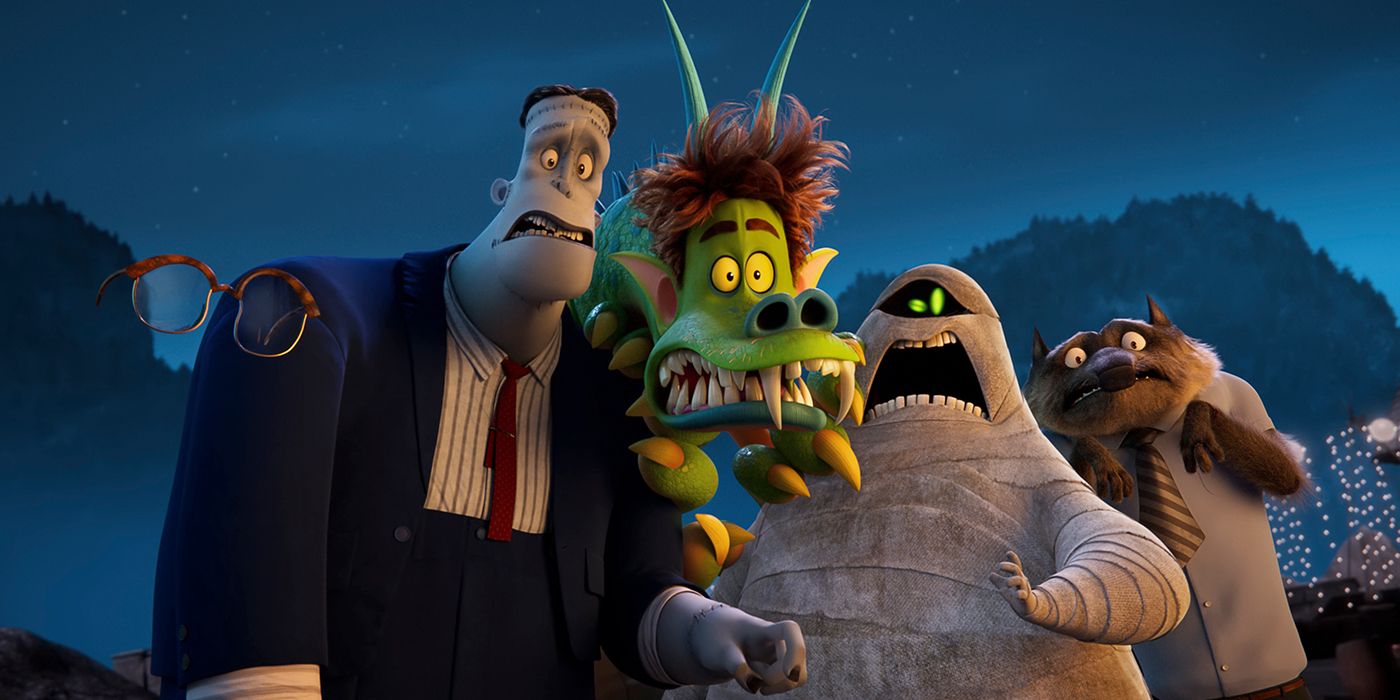
Winnie and Dennis. They're basically the heart of the later Hotel Transylvania movies, yet people still argue about whether their "zing" is cute or just a weird plot device. If you've watched Hotel Transylvania 2, you know the scene. Dennis, the curly-haired "dhampir" (half-human, half-vampire), is being bullied by some bratty monster kid. Suddenly, Winnie—one of Wayne and Wanda’s roughly 300 werewolf pups—snaps. She pins the bully, lets out a ferocious growl, and establishes herself as Dennis’s unofficial bodyguard. It’s a moment that defines their entire dynamic.
Honestly, the Hotel Transylvania Winnie and Dennis relationship is more than just a background subplot. It represents the franchise's core theme: acceptance. While Dracula is busy obsessing over whether his grandson will sprout fangs, Winnie is the only one who sees Dennis for exactly who he is. She doesn't care if he’s a "late flier." She just likes him.
But why does this specific pairing resonate so much with fans? It’s probably because it flips the traditional "damsel in distress" trope on its head. Winnie is the muscle. Dennis is the sensitive soul.
The Biology of a Zing: How Winnie and Dennis Changed Everything
In the world created by Genndy Tartakovsky, a "Zing" is basically the monster equivalent of a soulmate. It’s instant. It’s permanent. Most importantly, it’s rare. We saw it with Dracula and Martha, and later with Mavis and Johnny. But the Hotel Transylvania Winnie and Dennis connection is different because it happens when they are kids.
Some fans find it a bit intense. "They're just children!" people cry on Reddit. But if you look at the lore, the Zing isn't necessarily about romance in the way humans think of it. It’s a profound, spiritual recognition. For Winnie, she knew the second she saw Dennis. She even calls him "my Zing" before he even knows what the word means.
Think about Winnie’s upbringing. She lives in a chaotic household with hundreds of brothers who constantly cause mayhem. She has to be tough. She has to be loud. Dennis, on the other hand, is the product of Mavis’s overprotective parenting and Dracula’s high expectations. He’s quiet. He’s gentle. He likes "Kakie the Cake Monster." They shouldn't work, yet they do.
The contrast is the point.
Breaking Down the "Late Flier" Conflict
The tension in Hotel Transylvania 2 revolves entirely around Dennis's identity. Is he a monster? Is he a human? Dracula is terrified that if Dennis doesn't become a vampire by his fifth birthday, he'll have to leave the hotel and move to California. It’s a lot of pressure for a kid who just wants to play with his wolf-friend.
Winnie is the only character who provides Dennis with a "safe space," even if her version of safety involves pinning him to the ground and licking his face. While the adults are projecting their insecurities onto him, Winnie provides total, unfiltered validation. She doesn't need him to transform. In fact, her aggression toward the bully Bela is what finally triggers Dennis's transformation.
It wasn't Dracula’s "training" or being thrown off a tower that turned Dennis into a vampire. It was the desire to protect Winnie.
That’s a huge distinction.
The Evolution in Hotel Transylvania 3 and Transformania
By the time we get to Summer Vacation and Transformania, the Hotel Transylvania Winnie and Dennis dynamic has shifted into a more established partnership. They’re older, or at least as "old" as monsters get in these timelines. Winnie remains the assertive one. In the third film, she’s right there on the ship, helping Dennis hide "Tinkles," the giant puppy.
She's his partner in crime.
In Hotel Transylvania: Transformania, we see a bit more of how Dennis views her. While the movie focuses heavily on the Drac-and-Johnny body-swap shenanigans, the presence of Winnie serves as a grounding force for Dennis. He’s no longer the scared toddler. He’s a confident young vampire, but he still looks to Winnie for that raw, wolfy honesty.
Why Winnie is the MVP of the Wolf Pack
Wayne and Wanda (voiced by Steve Buscemi and Molly Shannon) are overwhelmed. That’s their whole bit. Their kids are a literal whirlwind of destruction. Among all those pups, Winnie stands out. Not just because she’s a girl, but because she has a distinct personality.
- She’s incredibly observant.
- She has a higher emotional intelligence than her brothers.
- She’s fiercely loyal to a fault.
Most of the wolf pups are treated as a collective unit—a swarm of fur and teeth. Winnie is the only one given a name and a narrative arc. This is because she serves as the bridge between the Werewolf family and the Dracula bloodline. Without her, the families are just business associates. With her, they’re truly joined.
Addressing the Controversy: Is it Weird?
Let's get real for a second. Some corners of the internet make the "Zing" between kids feel awkward. But in the context of a supernatural comedy, it functions more like a "best friends for life" pact. It’s the "Twin Soul" trope.
If you look at how Sony Pictures Animation handled the characters, they kept it innocent. It’s about devotion. It’s about having that one person who has your back when giant bat-monsters are attacking. The Hotel Transylvania Winnie and Dennis bond is a protective one.
When Winnie gets hurt or threatened, Dennis finds his strength. It’s a classic "protector" arc, but it works because they swap roles. Sometimes she's saving him; sometimes he's saving her.
The Cultural Impact of the Pairing
Believe it or not, Winnie and Dennis have a massive following in fan art and fan fiction communities. Why? Because they represent a "pure" version of the monster-human (or half-human) coexistence that the movies preach.
While Mavis and Johnny had to navigate the complexities of being the first "interracial" couple of the monster world, Winnie and Dennis just exist. They don't have the baggage of centuries of monster-human wars. They are the new generation.
Real Lessons from a Werewolf and a Vampire
What can we actually take away from these two? Beyond the slapstick humor and the vibrant animation, there are some pretty solid takeaways about relationships and identity.
First, identity isn't fixed. Dennis spent years thinking he was "broken" because he wasn't a monster. Winnie knew he was a monster at heart because of his spirit, not his fangs.
Second, support is the ultimate catalyst. People often change not because they are forced to, but because they have someone worth changing for. Dennis didn't grow fangs for Dracula. He grew them for Winnie.
Third, don't let others define your "Zing." Everyone in the hotel had an opinion on Dennis and Winnie. They ignored it all.
What's Next for the Duo?
With the franchise seemingly wrapping up with the fourth film, the future of Hotel Transylvania Winnie and Dennis lies in the imagination of the fans (and perhaps the TV series). If the timeline were to continue, we’d likely see them navigating the "teen years" of monsterhood, which is a terrifying thought given how much damage a werewolf-vampire duo could do.
How to Enjoy the Winnie and Dennis Arc
If you want to revisit their best moments, don't just watch the clips. You need the context.
- Watch Hotel Transylvania 2 specifically for the "birthday party" sequence. It’s the peak of their early development.
- Pay attention to the background of the cruise ship scenes in Hotel Transylvania 3. Winnie is often the one steering Dennis away from trouble (or into it).
- Look at the character designs. Notice how Dennis’s hair and Winnie’s fur are often textured similarly in scenes where they are together—a subtle visual cue from the animators that they belong together.
The story of Winnie and Dennis is a reminder that even in a world full of mummies, invisible men, and blobs, the most powerful thing is just having a friend who sees you.
Whether you call it a Zing or just a really intense childhood friendship, it’s the glue that holds the later films together. It’s chaotic. It’s messy. It’s loud. It’s exactly what a monster relationship should be.
To get the most out of this duo, look for the small details in their interactions. Notice how Winnie always sits to Dennis's left, or how Dennis shares his human snacks with her. These tiny, unscripted moments are what make the characters feel human—even when they're definitely not. Stop worrying about the "logic" of a Zing and just enjoy the ride of two kids trying to grow up in a world that can't decide if they're monsters or not.