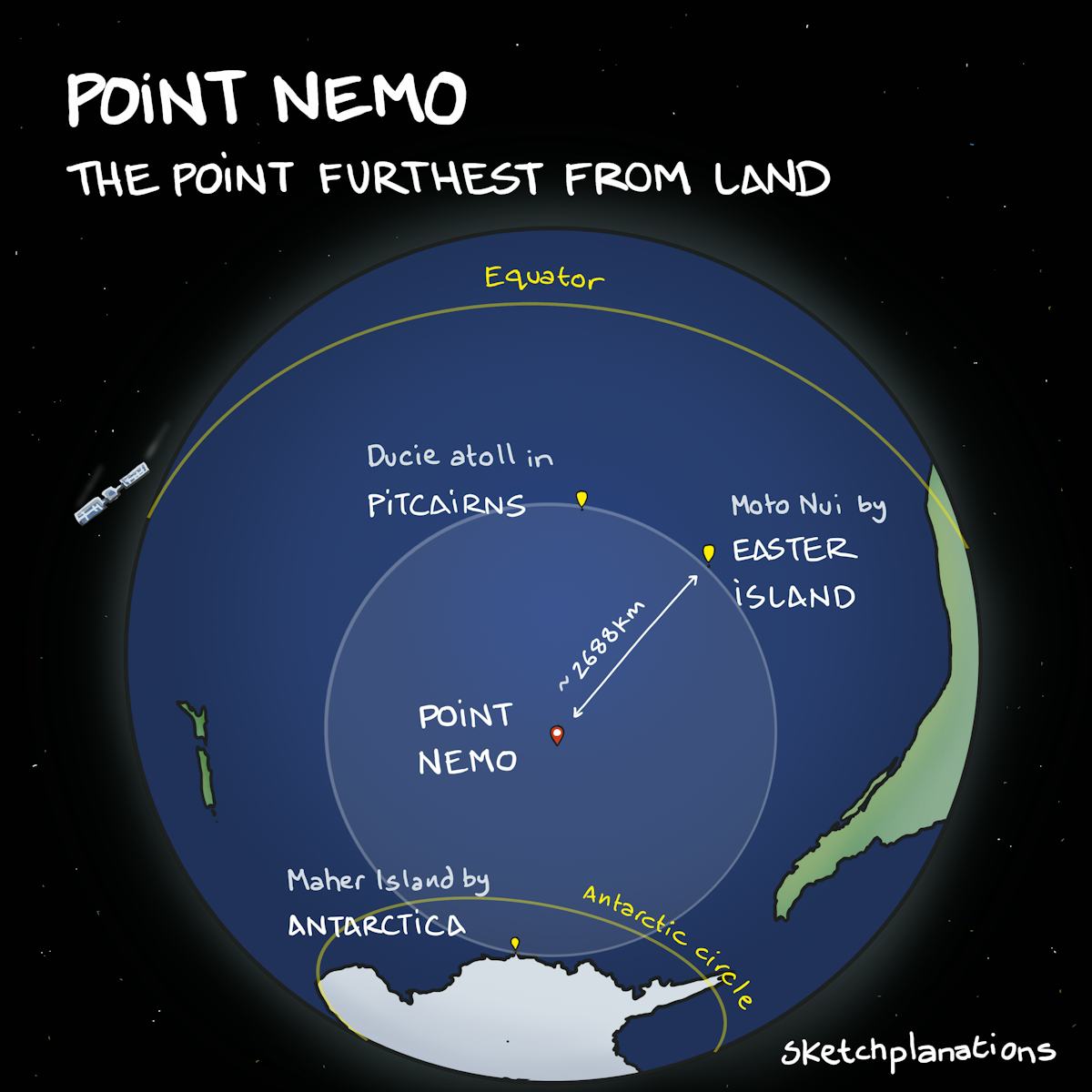
You are currently closer to astronauts than any other human being on Earth. That is the reality of Point Nemo. It’s officially known as the "oceanic pole of inaccessibility," a fancy way of saying it’s the middle of nowhere. Specifically, it's a spot in the South Pacific roughly 2,688 kilometers from the nearest tiny specks of land like Ducie Island or Maher Island.
People always ask: is Point Nemo dangerous?
The short answer? It’s not "haunted" or filled with Cthulhu, despite what H.P. Lovecraft fans might hope. But it is terrifying in a purely physical, logistical sense. If your engine fails or your hull cracks here, you are effectively on another planet.
The Reality of Isolation at the Pole of Inaccessibility
Danger is relative. If you’re sitting in a climate-controlled office in New York, Point Nemo isn't dangerous to you at all. It’s just a coordinate: 48°52.6′S 123°23.6′W. But for a solo sailor in the Vendée Globe race, it is the ultimate psychological hurdle.
The water here is incredibly deep—about 4,000 meters. Because it sits within the South Pacific Gyre, a massive rotating ocean current, it’s actually a "biological desert." The current blocks nutrient-rich water from entering the area. There’s almost no food. No fish. No birds. Even the plankton is sparse.
Basically, it’s a blue void.
Why the Logistics are a Nightmare
Think about a standard rescue mission. If a ship goes down in the Atlantic, the Coast Guard or nearby commercial vessels can usually reach it within hours or a couple of days. At Point Nemo, you’re looking at a minimum of 15 days for a high-speed vessel to reach you from the closest port. Most ships would take much longer.
The International Space Station (ISS) orbits about 400 kilometers (250 miles) above the Earth. When the ISS passes over Point Nemo, the astronauts are the closest humans to anyone at that sea-level coordinate. That is a staggering thought. It highlights the absolute lack of a safety net.
Is it dangerous? Yes, because help isn't coming.
The "Spacecraft Cemetery" and Falling Debris
One of the weirder reasons people worry about whether is Point Nemo dangerous involves things falling from the sky. NASA, the ESA, and JAXA use this region as a dumping ground. Since there’s nobody there to hit, it’s the perfect place to de-orbit decommissioned satellites and space stations.
Over 260 spacecraft have been laid to rest in the waters around Point Nemo. This includes the Soviet-era Mir space station and hundreds of cargo ships.
In 2031, the International Space Station is scheduled to join them.
Does this mean you’ll get hit by a falling titanium fuel tank? Honestly, the odds are astronomical. Space agencies calculate re-entry paths with extreme precision. They aim for Point Nemo specifically because the "splash zone" is huge and uninhabited. However, the idea of a graveyard for space junk adds a layer of metallic, industrial dread to the location.
The Bloop: Fact vs. Fiction
In 1997, the U.S. National Oceanic and Atmospheric Administration (NOAA) recorded an ultra-low-frequency sound coming from near Point Nemo. It was loud. Much louder than any blue whale. They called it "The Bloop."
For years, internet forums speculated that a massive sea monster lived in the depths of the pole of inaccessibility. This fueled the "Point Nemo is dangerous" narrative for a decade. People were genuinely spooked.
Science eventually ruined the fun.
By the early 2010s, NOAA confirmed that The Bloop was actually the sound of an icequake—a massive iceberg cracking and calving off the Antarctic shelf. When these giant sheets of ice break, they generate powerful, low-frequency sounds that can travel thousands of miles through the ocean.
It wasn’t a monster. It was just the sound of a planet changing.
Survival Challenges in the South Pacific Gyre
If you ended up in the water at Point Nemo, your biggest threat wouldn't be sharks. There aren't enough calories in the water to support large predators. Your enemies would be:
- Hypothermia: The water isn't freezing like the Arctic, but it’s cold enough to kill you in hours.
- Exposure: The sun in the South Pacific is brutal, and there is zero shade.
- Psychological Collapse: The visual field is 360 degrees of nothing. No land, no ships, no planes.
Sailors who have passed through this region often describe an eerie silence. Most of the ocean is surprisingly noisy with the sounds of snapping shrimp, whale songs, and boat engines. Point Nemo is quiet.
Real Threats: Plastic and Pollution
Interestingly, the most "dangerous" thing at Point Nemo might be what we've sent there. Despite its isolation, microplastics have been found in the water samples at the pole of inaccessibility.
During the 2017-2018 Volvo Ocean Race, yachts took samples near Point Nemo. They found between 9 and 26 particles of microplastic per cubic meter. It’s a depressing realization that even the most remote place on the planet is tainted by human waste.
This isn't an immediate danger to a human traveler, but it’s a systemic danger to the ocean's health.
Comparing Point Nemo to Other Extreme Locations
| Feature | Point Nemo | The Sahara Desert (Center) | Antarctica (South Pole) |
|---|---|---|---|
| Distance to Help | 2,700km (Sea) | ~500km (Land/Air) | 1,000km+ (Air) |
| Biological Life | Extremely Low | Moderate (Insects/Reptiles) | Microscopic (mostly) |
| Human Presence | Zero | Nomadic/Small Outposts | Scientific Stations |
| Primary Danger | Isolation/Drowning | Dehydration/Heat | Hypothermia |
Navigating the Mythos
There is a certain romanticism to the danger of Point Nemo. It represents the last truly "unreachable" place. In a world where GPS tracks our every move and every corner of the Earth is mapped on Google Street View, Point Nemo remains a blank blue spot.
Is it "dangerous" in the way a volcano or a war zone is? No.
It is dangerous in the way a vacuum is. It is the absence of everything humans need to survive. It is a place that reminds us how small we are and how much we rely on the infrastructure of civilization.
If you’re planning a trip—which you shouldn't, there’s nothing to see—you’d need a specialized vessel, months of supplies, and a rock-solid mental state.
Actionable Insights for the Curious
If you are fascinated by the isolation of Point Nemo, you don't need to charter a boat to experience the "danger" of the deep ocean.
- Track Space Re-entries: Keep an eye on Aerospace Corporation's tracking data. They often list when debris is expected to hit the South Pacific Cemetery.
- Study the South Pacific Gyre: Understanding the oceanography of why this area is a "desert" explains the lack of life. It’s a fascinating study in how ocean currents dictate biology.
- Virtual Exploration: Use coordinates 48.8767° S, 123.3933° W on Google Earth. Zoom out. Keep zooming. The sheer scale of the blue will give you a better sense of the isolation than any article ever could.
- Support Ocean Cleanup: The presence of microplastics at Point Nemo is a wake-up call. Supporting organizations like The Ocean Cleanup helps address the plastic that eventually migrates to these remote gyres.
Point Nemo isn't a place of active malice. It’s just indifferent. In the middle of the ocean, indifference is the most dangerous thing of all.