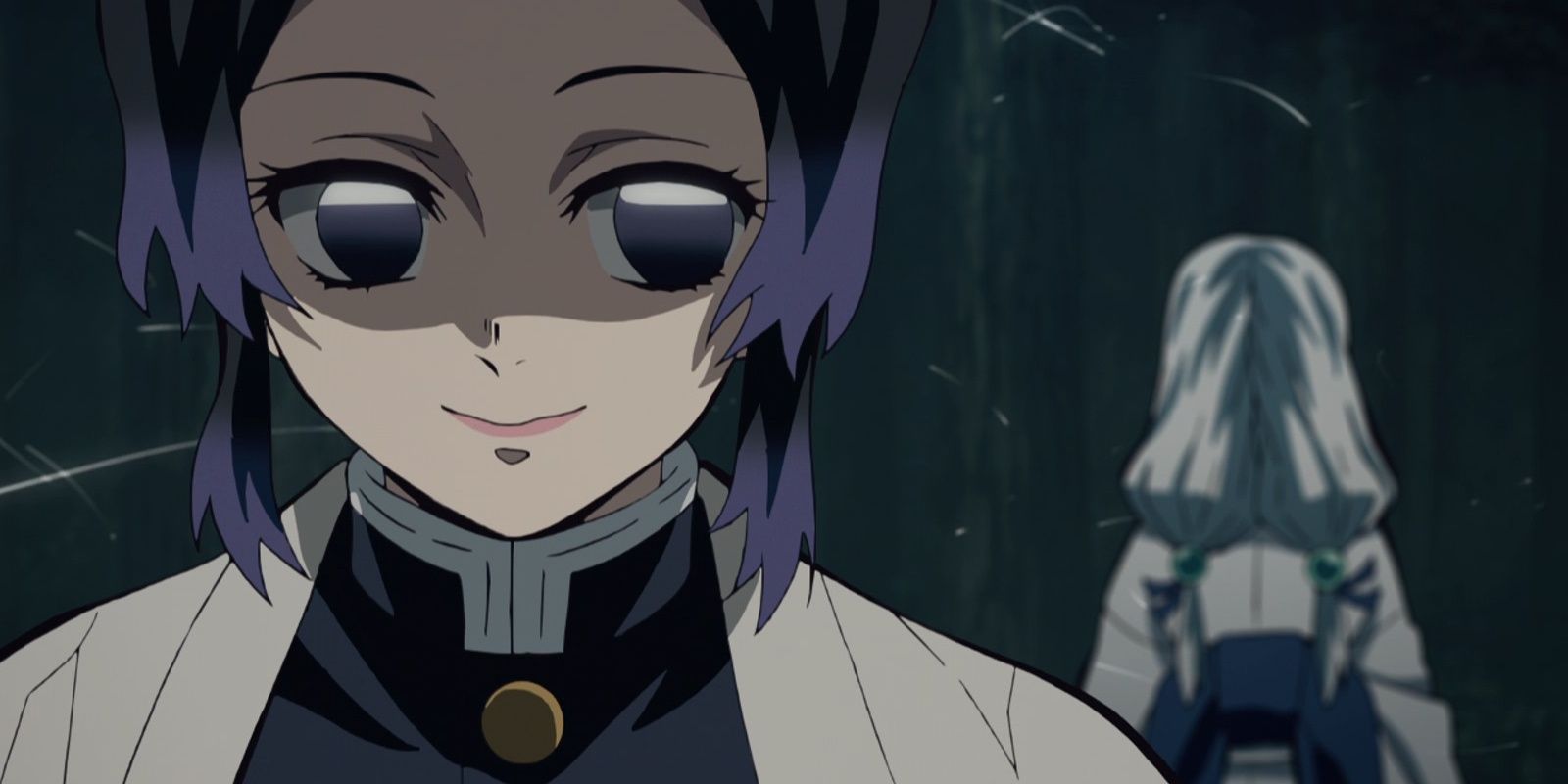
When you first meet Shinobu Kocho in Demon Slayer: Kimetsu no Yaiba, she’s basically the definition of "calm before the storm." She smiles. She speaks in this airy, melodic tone. But if you've watched enough of the series, you know that smile is a mask. It’s a literal tribute to Shinobu’s sister, Kanae Kocho.
Kanae is one of those characters who looms large over the entire plot despite being dead long before the main story starts. She’s the catalyst. Without her, Shinobu isn’t the Insect Hashira we know. Without her, Kanao Tsuyuri is probably dead or worse. Honestly, the entire vibe of the Butterfly Mansion—the healing, the mercy, the strange blend of medicine and murder—comes directly from Kanae’s specific philosophy. People often mistake Shinobu's sister for just another tragic backstory trope, but her influence is way more complex than that.
Who was Kanae Kocho?
The Flower Hashira. That was her title. While Shinobu struggles with the physical strength to decapitate demons, Kanae was a natural. She was the older sister, the protector, and the one who carried the "Flower Breathing" style. It’s a beautiful, graceful form derived from Water Breathing, and you can see echoes of it whenever Kanao fights later in the series.
Kanae and Shinobu weren't always demon slayers. They were born into a wealthy, happy family. Their parents were doctors. That medical background is huge. It’s why the Butterfly Mansion functions as a hospital. But, like almost every character in Koyoharu Gotouge’s world, that peace was shattered when a demon attacked their home. Their parents were slaughtered right in front of them. If Himejima Gyomei—the Stone Hashira—hadn't shown up at that exact moment, the Kocho bloodline would have ended there.
Instead of just being grateful and moving on, the sisters made a pact. They decided to join the Demon Slayer Corps so no one else would have to feel the way they did. It’s a classic revenge setup, but Kanae was different. She didn't just want to kill demons; she wanted to save them.
The weird philosophy of Shinobu’s sister
This is where things get interesting. Kanae Kocho had this incredibly optimistic, almost naive dream: she believed humans and demons could eventually live in peace.
Imagine telling that to someone like Sanemi or Iguro. They’d laugh in your face. Most slayers see demons as monsters that need to be erased. Period. But Kanae looked at them with pity. She saw the human they used to be, trapped inside a nightmare. Even as she was cutting them down, she felt a profound sadness for them.
Why this matters for Shinobu
After Kanae died, Shinobu tried to adopt this personality. The constant smiling? That’s Kanae’s smile. The soft-spoken nature? That’s Kanae’s voice. But the problem is that Shinobu is naturally angry. She’s fueled by a cold, sharp rage that Kanae never had. Shinobu is basically performing a decades-long tribute act to her sister’s memory, and it’s exhausting her. It’s why she’s so fascinated by Tanjiro later on—he’s the first person who actually embodies Kanae’s dream of showing sympathy to demons without it being an act.
The encounter with Doma: How Kanae died
We have to talk about the Upper Moon Two. Doma.
The fight between Shinobu’s sister and Doma happened several years before the series begins. We don't see the full fight in real-time, but we know it was brutal. Kanae fought him until sunrise. Think about that for a second. Doma is one of the strongest beings in existence, and Kanae, a human girl with a nichirin sword, held him off long enough for the sun to chase him away.
She didn't win. She was mortally wounded.
Shinobu found her as she was dying. In her final moments, Kanae didn't want Shinobu to seek revenge. She actually told her to leave the Corps. She wanted her sister to live a normal life, to grow old, to find happiness. But of course, seeing your sister die in your arms usually has the opposite effect. Shinobu didn't quit; she doubled down. She demanded to know which demon did it. Kanae gave her the description: a man who looks like he’s perpetually smiling, with rainbow-colored eyes and a cult following.
That description defined the rest of Shinobu’s life. Every poison she brewed, every thrust of her stinger-like sword, it was all a countdown to meeting the man who killed her sister.
Rescuing Kanao: A legacy beyond blood
One of the best moments involving Kanae isn't a fight. It’s a scene on a bridge.
She and Shinobu were traveling when they saw a young girl being led by a rope. The girl was emaciated, covered in dirt, and completely non-verbal. She was being sold into slavery. Shinobu, being the pragmatic one, was skeptical, but Kanae didn't hesitate. She basically threw money into the air to distract the slave trader and snatched the girl away.
That girl was Kanao Tsuyuri.
Kanae realized Kanao was so traumatized she couldn't make decisions for herself. So, she gave her a coin. "If you don't know what to do, flip this," she told her. It’s such a small, kind gesture, but it’s the only reason Kanao was able to function until she met Tanjiro. It shows that Shinobu’s sister wasn't just a warrior; she was a healer of the mind, too.
The combat style: Flower Breathing vs. Insect Breathing
While we're on the subject of expertise, let's look at the technical side of things. Flower Breathing is a direct derivative of Water Breathing. It uses seven distinct forms.
- Second Form: Spirit-Red Plum - A flurry of overlapping strikes.
- Fourth Form: Crimson Hanagoromo - A single curving slash.
- Fifth Form: Peonies of Futility - Nine consecutive attacks that flow together.
- Sixth Form: Whirling Peach - A spinning evasion move.
- Final Form: Equinoctial Vermilion Eye - This is the dangerous one. It raises the user's kinetic vision to a superhuman level, making the world look like it's in slow motion. The catch? It ruptures blood vessels in the eyes and can cause permanent blindness.
Shinobu couldn't master these because she lacked the arm strength to cut through a demon’s neck. Instead, she took the "stinger" concept and created Insect Breathing. It’s a fascinating evolution. Kanae’s style was about grace and flow; Shinobu’s style is about speed and lethality.
Why fans still talk about her
Kanae only appears in flashbacks and spirits, but she’s the emotional anchor of the Butterfly Mansion arc. She represents the "lost era" of the Hashira. When you look at the current generation—Sanemi, Giyu, Obanai—they are hardened, bitter, and focused solely on extermination. Kanae felt like a throwback to a more hopeful time.
Even her design is iconic. Those twin butterfly hairclips? They aren't just accessories. They are symbols of the Kocho legacy. When Shinobu dies (spoilers for the manga, obviously), Kanao wears both clips. It’s a visual representation of the burden and the love passed down from the elder sister to the middle sister to the adopted youngest.
Common misconceptions about Kanae Kocho
A lot of people think Kanae was weak because she lost to Doma. That’s a bad take. Doma is incredibly overpowered. The fact that she survived until dawn against him is a feat very few Hashira in history could manage.
Another misconception is that she was "too soft." Being able to hold a "peaceful" philosophy while actively hunting man-eating monsters requires a level of mental fortitude that most people can't comprehend. She wasn't soft; she was idealistic in a world that tried to beat the idealism out of her.
Actionable insights for fans and collectors
If you're looking to dive deeper into the lore of Shinobu’s sister or want to represent the character, here is what you need to know:
- Read the Light Novels: If you’ve only watched the anime or read the main manga, you’re missing out. The Demon Slayer light novels (specifically One-Winged Butterfly) go into much more detail about the sisters' early days and their relationship with Himejima.
- Cosplay Details: For those cosplaying Kanae, the key difference between her and Shinobu is the haori pattern and the hair. Kanae wears her hair long and loose with two butterfly clips, whereas Shinobu wears hers in a bun with one. Kanae’s haori also has a more vibrant, floral-adjacent butterfly wing pattern compared to Shinobu’s pink and green tips.
- Watch the Movie/Arc Transitions: Pay attention to the background art in the Butterfly Mansion. Many of the flowers grown there were specifically chosen by Kanae for their medicinal properties—specifically Wisteria, which is the ultimate weapon against demons.
- Analyze the Dialogue: Re-watch the scenes where Shinobu talks to Tanjiro on the roof. Every time she mentions "a certain person" who believed humans and demons could get along, she’s talking about Kanae. It adds a whole new layer of sadness to Shinobu's character when you realize she's trying to fulfill a dead woman's wish that she doesn't even truly believe in herself.
The story of the Kocho sisters is ultimately a tragedy about the weight of expectations. Kanae left behind a legacy of kindness, but for Shinobu, that legacy became a cage. It wasn't until the very end of the series, in the battle against the Upper Moons, that the spirits of both sisters were finally able to find peace.
To fully understand the themes of Demon Slayer, you have to look past the flashy breathing styles and see the grief driving the characters. Kanae Kocho is the personification of that grief turned into something beautiful, even if it couldn't last. By understanding her, you understand why the Butterfly Mansion isn't just a hospital—it's a monument to a dream that was too good for a world full of demons.