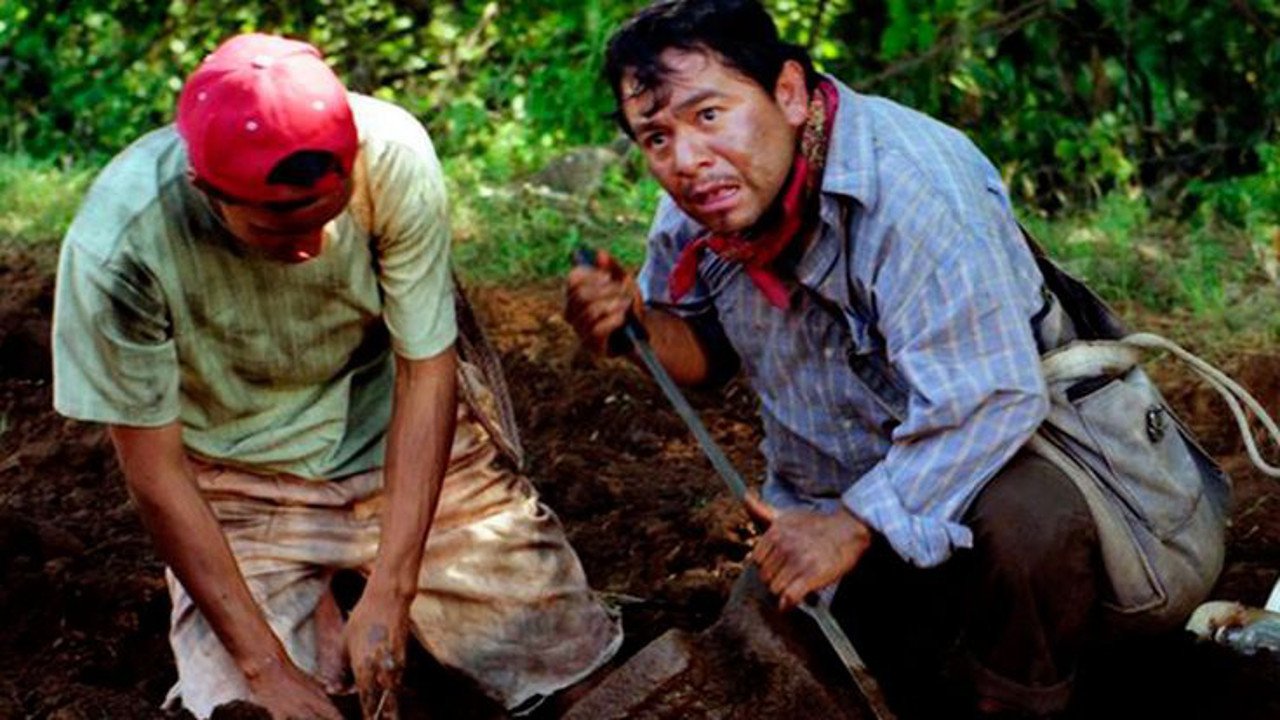
Maryse Sistach has a way of making you feel like a voyeur in the worst way possible. Honestly, if you’ve ever sat through La Niña en la Piedra, you know that "entertainment" is a bit of a stretch for a label. It’s more like a gut-punch. Released in 2006 as the final chapter of her "trilogy of cruelty," this film isn't just a piece of Mexican cinema history; it’s a terrifyingly accurate blueprint of how toxic masculinity and social neglect spiral into tragedy.
Movies about teenagers are usually full of angst and first loves, right? Not this one.
Set in the rugged, dusty outskirts of Mexico City—specifically around the rocky landscapes of Cuautitlán Izcalli—the film follows Maty, played with a hauntingly quiet intensity by Sofía Espinosa. It’s a story about a crush that turns into an obsession. Then it turns into a crime. It’s called "The Girl on the Stone" (the literal translation) because of a specific, horrific moment, but the title also feels like a metaphor for how the characters are stuck between a rock and a hard place. They are trapped by poverty, trapped by their parents' failures, and trapped by a culture that doesn't know how to tell a boy "no" and mean it.
The messy reality of Maty and Gabino
The plot is deceptively simple. Gabino is obsessed with Maty. Maty isn't interested. In a "normal" rom-com, Gabino would do something grand and win her over. But Sistach isn't interested in fairy tales. She wants to show you the rot. Gabino, played by Gabino Rodríguez, isn't a monster at first. He’s just a kid. A bored, frustrated kid who feels entitled to Maty’s affection because they go to the same school and live in the same neighborhood.
What makes La Niña en la Piedra so hard to watch is the normalcy.
The kids hang out. They go to school. They deal with teachers who are basically checked out. Gabino’s father is a piece of work—violent, dismissive, and basically a walking manual on how to raise a predator. You see the cycle happening in real-time. Gabino gets humiliated at home, so he seeks power elsewhere. And who is the easiest target? The girl who said no.
It’s a slow burn.
The cinematography by Serguei Saldívar Tanaka uses the natural light of the high Mexican plateau to create this hazy, almost dreamlike atmosphere that contrasts sharply with the gritty reality of the dialogue. You feel the heat. You feel the dust. And you feel the mounting dread as Gabino’s "pranks" get darker. It starts with him stealing her backpack. It ends... well, it ends on the stone.
Why Sistach’s "Trilogy of Cruelty" matters more than ever
To understand this movie, you have to look at what came before it. Sistach and her screenwriter partner, José Buil, started this journey with Nadie te oye: Perfume de violetas (2001) and continued with Manos libres (Nadie te habla) (2005). All three films deal with violence against women in Mexico, but La Niña en la Piedra feels the most refined—and the most pessimistic.
- Perfume de Violetas was about the betrayal of friendship and the silence of the state.
- Manos Libres tackled the digital age and kidnapping.
- La Niña en la Piedra focuses on the educational system and the domestic roots of femicide.
Basically, the film argues that the school isn't a safe haven. It's a pressure cooker. The teachers are overwhelmed or indifferent. The parents are either absent or abusive. When Maty tries to navigate her world, she’s doing it without a map. There’s a specific scene where the school tries to address "values," and it feels so hollow and performative that you want to scream at the screen.
Critics like Leonardo García Tsao have pointed out that Sistach doesn't use "movie violence." There are no explosions. No stylized fight choreography. It’s clumsy. It’s ugly. It’s the kind of violence that happens in back alleys and empty lots when nobody is looking. This realism is why the film was nominated for three Ariel Awards, including Best Actress for Espinosa. She was only about 16 or 17 when they filmed this, and the vulnerability she brings is what makes the final act so devastating.
The "Stone" is a mirror of Mexican society
Let’s talk about the geography. The "piedra" (the stone) isn't just a location. It’s a landmark of trauma. In the film, the characters live in a state of "limbo"—they aren't quite in the city, but they aren't in the rural countryside either. They are in the periphery. This geographic marginalization mirrors their social marginalization.
When you're on the edge of everything, the rules start to blur.
One of the most controversial aspects of the film is how it portrays Gabino’s friends. They aren't all "evil." Some are just followers. They are "good kids" who do nothing while something terrible happens. This is the "banality of evil" that Hannah Arendt talked about, just applied to a bunch of teenagers in hoodies. It asks the viewer: What would you do? Would you speak up, or would you be too afraid of losing your "status" in the group?
The film also touches on the concept of machismo in a way that isn't a caricature. It shows the subtle ways boys are taught to view women as property. Gabino doesn't think he’s a criminal. He thinks he’s a victim because Maty won't love him back. That twisted logic is exactly what we see in modern "incel" culture today, which makes a movie from 2006 feel strangely prophetic.
Is it worth watching in 2026?
Honestly, yes. But bring tissues and maybe a stress ball.
It’s not a "fun" watch. It’s a necessary one. In a world where we are finally having real conversations about consent and the systemic nature of violence against women, La Niña en la Piedra serves as a stark reminder of what happens when those conversations are ignored.
The film doesn't offer a happy ending. It doesn't give you a neat resolution where the bad guy goes to jail and everyone learns a lesson. Instead, it leaves you with a sense of profound unease. It forces you to sit with the consequences of a society that failed its children.
If you're a film student or just someone who likes cinema that actually says something, this is a masterclass in tone. The performances are raw. The directing is invisible in the best way possible—you forget you're watching a movie and feel like you're standing in that dusty lot with them.
What to take away from the film
If you’re going to dive into the world of Maryse Sistach, here is how to process the experience without losing your mind:
- Watch the whole trilogy: Start with Perfume de Violetas. It provides the context for Sistach’s obsession with "the silence" that surrounds victims.
- Look at the background: Pay attention to the secondary characters—the parents and teachers. They are the ones who truly fail the protagonists.
- Research the context: Look up the statistics of feminicidios in Mexico during the early 2000s compared to now. The sad reality is that while the film is nearly 20 years old, the themes are still headline news.
- Analyze the "Pranks": Notice how the escalation happens. It’s a lesson in how boundaries are eroded over time.
La Niña en la Piedra remains a cornerstone of New Mexican Cinema because it refuses to blink. It looks directly at the sun, even if it gets blinded in the process. It’s a film that demands you look at the "stones" in your own community and ask who is being crushed under them.
To truly understand the impact of this film, one should look for the 20th-anniversary retrospective essays often published in Mexican film journals like Cine PREMIERE or the archives of the Cineteca Nacional. These resources provide deeper dives into how Sistach influenced a new generation of female directors in Latin America who are now continuing the fight to tell these difficult stories.
Next Steps for Deepening Your Understanding:
- Locate the film: It can be hard to find on mainstream US streaming platforms, but it often appears on specialized Latin American cinema services or can be found in the physical archives of major universities with Latin American studies programs.
- Compare and Contrast: Watch La Niña en la Piedra alongside more recent films like Noche de fuego (Prayers for the Stolen) to see how the narrative surrounding violence in Mexico has evolved from the schoolyard to the cartel-dominated rural areas.
- Support the Creators: Follow the career of Sofía Espinosa; her growth from this "girl on the stone" to her portrayal of Gloria Trevi in Gloria (2014) shows the incredible range she developed starting with this raw, early performance.