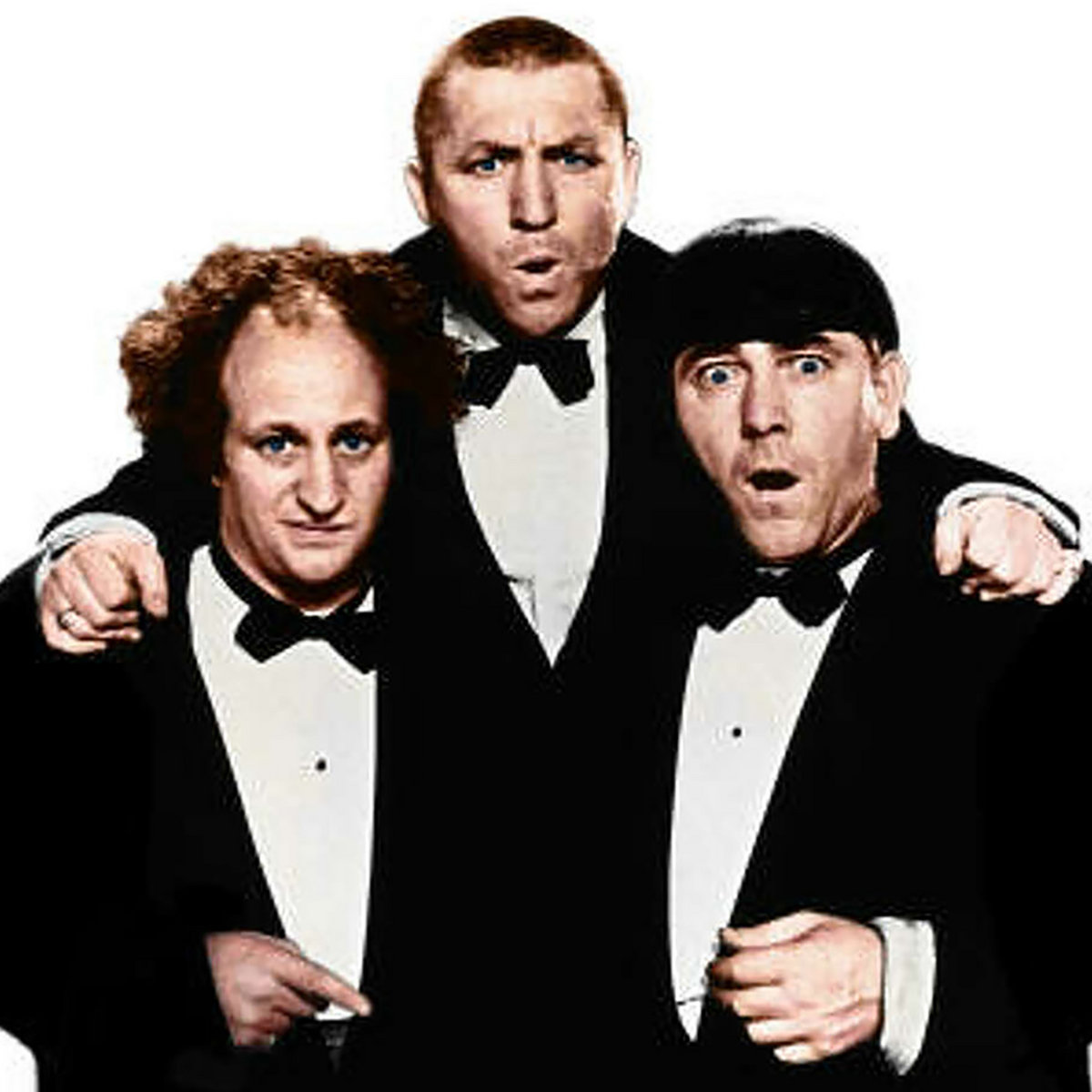
You’ve seen the eye pokes. You’ve heard the "nyuk-nyuk-nyuks" and the metallic clonk of a frying pan hitting a skull. For most of us, Moe, Larry, and Curly are just those three loud guys in black-and-white who made a career out of hitting each other. But honestly? The real story is a lot heavier than a falling piano.
Most people don’t realize that the "Three Stooges" weren't just a random act thrown together by a studio. They were a family business, a survival tactic, and, eventually, a bit of a tragedy. It’s kinda wild when you look at the actual numbers. We’re talking about a run that spanned decades, survived a world war, and saw enough cast changes to make a modern sitcom look stable.
The Boss, the Frizz, and the "Babe"
Let's get the names straight because "Moe, Larry, and Curly" weren't exactly what their mothers called them. Moe was Moses Horwitz. Curly was his baby brother, Jerome. Larry? He was Louis Feinberg, a guy from Philadelphia who played the violin like a pro and somehow ended up as the permanent middleman in this chaos.
Moe was the leader. In the shorts, he was the bully, the guy with the bowl cut who couldn't go five minutes without slapping someone. Off-camera, though? He was the one keeping the wheels from falling off. He managed the money, negotiated the (admittedly terrible) contracts, and looked after his brothers. He was the one who saved the checks because Larry had a gambling habit and Curly... well, Curly liked the high life.
Why Moe Larry and Curly Still Matter
Slapstick is easy to dismiss as "dumb humor." It's not. It’s physics. If you watch a classic short like Disorder in the Court, the timing is basically surgical. One second off and the gag fails. One inch to the left and someone actually loses an eye.
The trio's chemistry wasn't just practiced; it was baked in. Before they were stars, they were "Ted Healy’s Stooges." Healy was a vaudeville star who was—to put it bluntly—a bit of a nightmare. He’d get drunk and actually beat them on stage. That's where the act started. They learned how to take a hit because, for a long time, the hits were real.
When they finally broke away from Healy in 1934 and signed with Columbia Pictures, they became the legends we know. But they weren't getting rich. Not even close. Harry Cohn, the head of Columbia, was notorious for being a shark. He kept them on short-term contracts for 24 years, making them think the studio might drop them any second. They never knew they were the studio's biggest cash cow.
The Curly Misconception: The Man Behind the "Woo-Woo"
Everyone loves Curly. He’s the favorite. But there's a misconception that he was just naturally that "wild." In reality, Jerome "Curly" Howard was a shy, quiet guy who loved dogs and felt incredibly insecure about his looks.
He didn't want to shave his head. He did it because he wanted the job. His brother Shemp (the original third Stooge) had left the act, and Moe suggested Jerome. The director took one look at Jerome's long hair and mustache and said he wasn't funny. So, Jerome went to the barber, shaved it all off, and walked back in.
"Curly" was born.
But the fame took a toll. Jerome struggled with his weight and high blood pressure. If you watch the shorts from the mid-40s, you can actually see him slowing down. His voice gets deeper. His movements get sluggish. In 1946, while filming Half-Wits Holiday, he suffered a massive stroke right on set. He was only 42. He never fully recovered, and the "Golden Era" of Moe, Larry, and Curly essentially ended that day.
Life After the Golden Era
When Curly couldn't work anymore, Shemp Howard came back to save the act. Some fans get weird about Shemp, but honestly? He was a comedy genius in his own right. He didn't try to be Curly. He brought his own "bee-bee-bee-bee" energy.
The Stooges went through several "thirds":
- Shemp Howard: The veteran who stepped in for his brother.
- Joe Besser: The guy who famously had a clause in his contract saying he couldn't be hit too hard.
- "Curly Joe" DeRita: The man who helped them transition into the color film era of the 1960s.
Through it all, Moe and Larry were the anchors. They stayed together until the very end.
What We Can Learn From the Stooges
It’s easy to look back and see just a bunch of guys poking eyes. But there’s a nuance to it. They represented the "little guy" trying to navigate a world that was constantly hitting them over the head. Whether they were pretending to be doctors in Men in Black (the only Stooge short to get an Oscar nomination) or plumbers destroying a mansion, they were always just trying to get by.
The real takeaway? Persistence. These guys worked through injuries, bad pay, and personal tragedies because they loved the craft. They weren't just comedians; they were masters of a specific, violent, beautiful form of ballet.
Next Steps for the Stooge Curious
If you want to actually appreciate what they did, don't just watch a random clip on YouTube. Do this instead:
- Watch "A Plumbing We Will Go": It’s peak Stooge logic. Larry finds a leak, Moe pokes an eye, and by the end, the house is a literal waterfall.
- Look for the "Fake Shemps": After Shemp died in 1955, the studio still had a contract to fulfill. They used a body double (Joe Palma) to stand in for him, filmed from the back. It’s a fascinating, slightly eerie bit of film history.
- Check out Moe’s Autobiography: Moe Howard and the 3 Stooges is a genuine look at how much he cared for his family and the business.
The legacy of Moe, Larry, and Curly isn't just in the laughs. It's in the fact that, a hundred years later, we still know exactly what a "double eye poke" looks like. Not many performers can say that.
The Three Stooges remains a cornerstone of American physical comedy, proving that while times change, a well-timed slap to the face is somehow always funny. By understanding the real men behind the characters—the brothers who supported each other and the violinist who stayed for the ride—we see a story of resilience that’s just as impactful as the comedy itself.