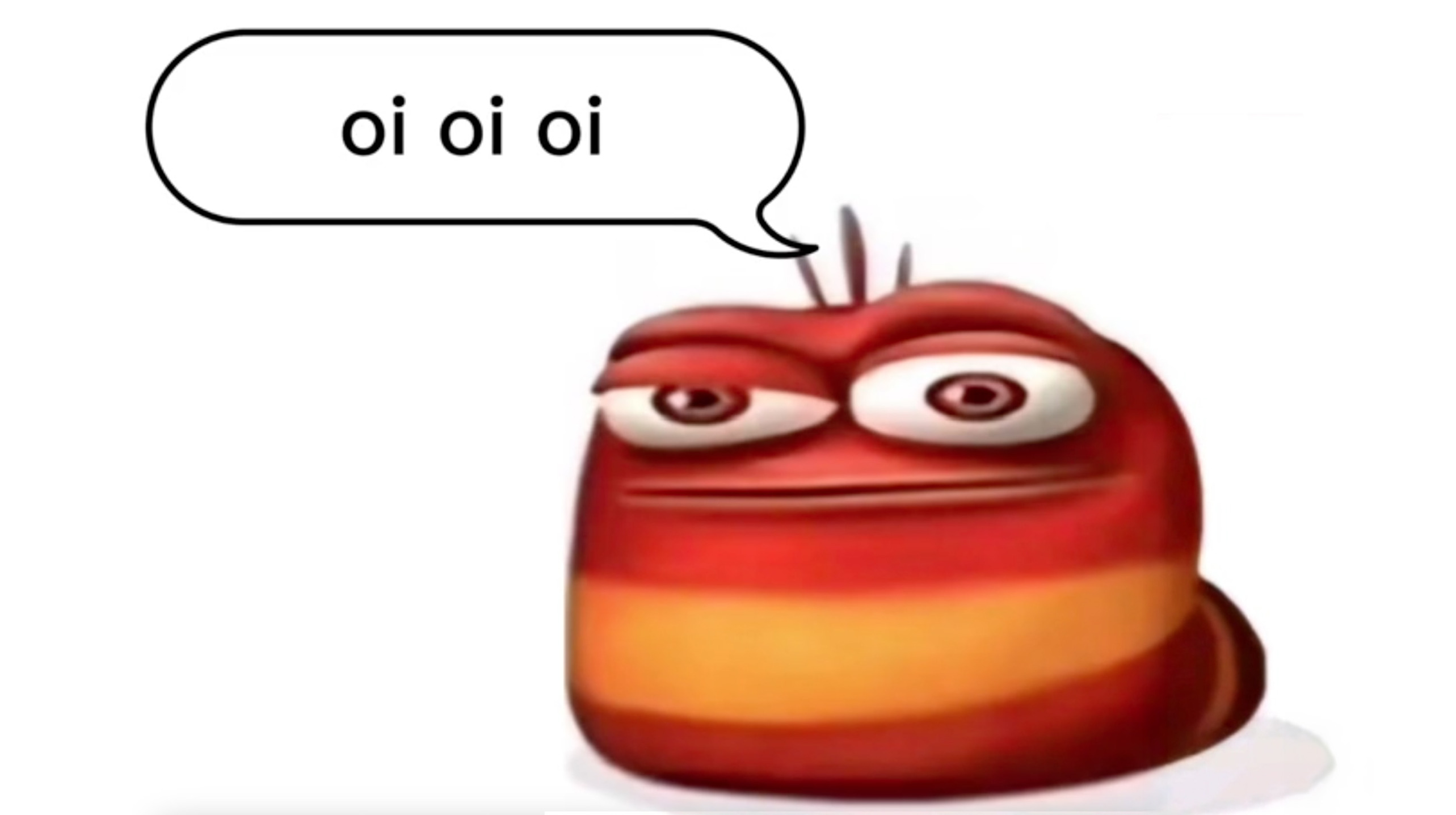
You’ve seen the videos. That strange, high-pitched "oi oi oi" sound bites into your brain while some bizarre, dancing larva creature wiggles across your screen. It’s everywhere. If you’ve spent more than five minutes on TikTok or Instagram Reels lately, you’ve probably encountered the oi oi oi larvae meme, and honestly, it’s one of those internet moments that makes you question the collective sanity of the planet. It’s weird. It’s loud. It’s inexplicably addictive.
But where did it actually come from?
Most people assume it’s just another random AI-generated fever dream, but the roots of the oi oi oi larvae phenomenon are actually a messy mix of Brazilian television, Japanese anime culture, and the chaotic evolution of "brainrot" content. It isn't just one thing. It is a digital chimera.
The Weird Origin of the Oi Oi Oi Sound
To understand why these larvae are screaming at you, we have to look at the audio first. The "oi oi oi" isn't just a random noise. It actually traces back to a very specific moment in Brazilian pop culture, specifically involving a character from the show Mister Brau. However, the version that blew up involves a remix of a scene from the anime Bakugo (My Hero Academia), where the character Katsuki Bakugo yells "Oi, oi, oi!" in his signature aggressive tone.
The internet did what the internet does.
Creators took that aggressive anime bark and pitched it up until it sounded like a chipmunk on a caffeine bender. This high-pitched version became the "soundtrack of the absurd." It’s a classic example of how TikTok audio migrates—starting as a serious or semi-serious piece of media and being distorted until all original meaning is stripped away, leaving only a raw, annoying, and hilarious shell.
What Are the Oi Oi Oi Larvae Anyway?
The visual part of the meme—the actual oi oi oi larvae—is where things get really surreal. These aren't real insects. Obviously. They are 3D-rendered characters that often resemble the "Larva" characters from the popular South Korean animated series Larva (produced by TUBA Entertainment).
If you aren’t familiar, Larva is a show about Red and Yellow, two maggots living under a sewer grate. It’s slapstick. It’s gross-out humor. It’s been around for over a decade. But the "oi oi oi" version isn't an official clip from the show. Instead, creators use CGI software or AI-generated animation filters to create "knock-off" versions of these larvae that dance, twitch, and move in sync with the high-pitched "oi" audio.
Why larvae?
Because they are inherently "ugly-cute." Their segmented bodies allow for fluid, rubbery animation that looks incredibly uncanny when paired with fast-paced audio. It’s the visual equivalent of a jump scare that never actually happens. It just keeps resetting.
The Rise of Brainrot Culture
We have to talk about "brainrot." It's a term used by Gen Z and Gen Alpha to describe content that is intentionally nonsensical, low-effort, and visually overstimulating. The oi oi oi larvae are the poster child for this.
Basically, the goal of this content isn't to tell a story. It’s to grab your attention for three seconds so you don’t swipe away.
Think about the Skibidi Toilet phenomenon. It’s the same energy. You have a repetitive sound, a recognizable but distorted character, and a sense of "What am I even looking at?" that keeps you scrolling. In the attention economy of 2026, being weird is more valuable than being "good."
The Evolution of the Meme
- Phase 1: The original Larva cartoon clips circulate as nostalgic content.
- Phase 2: The "oi oi oi" audio is created by pitching up anime voice lines.
- Phase 3: Brazilian creators start pairing the two, creating a localized meme.
- Phase 4: Global saturation. The meme hits the US and Europe, losing its Brazilian context and becoming pure "brainrot."
It’s kind of fascinating how a Korean cartoon, a Japanese anime voice, and a Brazilian trend collided to create something that kids in Ohio are obsessed with.
Why Do These Videos Rank So Well?
You might wonder why your feed is flooded with oi oi oi larvae specifically. It’s the algorithm. Platforms like TikTok and YouTube Shorts prioritize "watch time" and "re-watch rate."
Because these videos are usually only 5 to 7 seconds long and feature a high-frequency sound, people often watch them twice just to process what they saw. The algorithm sees that 200% watch time and thinks, "Wow, this is the best video ever made," and pushes it to ten million more people.
It’s a loop. A literal and metaphorical one.
The creators making these aren't necessarily "artists" in the traditional sense. They are often "content farmers" using automated tools to churn out hundreds of variations of the larvae dancing to the same sound. They change the background, change the color of the larvae, or add a different caption like "Only 1% can stop the video at the right time!" It’s gamified engagement.
Real World Impact (Yes, Really)
It sounds stupid to say a dancing maggot has a "real-world impact," but look at the search trends. Parents are searching for why their kids are shouting "oi oi oi" around the house. Teachers are dealing with "brainrot" slang in classrooms.
Even brands are trying to jump on it.
When a brand tries to use the oi oi oi larvae style, it usually fails miserably because they try to make it make sense. You can’t make this make sense. The moment you try to add a "marketing message" to a screaming larva, the magic (or the madness) dies. It has to be pure, unadulterated nonsense to work.
Understanding the Technical Side
Most of the "new" versions of these larvae are created using tools like Blender or simple AI video generators. You can actually see the evolution of the quality. Some look like high-end Pixar rejects, while others are glitchy, terrifying messes where the larvae’s eyes clip through their heads.
The glitchiness actually adds to the appeal.
There’s a specific subgenre of these videos called "void memes" or "distorted memes" where the oi oi oi larvae will suddenly turn into a black-and-white horror image or a loud static noise. It’s a way of subverting expectations. You think you’re watching a funny dancing bug, and then—BAM—digital nightmare.
How to Spot a "Fake" or "Farm" Account
If you’re trying to navigate this weird corner of the internet, you’ll notice that many accounts posting oi oi oi larvae content aren't run by people. They are bots. Here is how you can tell:
The account handles are often a string of random numbers or generic names like "User928374." They post the exact same video 20 times a day with slightly different hashtags. They also tend to have millions of views but almost zero meaningful comments. The comments are usually just other bots or kids typing "brainrot" or "skibidi."
It’s a strange ecosystem, but it’s how the modern web functions. These accounts are just trying to rack up enough followers or views to eventually sell the account or drive traffic to a sketchy link in the bio.
The Future of the Larvae
Memes like the oi oi oi larvae have a short shelf life. Usually. But the "larva" character itself has proven to be surprisingly resilient. It has survived since the early 2010s by constantly reinventing itself for new platforms.
Will we still be talking about "oi oi oi" in six months? Probably not. We’ll be onto the next weird sound—maybe a singing goat or a vibrating toaster. But the template remains the same:
Visual + Repetitive Sound + High Energy = Viral Gold.
Actionable Steps for Navigating the Trend
Whether you're a parent trying to understand what your kid is watching or a creator looking to understand the mechanics of virality, here is how to handle the oi oi oi larvae wave.
First, don't look for deep meaning. There isn't any. This is "vibes-based" media. If you try to analyze it like a film student, you'll just end up with a headache.
Second, if you’re a creator, don't just copy the trend. The market is already saturated with millions of these videos. If you want to use the "oi oi oi" sound, you have to add a twist. Use a different character. Change the context. Make it a commentary on how annoying the sound is. Subversion is the only way to stand out in a sea of clones.
Third, check your "Not Interested" button. If your feed is becoming a wall of maggots and it’s driving you crazy, use the platform's tools to reset your algorithm. Long-press the video and hit "Not Interested." It takes about five or six times, but eventually, the larvae will crawl back into the sewer where they belong.
Finally, just recognize it for what it is: a digital campfire. People gather around these weird trends because it’s a shared language. Even if that language is just high-pitched screaming and wiggling insects, it’s a way people (especially younger generations) connect in a fractured digital world.
The oi oi oi larvae are a symptom of an internet that moves too fast to be serious. It’s loud, it’s messy, and it’s completely nonsensical. And honestly? That’s okay. Just don't let the "oi oi oi" get stuck in your head for too long, or you'll never get it out.