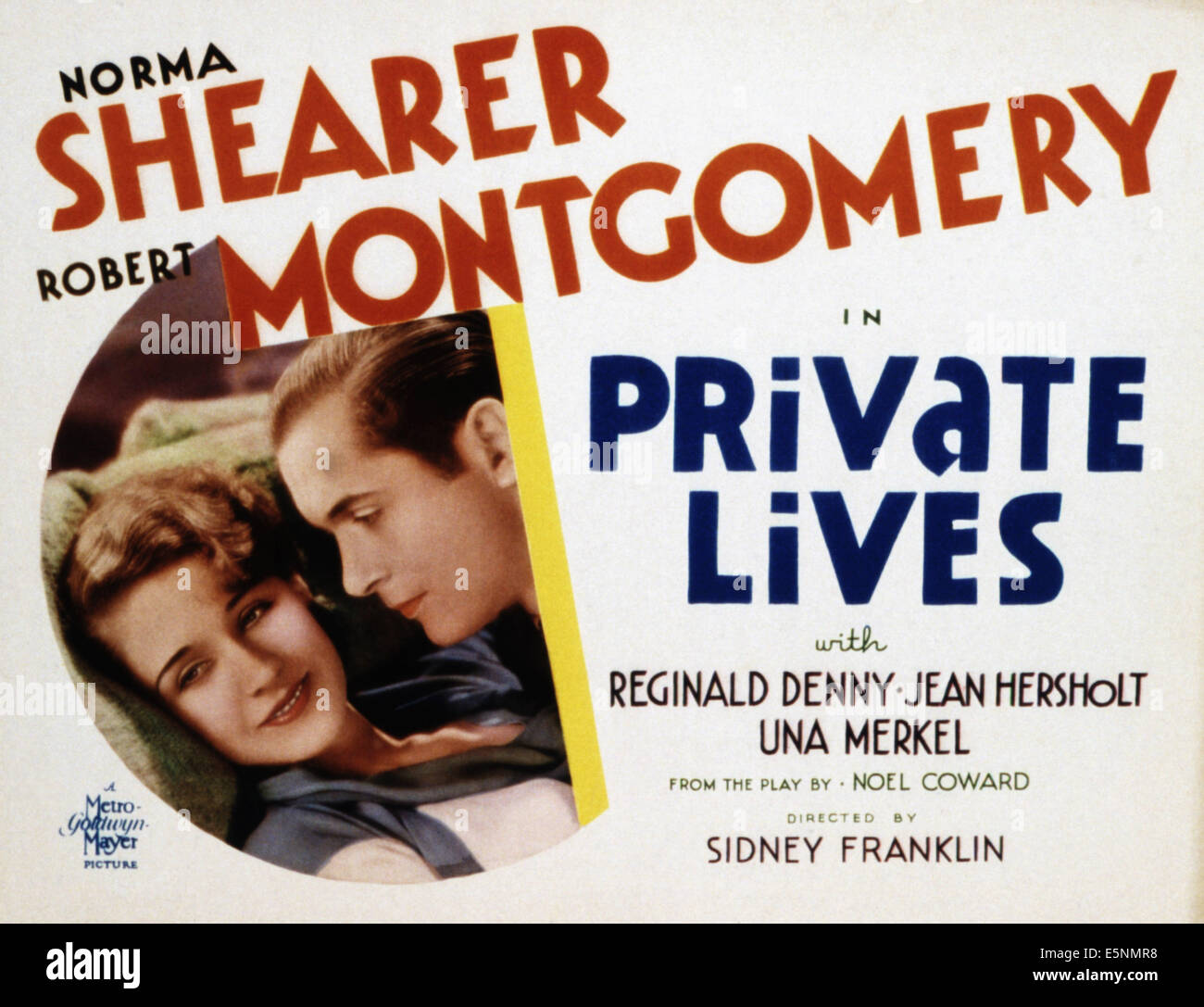
Norma Shearer wasn't supposed to be funny. In the early 1930s, she was the "First Lady of MGM," a title that usually meant she spent her days wearing three-ton velvet gowns and weeping over tragic betrayals. But then came Private Lives.
Honestly, if you look at the landscape of 1931, the movie shouldn't have worked. It’s based on a Noël Coward play that is basically just two people trapped in a room screaming at each other, drinking too much, and realizing they are terrible for everyone except themselves. It’s toxic. It’s messy. And for Norma Shearer, it was the ultimate gamble to see if she could trade her dramatic crown for a cocktail shaker and some sharp-tongued wit.
The Scandalous Setup of Private Lives
The plot is kind of a nightmare if you’re a fan of traditional romance. Amanda (Shearer) and Elyot (Robert Montgomery) are a divorced couple who absolutely loathed being married to each other. Naturally, they both get remarried to incredibly boring people—Victor and Sibyl—and head off on their respective honeymoons.
Here is the kicker: they end up in the exact same hotel in the south of France. Even worse? Their balconies are right next to each other.
You’ve probably seen this trope a thousand times now, but in 1931, this was electric. Within minutes, the "new" spouses are forgotten. Amanda and Elyot realize they are still madly in love, or at least madly obsessed, and they bolt. They ditch their new partners and flee to a flat in Paris, which is where the real chaos begins.
Why Irving Thalberg Bet Everything on This
It’s no secret that Norma Shearer was married to Irving Thalberg, the legendary "Boy Wonder" and head of production at MGM. People loved to whisper that she only got the best roles because of her husband. But let’s be real—Thalberg was a businessman first. He didn't just give her roles; he bought "prestige properties" to ensure she stayed at the top of the box office.
When he bought the rights to Private Lives, Noël Coward was skeptical. He wasn't sure Shearer could handle the "brittle" delivery required for his dialogue. To make sure she got it right, Thalberg actually had a stage performance of the play filmed privately just so Shearer and Montgomery could study the timing.
It worked.
Shearer’s Amanda Prynne isn't just a carbon copy of a stage actress. She’s playful. She’s weirdly modern. There’s a scene where she describes hitting Elyot over the head with gramophone records, and she says it with such glee that you almost forget she’s a "refined" lady of the screen.
The Physicality (and the Real-Life Injuries)
One thing people get wrong about old movies is thinking they were all stiff and polite. Private Lives is a physical brawl. There is a legendary fight scene in the second act where Amanda and Elyot go from dancing to a full-on furniture-breaking riot.
It wasn't just movie magic.
Robert Montgomery later recalled that the filming of that fight got way too real. Shearer, who was known for being incredibly disciplined and intense, didn't hold back. At one point, she actually knocked Montgomery unconscious. Another version of the story says she punched him so hard he went through a decorative screen.
This wasn't the "polite" Norma from The Barretts of Wimpole Street. This was Pre-Code Norma—the version of the star that fought for the right to play "un-ladylike" women who had sex lives and tempers.
The "Solomon Isaacs" Rule
In the middle of all the screaming, the couple has a pact. Whenever they feel a fight coming on, they shout "Solomon Isaacs!" This is supposed to force a two-minute truce.
It’s a hilarious bit of character writing. It shows that these two people know they are monsters. They know they can’t stop hurting each other, so they try to build a tiny safety net. Of course, it fails miserably. The truce usually lasts about ten seconds before one of them brings up an old grudge, and the records start flying again.
What Most People Get Wrong About the Reception
If you check Wikipedia today, it’ll tell you the film received "mixed reviews." That’s a bit of a dry way to describe what actually happened. Critics in 1931 were divided because the movie was too much like the play.
Some felt the dialogue was too fast, too "theatrical." But the public? They ate it up. It became one of the top box-office draws of the year.
Noël Coward, famously hard to please, eventually called the film "passable." Coming from him, that’s basically a standing ovation. He was mostly impressed that the film managed to keep the "new morality" of the play intact without being gutted by censors. Since this was before the strict enforcement of the Hays Code in 1934, they could get away with the idea of a divorced couple running off together without the movie "punishing" them for their sins.
Why This Version Still Matters
There have been countless stage revivals of Private Lives—everyone from Elizabeth Taylor and Richard Burton to Maggie Smith has taken a crack at it. But the 1931 film remains a bizarre, glittering relic.
- The Wardrobe: Adrian (the legendary MGM designer) put Shearer in gowns that looked like liquid silver. It defined the "Art Deco" look of the decade.
- The Gender Dynamics: Amanda isn't a victim. She isn't a "shrew." She’s an equal participant in the madness. She gives as good as she gets.
- The Pre-Code Energy: There is a frankness about desire in this movie that disappeared from Hollywood for the next thirty years.
How to Watch It Today
If you’re looking to dive into the private lives of these characters, don’t expect a rom-com. Expect a "dark-com." You can usually find the 1931 version on TCM or through specialized boutique labels like Warner Archive.
Pay attention to the way Shearer uses her eyes. She had a slight cast in one eye that she was famously self-conscious about, but in this film, she uses her gaze to project a kind of sharp, calculating intelligence that fits Amanda perfectly.
Next Steps for Classic Film Fans
To truly appreciate what Norma Shearer did here, you should watch her Oscar-winning turn in The Divorcee (1930) immediately after. It provides the context for how she reinvented herself from a "silents" star into the queen of the early talkies. You can also compare her performance to the 1939 Orson Welles radio adaptation of the same play to see how different actors handle Coward's lightning-fast dialogue.