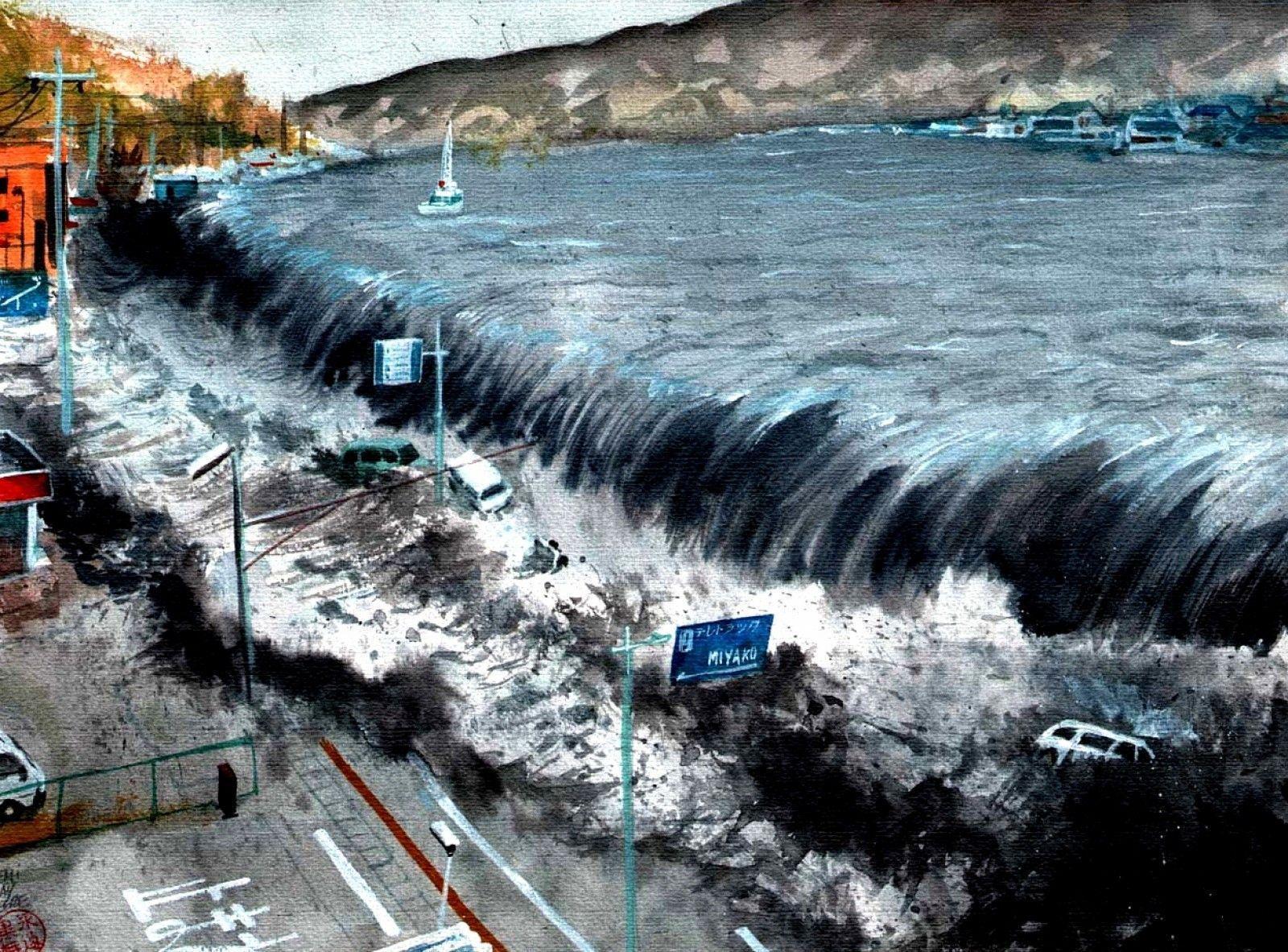
You’ve seen the Hollywood version. A massive, blue, translucent wall of water curling over a skyscraper in slow motion. It looks clean. It looks like a giant surfing wave. But if you start looking at real pictures of tsunami events from the last twenty years, you realize very quickly that the movies lied to us.
Real life is much messier.
When the 2004 Indian Ocean tsunami hit or when the Tohoku quake triggered that massive surge in Japan in 2011, the cameras didn’t capture a "wave" in the traditional sense. They captured the ocean turning into a liquid bulldozer. It wasn't blue. It was black, grey, and brown, filled with the pulverized remains of everything it touched. People often stand on the beach for too long because they’re looking for that cinematic wall of water. By the time they realize the "tide" just isn't stopping, it's usually too late.
What real pictures of tsunami actually show us
Most people expect a crest. Instead, what you see in authentic footage and photography is a "bore" or a rapid rise in sea level that looks like a high-tide on steroids.
In the famous shots from Banda Aceh, the water looks like a carpet of debris. You can barely see the water itself because it’s carrying cars, trees, and the literal foundations of homes. That's the first big misconception. A tsunami isn't just water; it's a slurry. It has density. If you get hit by a three-foot wave at the beach, you might fall over. If you get hit by three feet of a tsunami, the weight of the sediment and debris alone can crush bone.
Think about the photos from Sendai in 2011. There is a specific, haunting image of the water topping a concrete sea wall. It doesn't splash over like a wave hitting a pier. It pours over steadily, like a bathtub overflowing, but with the force of a jet engine.
The color of disaster
Why is the water so dark? In almost every high-resolution photo of a land-falling tsunami, the water is a deep, murky charcoal. This happens because the energy of the wave extends all the way to the ocean floor. It’s not just surface tension. It’s a column of energy. As it enters shallow water, it vacuums up the silt, mud, and sand from the seabed.
By the time it hits the street, it’s a churning mix of toxic chemicals, sewage, salt water, and mud. This is why survivors often talk about the smell. It isn't the salty "ocean" scent you’d expect. It’s the smell of the earth being turned inside out.
The "Drawback" phase: A deadly optical illusion
There is a very specific type of photo that haunts geologists. It’s the image of people walking out onto the sand when the water disappears.
In the 2004 disaster, many tourists in Thailand were caught on camera looking at fish flopping on the newly exposed sea floor. The tide had pulled back hundreds of yards. It looked fascinating. It looked like a once-in-a-lifetime photo op.
Honestly, if you see the horizon disappear and the beach grow by half a mile in sixty seconds, you need to run. That is the vacuum effect of the trough of the wave. It’s literally the ocean drawing breath before it exhales. Not every tsunami has a drawback, but when it does, it’s the most effective trap nature ever set.
The sheer scale of the debris field
We need to talk about what happens after the water stops moving forward.
If you look at aerial photography from the aftermath in Japan, the landscape looks like it was put through a blender. You see large fishing trawlers sitting on top of three-story apartment buildings. You see cars stacked like cordwood in the middle of forests.
- The 2011 Japan Tsunami: Generated roughly 5 million tons of debris.
- The 2004 Indian Ocean Tsunami: Traveled up to 3 miles (5km) inland in some flat areas.
- The 1958 Lituya Bay Megatsunami: While it didn't have many "on-the-ground" photos due to the era and location, the "after" photos show a trim line in the trees at 1,720 feet high. That is taller than the Empire State Building.
The sheer mass of a tsunami is hard to wrap your head around. Water weighs about 62.4 pounds per cubic foot. Now multiply that by a wave that is miles long and twenty feet high, moving at 30 miles per hour. The physics are terrifying. You aren't being hit by a liquid; you're being hit by a freight train made of bricks.
Why some people survive and others don't
Looking at the survivors' photos, a pattern emerges. It’s rarely about being a strong swimmer. You cannot swim in a tsunami. The debris—logs, glass, chunks of asphalt—will knock you unconscious or pin you.
Survival is almost entirely about vertical evacuation.
In Japan, there are photos of people on the roofs of reinforced concrete buildings watching the water swirl just inches below their feet. These "vertical evacuation towers" are now a staple of coastal engineering. If you can get twenty or thirty feet up in a structurally sound building, your odds jump from near-zero to almost certain survival.
But wood-frame houses? They’re toothpicks. Real photos show them being lifted off their foundations and carried away intact, sometimes with people still inside, before they eventually collide with a bridge or another building and disintegrate.
The psychological impact of the "Long Wave"
One thing you notice in videos and sequential photos is the duration. A normal wave hits and retreats in ten seconds. A tsunami just keeps coming. It flows for five, ten, fifteen minutes.
The photos of the 2011 event show the water pushing inland, stopping, and then—this is the part people forget—rushing back out. The "recede" is just as dangerous. It carries everything it just broke back into the deep ocean. Many victims were never found because they were swept miles out to sea as the water returned to its basin.
Modern sensing and the "Quiet" photos
Some of the most important real pictures of tsunami aren't of the water at all. They are the data visualizations from the DART (Deep-ocean Assessment and Reporting of Tsunamis) buoys.
These sensors sit on the ocean floor and measure pressure changes. When a massive displacement happens, they ping a satellite. This is the only reason we have photos of people evacuated and safe today; the data moves faster than the water.
We also have "ghost forests" along the coast of Washington and Oregon in the United States. These are clusters of dead cedar trees that were killed by salt water during the 1700 Cascadia tsunami. These photos serve as a silent, grim reminder that this isn't just an "overseas" problem. The geology of the Pacific Northwest is a mirror image of northern Japan. It has happened there, and it will happen again.
Critical insights for coastal safety
If you live near or are visiting a coastal area, forget the "big wave" image. It’s a distraction. You need to focus on these specific, actionable reality checks based on historical data and photographic evidence:
- Ground Shaking is your siren. If you feel an earthquake that lasts longer than 20 seconds and you are near the coast, stop what you are doing. Don't wait for an official tweet or a siren. The photos of the most successful evacuations show people moving the second the shaking stops.
- The ocean behaving strangely. If the water disappears, or if it looks like a "boiling" line on the horizon, move to high ground immediately. Don't grab your camera. You don't need a photo of the wave; you need to be above it.
- Think vertically. If you can’t get inland, go up. At least three stories. Reinforced concrete is your best friend. Avoid staying in cars; photos show that cars quickly become floating coffins or get trapped in gridlock as everyone tries to flee at once.
- Stay there. Tsunamis are a series of waves. Often, the second or third wave is larger than the first. Photos from the 2004 event show people returning to the shore to help others after the first wave receded, only to be caught by the second, more powerful surge.
Understanding the reality of these events through actual photographic evidence—rather than cinema—is the best way to stay alive. The ocean is beautiful, but it is also a massive physical system that doesn't care about your plans. Watch the horizon, know your exits, and never underestimate the power of a "small" rise in sea level.
---