It’s one of the most debated moments in cinematic history. You know the scene. The carnival music is blaring, the Ferris wheel is spinning in the background, and suddenly, the "good girl" from Australia isn't wearing a poodle skirt anymore. Sandy at the end of Grease steps out of that car, crushes a cigarette under her red heel, and tells Danny Zuko, "Tell me about it, stud."
Honestly, it’s iconic. It’s also kinda weird when you actually stop to think about the message it sends. For decades, fans have argued over whether this was a story of female empowerment or a total surrender of identity just to keep a guy. Grease isn't just a 1978 musical; it’s a cultural touchstone that basically defined how we view the "high school makeover" trope. But the reality of what happened to Sandy Olsson in those final frames is a bit more nuanced than just putting on some tight pants and getting a perm.
The Physicality of the Transformation
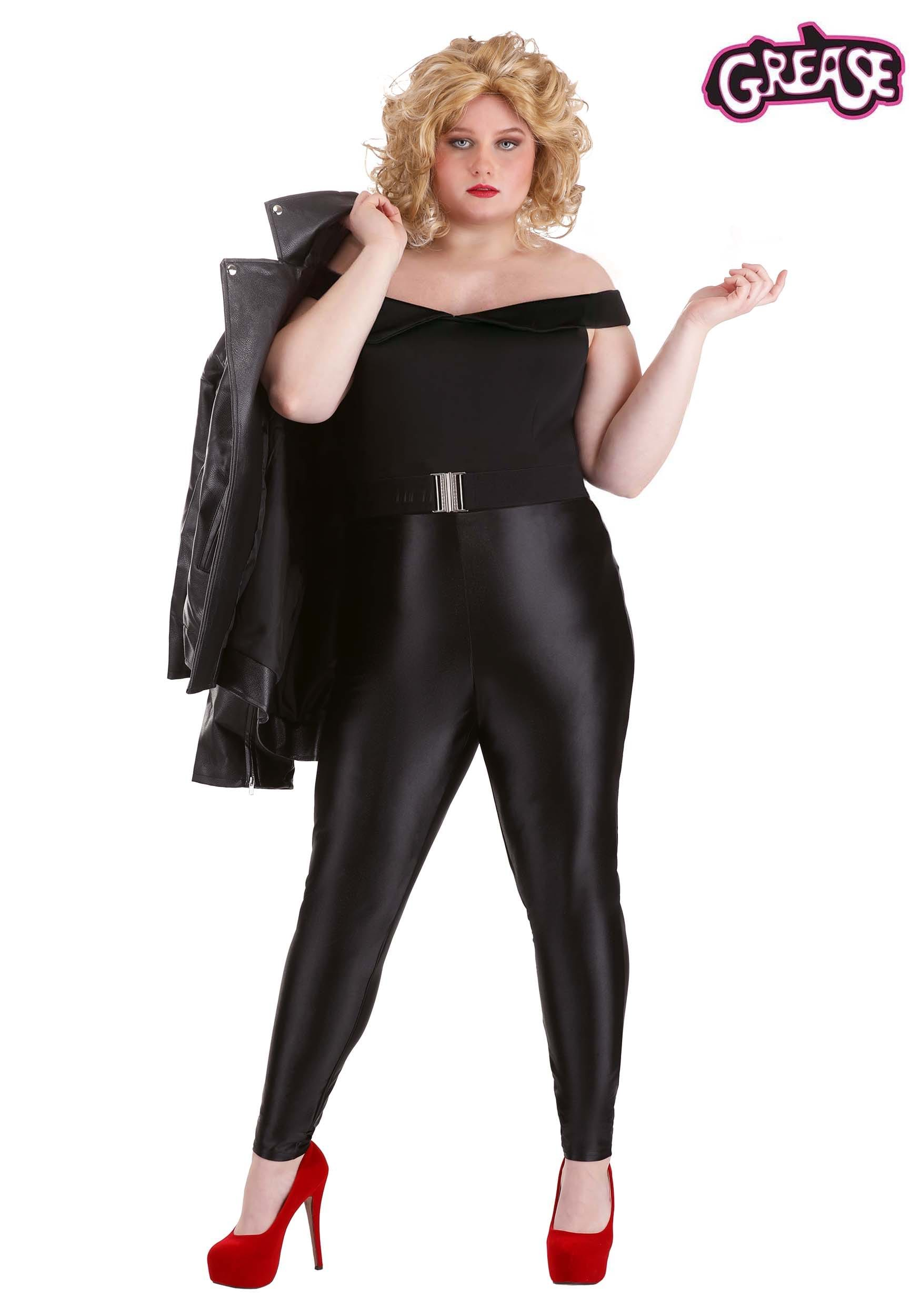
Let’s talk about the outfit. Costume designer Albert Wolsky didn't just pick those clothes out of a bin. The black spandex pants Olivia Newton-John wore were actually vintage from the 1950s. They were so tight that the zipper broke, and Newton-John literally had to be sewn into them every morning on set. Can you imagine? You’re trying to do the "You’re the One That I Want" choreography while being held together by thread.
The contrast is the point. Throughout the movie, Sandy is draped in pastels—pinks, pale yellows, and whites. She represents the "Sandra Dee" archetype of 1950s purity. When she shows up as Sandy at the end of Grease, she’s a visual antithesis to everything she was. It’s a leather jacket, hoop earrings, and hair that looks like she’s been riding a motorcycle for three days straight. It works because it’s a shock. It’s supposed to be a shock.
Did Sandy Change for Danny, or for Herself?
This is the big one. Most people watch the finale and think, "Wow, she changed everything about herself just because she wanted to date a T-Bird." And yeah, on the surface, that looks pretty bad. It’s the classic 'change your soul for a boyfriend' trope that wouldn't fly in a modern screenplay.
But here’s the thing. Look at Danny.
Danny Zuko shows up to that carnival in a letterman sweater. He’s trying to be a "jock" because he thinks that’s what Sandy wants. He lettered in track! He was willing to give up his leather jacket and his "cool" persona to meet her in the middle. The tragedy—or the comedy, depending on how you look at it—is that they both decided to change for each other at the exact same time, effectively swapping places.
Basically, Sandy realized that her "good girl" persona was a cage. She tells Frenchie earlier in the movie that she’s tired of being Sandra Dee. She wanted to let loose. The transformation wasn't necessarily about becoming "bad"; it was about claiming a sexuality and a confidence that the 1950s social structure told her she shouldn't have.
The Empowerment Argument
Some critics, like those who analyze film through a feminist lens, argue that Sandy is actually the one in control here. When she says "Better shape up," she’s giving orders. She isn't pining after Danny anymore; she’s demanding that he meet her new standard. She’s leaning into her own power.
Others? Not so much. They see it as a surrender. They see a girl who was perfectly fine as she was, caving to the pressure of a clique (the Pink Ladies) and a boy who couldn't handle a "square."
That Bizarre Flying Car Ending
We can't talk about Sandy at the end of Grease without mentioning the literal "ascension" at the end. They get into the Greased Lightnin’ car, and instead of just driving off to a burger joint, the car takes flight. It flies into the sky like a UFO while the rest of the cast waves goodbye.
What is that?
There’s a popular fan theory that’s been floating around the internet for years—even Jim Morrison’s daughter, Sarah, allegedly mentioned it—that Sandy actually drowned at the beach during the "Summer Nights" sequence. The theory suggests the entire movie is a fever dream she’s having as she loses oxygen, and the flying car at the end is her literally going to heaven.
It’s dark. It’s also almost certainly not what the creators intended.
Director Randal Kleiser has addressed this, basically saying it’s just a whimsical, musical-theater ending. It’s a fantasy. Grease isn't a documentary about 1950s delinquency; it’s a stylized, kitschy celebration of youth. The car flies because, in the world of Grease, feelings are so big they defy gravity.
The Cultural Impact of "Bad Sandy"
The "Bad Sandy" look became a blueprint. You see it in Clueless, you see it in Mean Girls, and you see it in almost every teen movie where a girl undergoes a makeover to find her "true" (or more popular) self.
But Olivia Newton-John brought something specific to it. She was genuinely nervous about playing the "bad" version of the character. She was a pop-country singer known for being sweet. That nervousness translates into the performance—there’s a bit of a "fake it till you make it" energy in Sandy’s eyes during that final scene that makes it feel human rather than just a costume change.
The Music as a Narrative Tool
"You’re the One That I Want" is a powerhouse. It’s one of the best-selling singles of all time. But notice the lyrics. Sandy is the one setting the terms. She’s telling him he needs to "prove" he can handle her. The song is a duet, but Sandy’s vocals are what drive the energy. By the time we get to "We Go Together," the hierarchy of the group has shifted. She’s no longer the outsider; she’s the centerpiece.
Breaking Down the "Transformation" Trope
If we look at Grease in the context of 1978, the film was released in a post-sexual revolution world. People were looking back at the 50s with a mix of nostalgia and a "glad that’s over" sentiment. Sandy’s transformation mirrored the way 1970s audiences felt about the repressive nature of the previous generation.
- Sandy’s Agency: She asks Frenchie for the makeover. It isn't forced on her.
- The Reaction: The T-Birds and Pink Ladies aren't just shocked; they’re impressed.
- The Mutual Effort: Danny’s attempt at athletics is often ignored in this conversation, but it proves the "change" was a two-way street.
Honestly, the ending works because it’s a payoff to all the tension. If they had just stayed the same, the movie would have ended on a whimper. Instead, it ends on a high-octane, leather-clad bang.
Final Insights on Sandy's Journey
When you look back at Sandy at the end of Grease, try to see it through the lens of the era. It’s a film about the friction between who we are told to be and who we want to be. Sandy was a character who lived in the "in-between"—too Australian for the Americans, too "good" for the T-Birds, and too curious for her own "Sandra Dee" reputation.
The ending isn't a funeral for her old self. It’s a celebration of the fact that she can be both. She can be the girl who fell in love at the beach and the woman who can hold her own on the dance floor.
Next Steps for Grease Fans:
If you want to understand the character deeper, go back and watch the 1977 stage play versions or read about the original Chicago production. You’ll find that the original Sandy Dumbrowski (not Olsson) was much tougher and "greasier" from the start. Comparing the stage version to Olivia Newton-John's portrayal gives you a lot of perspective on how the "Bad Sandy" moment was softened for Hollywood. You might also want to look into the 2023 prequel series Rise of the Pink Ladies to see how the franchise has attempted to retroactively add more depth to the social dynamics of Rydell High.