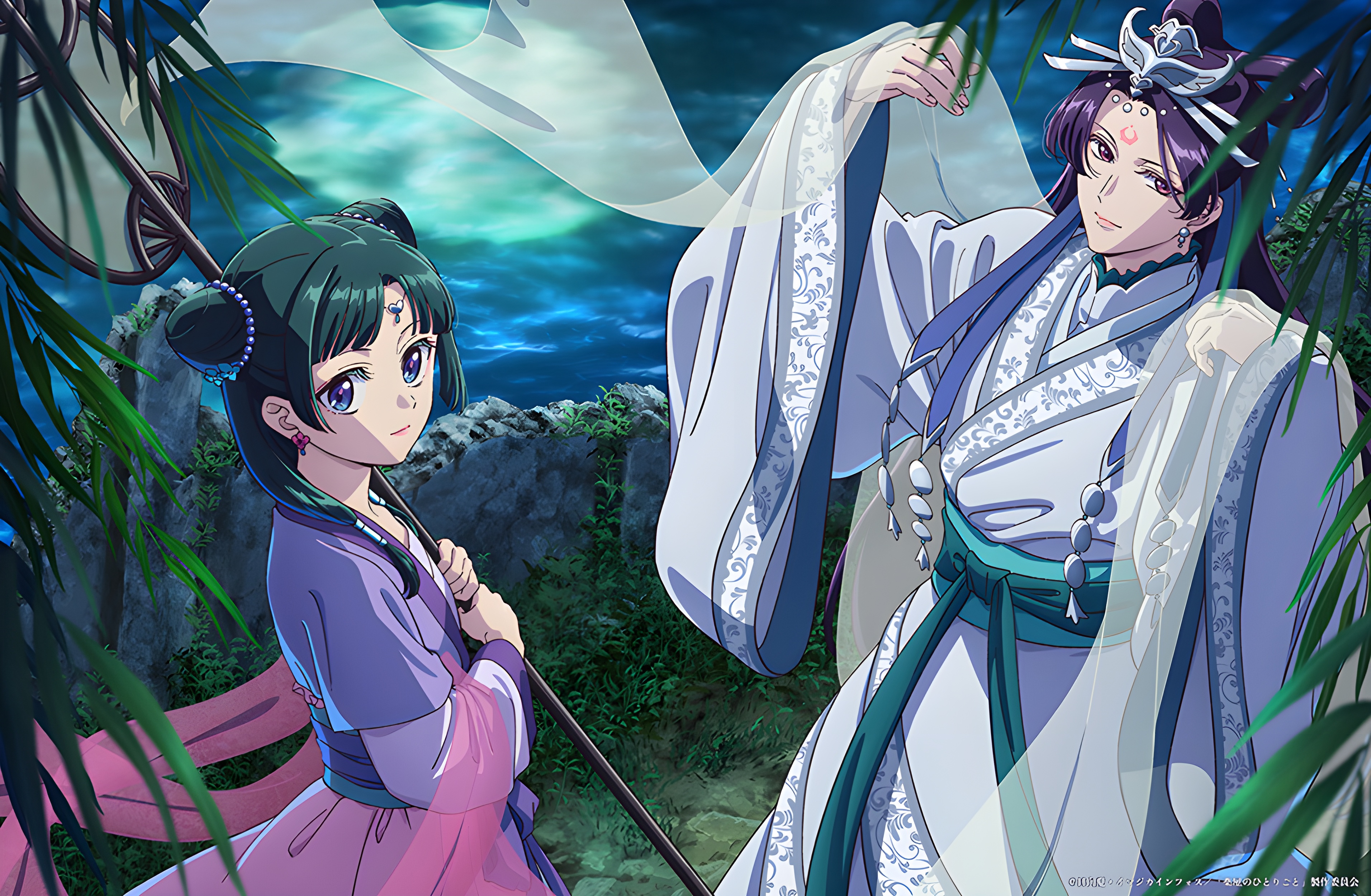
You know that feeling when a story finally stops playing it safe and just hits you with something visually and emotionally massive? That’s basically the collective experience of the fandom when The Apothecary Diaries the moon fairy episode dropped. It wasn’t just about the pretty colors or the animation budget, though OLM and P.I.C.S. clearly went all out. It was about the culmination of Maomao’s specialized knowledge and Jinshi’s internal struggle finally colliding in a way that felt earned.
Maomao is usually the personification of "I'm just here so I don't get fined." She wants her herbs, she wants to avoid the Rear Palace drama, and she’d really prefer it if people stopped trying to poison each other with lead-based makeup. But the Moon Fairy dance? That changed the vibe. It shifted the dynamic from a simple mystery-of-the-week procedural into a sweeping historical drama where the stakes are written in the stars—or at least in the glow of a very well-timed bonfire.
The Science and Superstition Behind the Moon Fairy
In the world of Kusuriya no Hitorigoto, nothing is ever truly supernatural. That’s the whole point of Maomao’s character. She’s a scientist in a world of ghosts. When we talk about the Apothecary Diaries the moon fairy, we’re talking about a meticulously staged piece of political theater. The "Moon Fairy" isn't an actual celestial being; it’s a role played during a mid-autumn festival, a moment where the veil between the Emperor's court and the divine is supposed to be at its thinnest.
Jinshi takes on this role. Honestly, it’s the perfect casting because Jinshi’s entire existence is built on a sort of ethereal, untouchable beauty that borders on the divine anyway. But Maomao sees the mechanics. She sees the way the light hits the silk. She understands the chemistry of the incense and the way the atmosphere is manipulated to create awe.
There’s a specific nuance here that many casual viewers miss. The dance is a ritual meant to bring prosperity, but for Jinshi, it’s a cage. Every movement is choreographed. Every glance is calculated. While the court sees a deity, Maomao sees a man performing a duty that weighs heavy on his shoulders. This contrast is what makes the "Moon Fairy" sequence so vital to their character development. It’s the first time Maomao truly looks at him—not as a nuisance or a "pretty face," but as a person trapped in a role.
Why the Visuals Actually Matter for the Plot
The animation in this specific sequence isn't just "eye candy." It’s narrative. The way the flowing sleeves of the garment mimic the craters and shadows of the moon reflects the dual nature of Jinshi himself. In Natsu Hyuuga’s original light novels, the description of this scene emphasizes the overwhelming sensory experience.
The anime takes it a step further.
They used a specific color palette—deep indigos, shimmering silvers, and that hauntingly pale moonlight—to isolate Jinshi from the rest of the crowd. He isn't part of the world of men in that moment. He is the moon fairy. And Maomao, standing in the shadows with her knowledge of poisons and medicine, is the only one who sees the reality of the performance.
The Chemistry of the Moon Fairy Dance
Let’s get into the nitty-gritty of why this moment sticks. It’s the chemistry. Not just the romantic kind, though the "Maomao x Jinshi" shippers were eating well that night. I’m talking about the chemistry of the scene’s construction.
- The Lighting: Notice how the shadows fall. In the Rear Palace, light is often harsh or filtered through screens. During the Moon Fairy dance, the light is open, vast, and cold.
- The Wardrobe: The costume design for the moon fairy is historically inspired but leaned into the fantastical elements of the "Celestial Maiden" tropes. It’s heavy. It’s restrictive. It’s a literal representation of Jinshi’s social standing.
- Maomao’s Reaction: She doesn’t swoon. She doesn't fall over herself like the other ladies-in-waiting. Instead, she observes. She analyzes the grace of the movement. It’s her way of showing respect.
Kinda makes you realize how much thought goes into a five-minute sequence, doesn't it?
Most people think Maomao is completely indifferent to Jinshi’s charms. They’re wrong. She’s just resistant to the facade. When Jinshi is acting as the Moon Fairy, he is at his most "fake," yet there’s a vulnerability in the perfection of the dance that Maomao recognizes. It’s the moment she realizes that being the most beautiful person in the empire is actually a bit of a nightmare.
Addressing the "Magic" Misconception
One thing that drives me crazy in the forums is when people suggest there’s actual magic involved in the Apothecary Diaries the moon fairy scene. No. Just no.
The series is grounded in historical realism (with a fictionalized setting reminiscent of Ming-era China). The "magic" is just high-level production value for the time. Maomao’s entire schtick is debunking the supernatural. If there were actual fairies, she’d probably try to catch one to see if its wings could be ground into a powder to cure a rash.
The "Moon Fairy" is a title. It’s a tradition. It’s a social tool used by the Emperor to solidify his connection to the heavens. By having Jinshi perform it, the Emperor is making a very specific political statement about Jinshi’s value and his place in the hierarchy—even if the viewers (and Maomao) are still piecing together exactly what that place is at that point in the story.
The Impact on the Light Novel vs. Anime
If you’ve read the light novels, you know the inner monologue is way more intense. Maomao’s thoughts during the moon fairy dance are a mix of clinical observation and a rare, suppressed sense of wonder. The anime had to translate that internal dialogue into visual cues.
They did it by focusing on her eyes.
The reflection of the flames and the moon in Maomao’s pupils tells the story that her words don’t. She’s captivated. Not by a crush, but by the sheer magnitude of the spectacle and the person at the center of it. It’s a turning point. After the moon fairy incident, Jinshi starts pushing harder to be seen by Maomao as a man, not just a superior. He’s tired of being the fairy; he wants to be the person who gets to annoy her in her pharmacy.
Behind the Scenes: Production of the Spectacle
It’s worth noting that the staff at OLM reportedly spent a disproportionate amount of time on the fabric physics for this episode. You can see it in the way the silks drag and loft. In the industry, this is often called "sakuga," a term for when the animation quality spikes for a specific, high-impact scene.
The director, Norihiro Naganuma, knew this was the "money shot" of the season. If the Moon Fairy dance didn’t land, the emotional core of the middle of the story would have felt hollow. They used a combination of traditional 2D animation with some digital layering to give the "moonlight" that ethereal, glowing quality that makes the scene feel like a dream.
Honestly, it’s one of the best examples of how to adapt a light novel. You don't just show what happened; you show how it felt.
Actionable Takeaways for Fans and Creators
If you’re a fan or even a writer looking to understand why this specific beat worked so well, here are the core elements you should look at:
1. Contrast is King. The Moon Fairy works because it puts a character we usually see in a position of power (Jinshi) into a position of performative servitude. He is serving the ritual. This creates instant empathy.
2. Use "The Outsider" Perspective. By framing the dance through Maomao’s cynical, scientific eyes, the moments where she is genuinely impressed carry ten times more weight. If a character who hates everything suddenly thinks something is "okay," the audience knows it’s actually incredible.
3. Visual Metaphor over Dialogue. They didn’t need Jinshi to say, "I am lonely and burdened by my beauty." They just showed him dancing alone under a cold moon while thousands of people watched him without actually seeing him.
4. Research the History. The Apothecary Diaries the moon fairy sequence draws heavily from real-world Mid-Autumn Festival traditions. Looking into the "Chang'e" myths adds a layer of depth to the viewing experience. Chang'e, the Chinese goddess of the moon, lived in a lonely palace with only a rabbit for company. Sound familiar? Jinshi’s "Rear Palace" is his moon, and he is just as isolated.
5. Pay Attention to the Soundtrack. The music during this scene shifts from the usual playful, inquisitive woodwinds to something much more orchestral and haunting. It signals to the viewer: "Pay attention, this matters."
To really appreciate the depth of the moon fairy arc, you should go back and watch the preceding three episodes. Look for the subtle mentions of the upcoming festival. Notice how Jinshi’s mood shifts as the date approaches. It’s not just a standalone "cool scene"; it’s the payoff of a long, stressful build-up for him.
The legacy of the Apothecary Diaries the moon fairy isn't just about the memes or the fan art. It’s about the moment the show proved it could handle high-stakes emotion just as well as it handled forensic science. It’s the heartbeat of the series.
To dive deeper into the world of Maomao, your next step is to compare the "Moon Fairy" sequence in Episode 12 of the anime with the descriptions in Volume 2 of the light novel. You'll notice that the anime emphasizes the "distance" between the characters, whereas the novel emphasizes Maomao's confusion over her own reaction. Examining these differences gives you a much fuller picture of how Maomao's character is actually evolving under her stoic exterior.