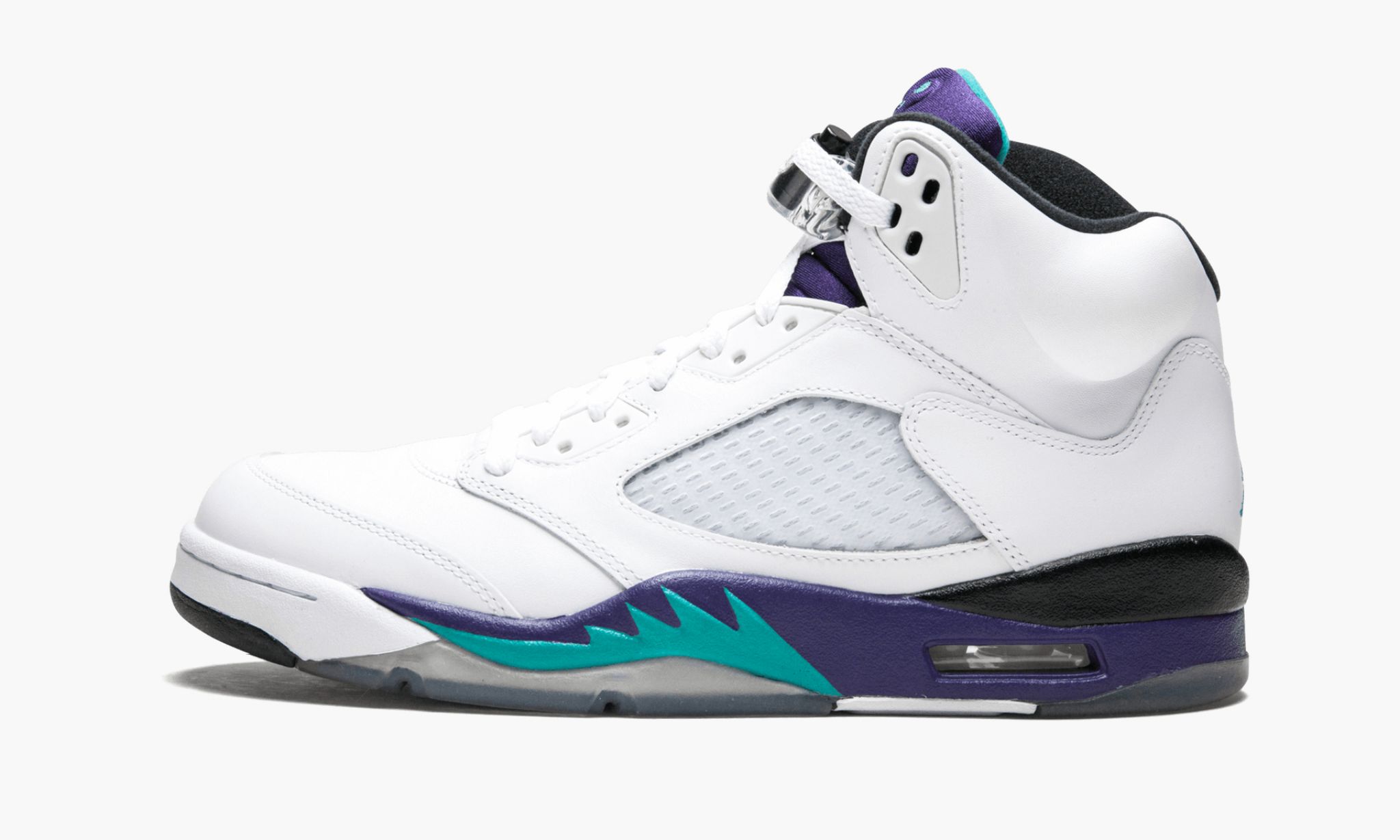
Sneaker culture is weird. One day everyone wants minimalist white leather, and the next, we’re all obsessed with neon purple and teal accents on a bulky basketball shoe from 1990. That’s basically the story of the jordan 5 grape black, or as most of the OGs call it, the "Black Grape." It shouldn't work. It’s loud. It’s aggressive. Yet, it remains one of the most significant colorways in the entire Jordan Brand catalog.
If you were around in 2013, you remember the absolute chaos. People were lining up for blocks. It wasn't just another Saturday release; it was a flip on a classic that felt surprisingly fresh. The original "Grape" 5—the white one—was already a legend because of The Fresh Prince of Bel-Air. But the jordan 5 grape black took that 90s aesthetic and dipped it in ink. It made it moodier.
The Weird History of the Grape Colorway
Tinker Hatfield is a genius. We know this. When he designed the Air Jordan 5, he took inspiration from World War II Mustang fighter jets. You can see it in the shark teeth on the midsole. But the color palette? That was pure 90s lifestyle. Unlike the "Bred" or "Chicago" colorways, Michael Jordan never actually wore the Grapes on the NBA court.
Think about that.
One of the most famous Jordans ever has almost zero "on-court" heritage. It gained its status through pop culture. Will Smith wore the white Grapes without laces on TV, and suddenly, every kid in America needed a pair. Fast forward to June 2013, and Jordan Brand decides to give us the "Black Grape."
It swapped the white leather for a rich, black nubuck. Honestly, the material choice was a gamble. Nubuck can be finicky. It scuffs if you look at it wrong, and if it gets wet, you're in for a bad time. But man, did it look good. The contrast between that deep matte black and the "New Emerald" and "Grape Ice" hits made the colors pop way harder than they ever did on the white version.
Why the 2013 Release Was a Turning Point
The jordan 5 grape black dropped at a specific moment when sneaker collecting was transitioning from a niche hobby to the mainstream monster it is today.
- It proved that "Reverse" colorways could be just as popular as originals.
- It highlighted the importance of nubuck in the Jordan 5 silhouette.
- It solidified the "Grape" trio (White, Black, and later the "Fresh Prince" laceless and "Alternate" Purple).
I’ve spent a lot of time looking at mid-sole crumbling issues on older pairs. If you’re buying a 2013 pair today, you’ve got to be careful. That polyurethane midsole doesn't last forever. It’s a ticking time bomb. Most pairs from that era are starting to show their age, with the clear outsoles turning a murky yellow instead of that crisp icy blue we all fell in love with.
Design Details That Actually Matter
Let’s talk about the tongue. The Jordan 5 is famous for that oversized, reflective 3M tongue. On the jordan 5 grape black, the tongue is "Grape Ice" teal, and it doesn't just sit there—it screams.
The lace locks are another thing. People lose these all the time. If you’re buying a used pair, check for the clear/teal toggles. Without them, the shoe looks naked. It’s a small detail, but for collectors, it’s a dealbreaker.
The side mesh is also a point of contention. On the black grapes, the mesh is black, which is great because it hides the yellowing that plagues the white version. You can wear these a lot more without them looking "beat." That’s the secret reason why people actually prefer the black version for daily wear. It’s durable. Sorta.
The Material Reality
Nubuck isn't leather. It’s top-grain cattle hide that’s been sanded on the outside. This gives it that velvet-like feel.
The downside? It absorbs everything.
If you drop a greasy fry on your jordan 5 grape black, that’s it. Game over. You’re going to need a suede eraser and a lot of patience. I’ve seen people try to use wet wipes on these—don't do that. You'll ruin the nap of the fabric and end up with a shiny, bald spot on your toe box.
Is the Jordan 5 Grape Black Still Relevant in 2026?
Short answer: Yes.
Long answer: It depends on what you value.
We’ve seen the "Alternate Grape" (the all-purple suede one) and the "NRG Fresh Prince" versions drop since then. But the jordan 5 grape black maintains a higher price point on sites like StockX and GOAT. Why? Because it’s the most wearable "wild" shoe. It balances the neon colors with a dark base.
The market for these fluctuates, but they generally stay in the $300-$500 range depending on condition. That’s a lot of money for a shoe that came out over a decade ago. It shows that the "Black Grape" isn't just a trend. It’s a staple.
I remember talking to a shop owner in New York who said he sells more Black Grapes to people who don't even play basketball than to people who do. It’s a fashion statement. It's about the era it represents—the transition from the rugged 80s to the vibrant, experimental 90s.
Addressing the "Comfort" Myth
Let's be real. The Jordan 5 isn't the most comfortable shoe by modern standards. Compared to New Balance 990s or anything with ZoomX foam, the jordan 5 grape black feels like wearing a stylish brick.
The "Air" unit is there, sure, but it's 1990 technology. The collar is heavily padded, which is great for ankle support but makes your feet sweat like crazy in the summer. If you’re planning on walking 10 miles in these at Disney World, maybe rethink your life choices. But for a night out or a casual fit? They’re perfect.
How to Spot a Fake in Today's Market
The replica market has gotten scary good. In 2013, fakes were easy to spot—the colors were off, or the "jumpman" looked like he was doing the splits. Now? It’s harder.
When you’re looking at a jordan 5 grape black, check the shark teeth on the midsole. On authentic pairs, the paint should be crisp. There shouldn't be massive "overspray" onto the black part of the sole.
Check the tongue height. Fakes often have a shorter, stumpier tongue. The real Grape 5 tongue should stand tall and proud. Also, the "Grape Ice" color is very specific. It’s a deep purple with a blue undertone. If it looks too "royal blue" or too "magenta," walk away.
Practical Steps for Owners and Buyers
If you actually own a pair or are about to drop a few hundred bucks on one, you need a plan. You can't just throw these in the back of a closet.
- Buy a Suede Kit: Get a brass-bristle brush and a suede eraser. Use them after every three or four wears to keep the black nubuck from looking "flat."
- Check the Midsole: If you see "spider-web" cracks in the paint on the midsole, the foam is starting to dry out. This is the beginning of the end. Wear them occasionally to keep the molecules moving—believe it or not, letting them sit in a box makes them crumble faster.
- Storage Matters: Keep them away from sunlight. That "New Emerald" teal will fade into a weird lime green if they sit in a window display for too long.
- The Sole Protector Debate: Some people swear by plastic sole protectors to keep the "icy" look. Honestly? Just wear them. The yellowing is a badge of honor. It shows the shoe is authentic to its era.
The jordan 5 grape black is more than just a sneaker. It’s a piece of 90s design language filtered through a 2010s lens. It’s bold, it’s slightly impractical, and it’s undeniably cool. Whether you’re a "Fresh Prince" fan or just someone who loves a black-based sneaker with a pop of color, this pair deserves a spot in the rotation. Just watch out for the rain. Seriously.