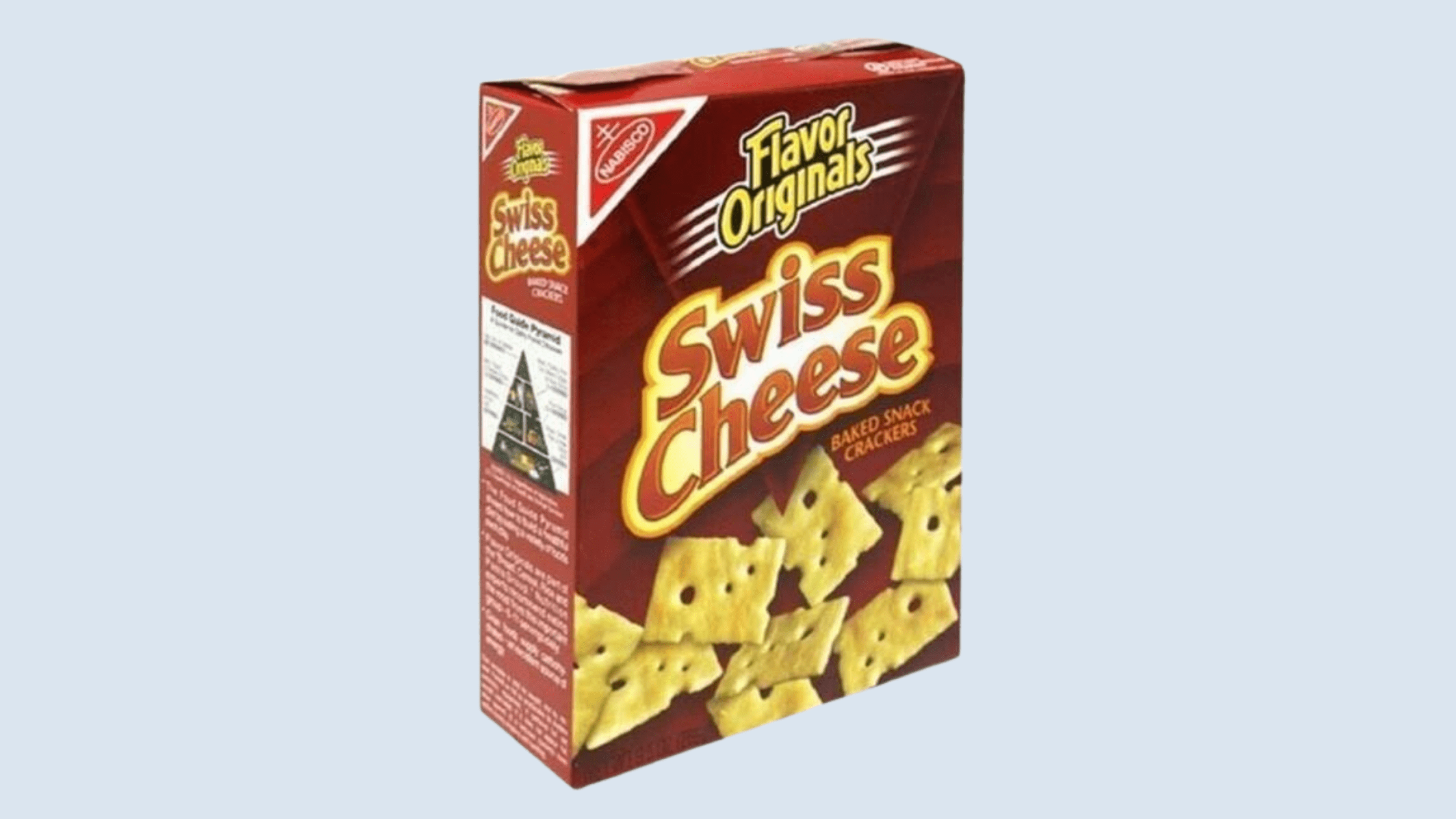
You know that specific, salty, slightly funky crunch that only comes from a box of Nabisco Swiss Cheese Crackers? It’s unmistakable. Honestly, if you grew up with these in your pantry, you probably have a visceral memory of the way they smell the second the inner plastic bag pops open. It's a scent that's part sharp cheese, part toasted wheat, and entirely nostalgic. But lately, finding them feels like a treasure hunt.
People are genuinely stressed about it.
These aren't your standard buttery rounds or saltines. They have holes. They’re shaped like actual slices of Swiss cheese, which is a gimmick that probably shouldn't work as well as it does, yet here we are. The texture is what really sets them apart—they aren't "light and airy" like a Ritz. They have a density, a snap, and a specific "stale-but-in-a-good-way" crunch that fans have defended for decades.
What’s Actually Happening with Nabisco Swiss Cheese Crackers?
If you’ve walked down the cracker aisle lately and seen a gaping hole where the red box used to be, you aren't alone. It's frustrating. You’re looking for that specific savory hit, and all you see are "Chicken in a Biskit" or "Wheat Thins." While those are fine, they aren't these.
Nabisco, which is a subsidiary of Mondelēz International, hasn't officially "discontinued" the product in a global, permanent sense, but regional availability is a total mess. This is basically how the modern snack supply chain works now. Companies look at velocity—how fast a product moves off a shelf in a specific zip code—and if the Swiss Cheese Crackers aren't hitting the numbers, they get swapped for a safer bet like Original Oreos or a newer limited-edition flavor.
It's a numbers game. It's cold.
The "Swiss" flavor in these crackers is actually pretty complex for a mass-produced snack. If you look at the ingredients, you’ll see things like Swiss cheese powder and "natural flavor," but there’s also a hint of onion and garlic powder that rounds out the profile. It’s that savory backbone that makes them addictive. Most people don't realize that the "Swiss" taste is actually quite difficult to replicate in a baked dry good because real Swiss cheese (Emmental or Gruyère) has a very high oil content. Nabisco manages to dehydrate that essence into a shelf-stable cracker without it tasting like cardboard.
Why the Cult Following is So Intense
Most snacks have fans. Nabisco Swiss Cheese Crackers have a militia.
Go to any grocery store review site or subreddit dedicated to snacking, and you will see the same desperate pleas. "Where did they go?" "Did the recipe change?" "I drove three towns over for the last six boxes." This isn't just about hunger; it's about a specific flavor profile that nobody else is making. There is no "Great Value" or "Signature Select" version of the Swiss Cheese Cracker that actually hits the mark. They usually end up tasting too much like white cheddar, which is a totally different vibe.
Swiss cheese is polarizing. It’s nutty. It’s a little bit bitter. In a cracker format, that bitterness is balanced by the saltiness of the dough.
The Composition of the Perfect Snack
- The "Holes": They aren't just for aesthetics. Those perforations allow steam to escape during the high-heat baking process, which ensures the cracker stays flat and crisp rather than puffing up like a pita.
- The Size: They are bite-sized. You don't have to navigate a giant cracker that crumbles down your shirt. You just pop them.
- The Salt Distribution: Unlike saltines, where the salt is clearly visible on top, the saltiness in Nabisco Swiss Cheese Crackers feels "baked in." It’s more consistent.
Actually, the history of Nabisco is littered with these "cult classics." Think about the Social Tea biscuit or the Crown Pilot cracker. Nabisco has a habit of creating these very specific, niche products that build a small but fiercely loyal audience, only to make them incredibly difficult to find thirty years later. It’s a weird strategy, but it keeps the brand in the conversation.
The Regional Scarcity Myth
There is a common theory floating around online that Nabisco Swiss Cheese Crackers are only sold in Canada now. This is sort of true but mostly a misunderstanding of how Mondelēz distributes products. In Canada, they are often branded under the "Christie" name (which is the Canadian arm of Nabisco). If you cross the border into Ontario, you’ll see them everywhere. They are a staple.
In the United States, it’s a regional crapshoot. If you live in the Northeast, you might see them at a Wegmans or a ShopRite. If you’re in the South or the West Coast, you might go years without seeing a box on a shelf. This has led to a thriving "gray market" on sites like eBay and Amazon where people are legitimately paying $15 to $20 for a single box of crackers.
Is a box of crackers worth $20? Probably not. But nostalgia is a hell of a drug.
When people talk about the "Golden Age" of Nabisco, they usually point to the 80s and 90s. Back then, the variety on the shelves was insane. You had Vegetable Thins, Swiss Cheese, Bacon Thins (which are also a lost relic), and those weirdly delicious "Twigs." Today, the shelf space is dominated by different "thins" and "flips." The bold, funky flavors like Swiss cheese have been pushed to the edges.
Nutrition and Ingredients: What are you actually eating?
Let’s be real: nobody is eating these for their health. But if you’re curious about what’s actually in the box, it’s a standard enriched flour base. You’ve got the usual suspects: soybean oil, sugar, and salt.
The "cheese" element comes from a blend of dried cheeses. It’s not "health food," but compared to some of the ultra-processed neon-orange snacks on the market today, the ingredient list is relatively straightforward. There are about 140-150 calories per serving (which is usually about 15 crackers). The problem, obviously, is that nobody eats just 15 crackers. The box is designed for mindless grazing.
One thing that people often overlook is the "mouthfeel." These crackers have a slight oiliness to them that helps the flavor coat your tongue. That's why they pair so well with things that are acidic—like a sharp green apple or a glass of dry white wine. If you're feeling fancy, putting a tiny smear of spicy brown mustard on a Swiss cheese cracker is a game-changer. It highlights the nuttiness of the cheese powder.
How to Find Them (Without Paying a Fortune)
If you are currently staring at an empty shelf, don't panic. You have options that don't involve giving your life savings to a reseller.
First, check the "International" aisle. Sometimes, if a store gets their stock from a different distributor, the Christie-branded boxes from Canada will end up in a weird spot. It’s rare, but it happens. Second, use the Mondelēz product locator tool on their website. It isn't 100% accurate because it relies on inventory data that might be a few days old, but it's better than driving around aimlessly.
Finally, look at smaller, regional grocery chains. The big players like Walmart and Target use automated inventory systems that are brutal toward "slow-moving" items. Smaller chains often have more flexibility in what they order, and they might still carry the Swiss Cheese Crackers because they know their local customer base loves them.
The Future of the Red Box
Will Nabisco eventually kill off the Swiss Cheese Cracker for good? It’s unlikely. They know the value of a "legacy" product. What’s more likely is that it stays in this weird limbo where it’s "available" but hard to find. It’s a classic marketing tactic—accidental or not—that creates artificial scarcity and keeps the brand relevant.
There’s also the possibility of a "New Look" or a "New Recipe." We’ve seen this happen with other snacks where the brand tries to "modernize" a classic, usually by reducing the sodium or changing the oil. Fans usually hate this. The beauty of the Nabisco Swiss Cheese Cracker is that it feels like a time capsule. It tastes like 1994. In a world of "Extreme Buffalo" and "Truffle Zest" snacks, there is something deeply comforting about a cracker that just tries to taste like a holey cheese.
Actionable Steps for the Swiss Cheese Fanatic
If you’re serious about your snack game, here is how you handle the current situation:
- Bulk Buy when possible: If you find them in the wild, check the expiration date. These crackers have a decent shelf life due to the packaging, so grabbing 3-4 boxes isn't crazy. It’s prepared.
- The Canadian Connection: If you have friends in Canada, ask them to send a "snack care package." The Christie version is identical in flavor.
- Storage Matters: Because of the high fat content in the cracker dough, they can go rancid if left in a hot pantry. Keep your backup boxes in a cool, dark place to preserve that specific "Swiss" snap.
- Pairing: Try them with a slice of summer sausage or a bit of fig jam. The sweetness of the jam cuts through the salty funk of the cracker in a way that feels way more sophisticated than it actually is.
- Contact the Manufacturer: It sounds old-school, but companies actually track customer inquiries. If enough people complain to Mondelēz that they can't find Swiss Cheese Crackers in a specific region, it can influence distribution patterns.
Stop settling for subpar substitutes. If you want that specific Nabisco Swiss Cheese flavor, keep hunting. It's out there somewhere, likely tucked away on a bottom shelf in a grocery store that hasn't been renovated since the Bush administration. And when you find it, that first crunch will be worth the effort.