That house. You know the one. It’s the white plantation-style home with the blue shutters and the massive wrap-around porch that basically became the third lead character in the 2004 movie The Notebook. Honestly, when Noah Calhoun—played by a very muddy and determined Ryan Gosling—stands in front of that dilapidated ruin and promises Allie he's going to fix it, half the audience fell in love with the architecture before they even fell for the guy.
But here is the thing about The Notebook house. It isn't just a movie set that got torn down once the cameras stopped rolling. It’s a real place with a history that stretches way further back than Nicholas Sparks’ imagination. People still drive out to South Carolina just to catch a glimpse of it, even though the movie came out over two decades ago. It has this weird, staying power. It represents the "fixer-upper" fantasy long before HGTV made it a personality trait.
Where exactly is the house from The Notebook?
If you’re looking for the actual structure, you have to head to Wadmalaw Island, South Carolina. It’s known as Martins Point Plantation. Now, don't get it twisted—it’s a private residence. You can’t just walk up onto the porch and wait for a rainstorm to start a dramatic make-out session. That would be trespassing, and the current owners probably wouldn't appreciate it.
The house sits on a massive 900-acre estate. It’s nestled right along the Toogoodoo River. In the film, it’s supposed to be in Seabrook, but the production team used several locations around the Charleston area to piece together that coastal, Lowcountry vibe. The Martins Point house was the perfect skeleton for Noah’s obsession.
The big "fake" renovation
Movie magic is kinda wild. When the production crew found the house at Martins Point, it was actually in pretty good shape. It didn't look like the haunted, falling-apart wreck you see at the beginning of the movie.
So, what did they do?
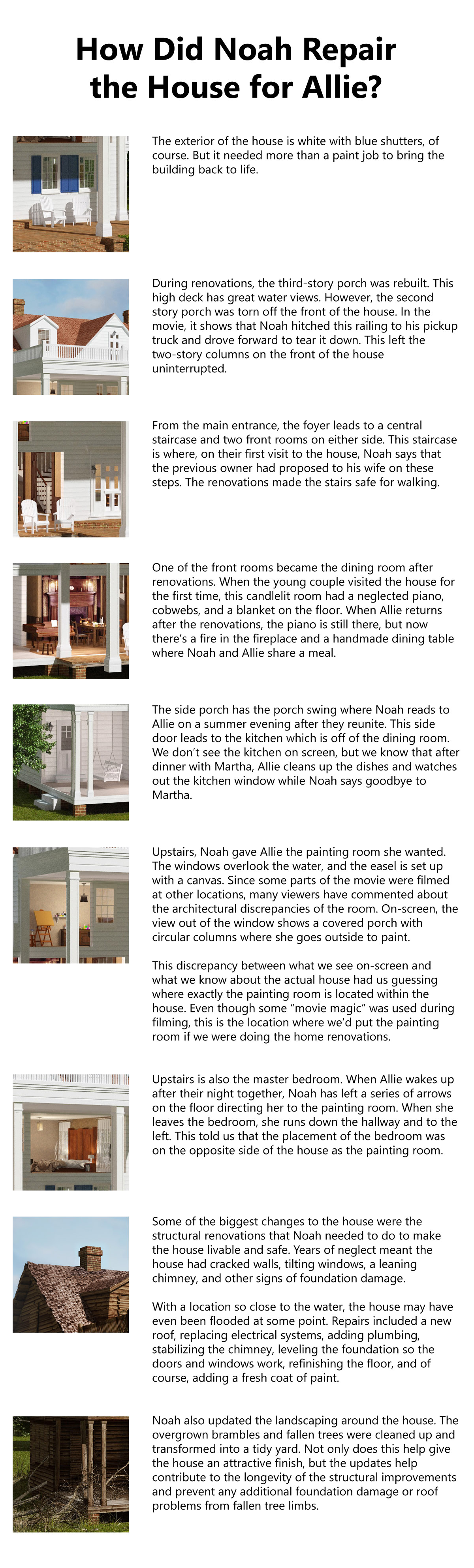
They spent a fortune making a perfectly good house look like it was rotting. They added "distressed" siding, fake peeling paint, and overgrown weeds to make it look like a place that hadn't seen a paintbrush since the Great Depression. They basically "anti-renovated" it. Then, as the movie progresses and Noah "fixes" it, they simply removed the fake layers to reveal the beautiful home underneath. It’s a clever trick. The blue shutters, the side porch, the pristine white finish—that was the house’s "natural" state being restored for the screen.
The architectural style is classic Southern Federal. It’s got those tall, symmetrical windows and the heavy influence of Greek Revival in the columns. It screams "Old South," which is exactly why it worked for a story set in the 1940s.
Fun fact: That wasn't the only house
While the Martins Point Plantation house is the primary Notebook house we all remember, the movie used other iconic Charleston spots. Boone Hall Plantation served as Allie’s family’s summer home. You might recognize the "Avenue of Oaks" there—it’s that long, stunning driveway with the moss-covered trees. If you’re doing a pilgrimage, you really have to see both. Boone Hall is open to the public; Martins Point is not.
Why we can't stop talking about this specific house
Why does this house rank so high in the pantheon of movie homes? It’s up there with the Home Alone house or the Father of the Bride cottage.
Maybe it’s the symbolism. In the story, the house is Noah’s physical manifestation of his love for Allie. He told her he’d buy it. He told her he’d fix it. He even followed her specific, somewhat demanding floor plan requests—like the room overlooking the river so she could paint.
When he finally finishes it, the house becomes a beacon. It’s why Allie sees it in the newspaper and loses her mind. It wasn't just a building; it was proof that he never moved on. In a world of fast-paced dating and disposable everything, the idea of a man spending years hammering nails into a house just to keep a promise is... well, it’s a lot. It’s a vibe.
The "Notebook House" aesthetic in modern design
You’ve probably seen the "Coastal Grandmother" or "Southern Charm" trends on Pinterest. A huge chunk of that DNA comes from this movie.
- The Blue Shutters: Specifically that soft, historical blue. It’s not navy, and it’s not baby blue. It’s a weathered, slate-adjacent tone that pops against white siding.
- The Wrap-Around Porch: Deep porches are a staple of Lowcountry architecture because they provide shade and catch the breeze. In the movie, they provide a place for tension-filled conversations.
- The Painting Studio: Every hobbyist now wants a sun-drenched room with large windows.
Real-world details you might have missed
The house wasn't built for the movie. It dates back to the 1800s. It has survived hurricanes, the humidity of the South Carolina coast, and the sheer weight of being a cinematic landmark.
Interestingly, the interior shots weren't all filmed inside the actual house. While the exterior is the star, movie sets often use "stages" for the interiors to allow for better lighting and camera movement. However, the production design was so seamless that you’d never know you weren't actually standing in a 19th-century hallway.
Seeing the area for yourself
If you're planning a trip to find the Notebook house vibes, don't just stick to Wadmalaw Island. Charleston is the real heart of the film.
- The American Theater: This is on King Street. It’s where Noah and Allie had their first date and danced in the street. It still looks almost exactly the same.
- Cypress Gardens: This is where the famous swan boat scene happened. Fun fact: The swans weren't actually native to that swamp. The crew had to bring them in and train them to follow the boat. If you go there today, it’s beautiful, but don't expect a thousand swans to greet you.
- The Old Village in Mt. Pleasant: This area stood in for the town of Seabrook. It has that quiet, timeless feel that makes you want to wear a sundress and eat an ice cream cone.
Sorting out the misconceptions
One of the biggest myths is that you can stay in the house as a bed and breakfast. You can't. Every few years, a viral post goes around claiming it’s on Airbnb. It’s not. It’s a private family home. People actually live there, eat breakfast there, and probably get really tired of people taking photos from the end of their driveway.
Another misconception? That the house was built specifically for the film like the one in The Big Fish. Nope. It was a renovation of a historical site. The "rebuilding" you see on screen was a mix of clever carpentry and removing the "ugly" layers the art department had added.
What you can do if you're obsessed with the look
Since you can't buy the actual house (it's worth millions and isn't for sale), most people settle for recreating the look. Architects in the South still get requests for "The Notebook Porch."
If you're looking to bring that energy to your own home:
- Look for "Haint Blue" paint for your porch ceiling. It's a Southern tradition meant to ward off spirits, and it's exactly what you see in many Lowcountry homes.
- Invest in oversized rocking chairs.
- Focus on "symmetry." The Federal style is all about balance.
The lasting legacy of a pile of bricks and wood
It’s rare for a piece of real estate to hold such a firm grip on the public consciousness. We see houses in movies every day, but we don't always remember the floor plan. We don't always remember the color of the shutters.
The house from The Notebook is different because it represents a specific kind of dedication. It’s the "Old House" soul—the idea that something broken can be made beautiful again if you're willing to put in the work.
Whether you’re a fan of the romance or just a fan of really good architecture, the Martins Point Plantation house remains a stunning example of Southern history. It’s a reminder of a time when houses were built to last, and stories were built to make us cry.
Actionable steps for fans and travelers:
- Visit Boone Hall Plantation: If you want the "Notebook experience" without trespassing, this is your best bet. It's open for tours and captures the Allie Hamilton lifestyle perfectly.
- Check out Cypress Gardens: You can actually rent a boat and row through the same swamp area as Noah and Allie. It’s located in Moncks Corner, SC.
- Research Lowcountry Architecture: If you're building or renovating, look into the "South Carolina Federal" style to get those specific proportions and porch details.
- Respect Private Property: If you do drive out to Wadmalaw Island, stay on the public roads. The best views of the house are often from the water, so consider a boat tour of the Toogoodoo River.