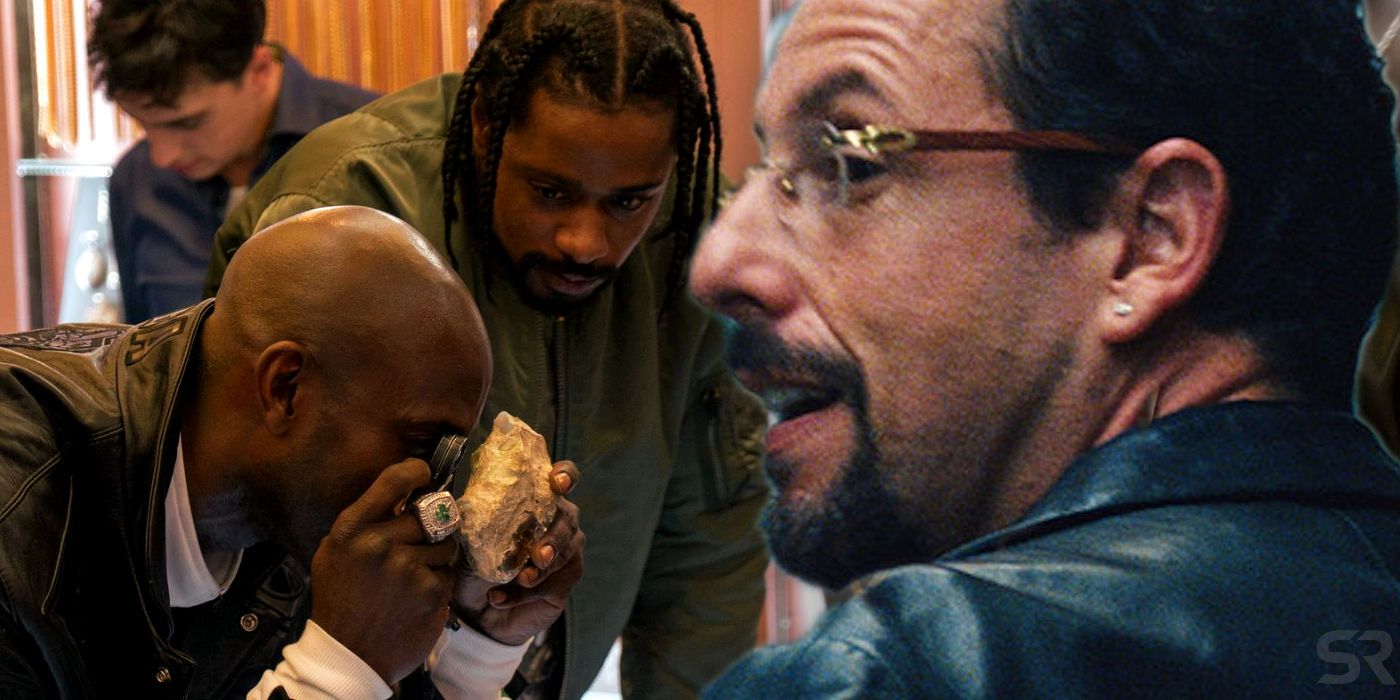
Howard Ratner is a degenerate. Let’s just start there. If you’ve seen the Safdie brothers' 2019 masterpiece, you know that the adrenaline doesn’t just pulse through the screen—it practically punches you in the throat for two hours. But it’s that final, bloody moment that leaves everyone staring at the credits in a state of absolute shock. The uncut gems ending explained isn't just about a guy getting shot; it’s about the inevitable physics of a life built on "leaning in" to the void. Howard finally won. That's the tragedy. He actually hit the parlay, and in the world of high-stakes gambling and Diamond District debt, winning is sometimes the most dangerous thing you can do.
People talk about this movie like it’s a thriller. It’s actually a horror film where the monster is Howard’s own brain. By the time we get to those final frames, Howard has trapped his loan shark brother-in-law, Arno, and the terrifyingly silent Phil in a glass vestibule. He’s forced them to watch his life-or-death bet on Kevin Garnett and the Boston Celtics. It is pure, unadulterated chaos.
The Bet That Sealed the Fate
To understand why things ended the way they did, you have to look at the math of the bet. Howard didn't just put money on a game; he bet his entire existence on a black opal that he believed had mystical properties. He sold the opal to Kevin Garnett for $165,000—after a series of frantic, self-inflicted hurdles—and instead of paying off the people who were literally threatening to kill him, he gave the cash to his mistress, Julia, to fly to Mohegan Sun.
He placed a massive parlay: Celtics to win the tip-off, Garnett to hit over on points and rebounds, and the Celtics to win the game.
It hit. All of it.
The payout was roughly $1.2 million. In that moment, Howard is at his peak. He’s vibrating. He’s screaming at Arno and Phil through the glass because he thinks the money fixes everything. He thinks the win justifies the madness. But the uncut gems ending explained through Phil’s perspective is much simpler: Phil doesn't care about the money. He cares about the disrespect. Phil is a professional collector who has been locked in a cage like an animal for hours. When Howard finally opens that door, he expects a celebration. He gets a bullet to the face instead.
Why Phil Pulled the Trigger
A lot of viewers ask, "Why would Phil kill him if the money was right there?" Honestly, it’s about the hierarchy of the streets. Arno, the guy Howard actually owed, didn't want him dead. Arno wanted his points. He wanted his vig. But Arno lost control of his muscle.
Phil represents a different kind of commerce. He represents the "fuck you" tax. Howard spent the entire movie treating these dangerous men like annoying bill collectors he could skip out on with a clever lie. He made them wait in cars, he hid from them, and finally, he trapped them in a glass box while he gloated about a basketball game. For Phil, the money wasn't worth the humiliation anymore. Shooting Howard—and subsequently shooting Arno—was an act of reclaiming power. It was nihilism meeting greed.
The Cosmic Connection of the Black Opal
The Safdie brothers bookend the film with two very specific shots. We start inside the microscopic world of the black opal, which transitions into the interior of Howard’s colon during a colonoscopy. We end by zooming into Howard’s bullet wound, back into the cosmic structure of the gem.
This isn't just "cool" cinematography. It’s a statement on the circular nature of Howard’s greed. The opal is old. It’s ancient. It’s "uncut." It represents a raw, geological desire that humans have been killing each other over for centuries. Howard thought he owned the opal, but the opal actually owned him. Kevin Garnett felt the "vibe" of the rock, using it to fuel his performance on the court. Howard just used it as a chip in a game he was never meant to win.
The Tragedy of Julia and the Bag
While Howard is bleeding out on the floor of KMH Gems & Jewelry, Julia is at the casino, surrounded by bags of cash. She is the only one who actually "wins." But what does she win? She’s a young woman in a hotel room with over a million dollars in cash and a dead boyfriend she doesn't know is dead yet.
The irony is staggering.
Howard’s wife, Dinah, played with a perfect, weary coldness by Idina Menzel, had already checked out. She told him to his face she wanted a divorce. Howard’s family life was a hollow shell. His only "real" connection was Julia, and he sent her away so he could chase one last high. The uncut gems ending explained as a cautionary tale shows that even when the money shows up, there's no one left to share it with who isn't tainted by the chase.
Realism in the Diamond District
The Safdies spent years researching the 47th Street jewelry scene. They used real players from the district, like Mitchell Wenig and Marshall Levinsky, to ground the film in a gritty, tactile reality. This wasn't some Hollywood version of New York; this was the high-blood-pressure reality of a middleman.
Howard is a middleman. He doesn't create anything. He buys low, sells high, and borrows from Peter to pay Paul. In the real jewelry world, your word is your bond. Howard’s word was worth zero. That’s why the ending feels so earned. You can only "triple-down" so many times before the math catches up to you.
What Most People Get Wrong About the Ending
People often think Howard was a genius who got unlucky. That’s wrong. Howard was a lucky man who pushed his luck until it broke.
- He had the money to pay Arno multiple times.
- He chose to gamble it instead.
- He saw the danger and mistook it for "energy."
The ending wasn't a fluke. It was the only possible conclusion for a character who refuses to accept a "win" and go home. For Howard, the win wasn't the money—it was the feeling of being right when everyone else said he was wrong. He died with a smile on his face because, in his mind, he proved them all wrong. He beat the odds. The fact that he didn't live to spend the money is almost secondary to him.
Practical Takeaways from Howard's Downfall
If you're looking for the "so what" of this chaotic ending, it's about the distinction between calculated risk and self-destruction. Howard Ratner is a case study in "sunk cost fallacy." He kept throwing good energy (and money) after bad, hoping the next big score would erase the previous mistakes.
- Recognize the "High": Howard wasn't addicted to money; he was addicted to the dopamine spike of the gamble. If you find yourself making decisions based on the "rush" rather than the logic, you're in the Ratner Zone.
- Know Your Exit: A true professional knows when to take the win. Howard’s inability to walk away when he was "up" is what ultimately put the gun to his head.
- Respect the Stakes: Howard treated life-threatening debt like a game of tag. In the real world—and in the Safdies' New York—actions have finality.
The uncut gems ending explained simply is this: You can't trap the world in a glass box and expect it not to break its way out. Howard won the bet, but he lost the war. If you're looking for a happy ending, you're watching the wrong movie. If you're looking for a brutal, honest look at the cost of obsession, Howard’s bloody floor is exactly where the story had to end.
For your next watch, pay close attention to the background noise. The overlapping dialogue isn't just a stylistic choice; it's the sound of Howard's walls closing in long before Phil pulls the trigger. Go back and watch the opening sequence again; the connection between the mine in Ethiopia and the shop in New York tells you everything you need to know about how "raw" these gems really are.