You've seen him everywhere. He's on t-shirts, coffee mugs, and probably plastered all over your social media feed every time a new Bethesda game gets announced. He has that bright blonde hair, a winning smile, and he's giving you a confident thumbs up while dressed in a blue and yellow jumpsuit. Most people call him the Fallout thumbs up guy, but if you want to get technical, his name is Vault Boy.
He is the face of the apocalypse.
It’s honestly kinda weird when you think about it. Vault Boy isn't a character you actually meet in the wasteland. He’s a mascot. He’s the corporate "everything is fine" guy for Vault-Tec, the shadowy company that built the underground bunkers. While people are literally melting or turning into ghouls, this cartoon guy is smiling like he just won the lottery. That contrast is exactly why he became an icon. But there is a massive rumor about that thumb—one that has been debated in Reddit threads and gaming forums for decades—and the truth is actually much simpler than the internet wants you to believe.
Why the Fallout Thumbs Up Guy Isn't Who You Think
Let’s clear something up right away: Vault Boy is not Pip-Boy.
Seriously.
Even though the wearable computer on your wrist is called a Pip-Boy, the blonde mascot is Vault Boy. The actual "Pip-Boy" mascot exists, but he looks different—he has peaked hair and a slightly more pointed face. Somewhere along the line, the names got tangled, and now even casual fans get them swapped. It doesn't help that Vault Boy is the one who pops up on the Pip-Boy screen to show you your stats.
He was originally created by Leonard Boyarsky, one of the key minds behind the original 1997 Fallout. Boyarsky wanted something that captured the aesthetic of "Rich Uncle Pennybags" from Monopoly mixed with 1950s instructional films. The goal was to make the apocalypse feel like a consumer product. Tramell Ray Isaac ended up drawing the first iterations. They wanted a mascot that felt dangerously optimistic. It’s that "duck and cover" energy—the idea that if you just follow the rules and keep a positive attitude, you’ll survive a direct hit from a multi-megaton warhead.
Spoiler: You won't.
The Thumb Myth: Measuring Mushroom Clouds
If you’ve spent five minutes in a Fallout lore community, you’ve heard the theory. It’s the "Rule of Thumb."
The story goes like this: In the 1950s, the US government supposedly taught children that if they saw a nuclear explosion, they should hold out their arm and stick up their thumb. If the mushroom cloud was smaller than their thumb, they were in the "safe zone" and should start running. If the cloud was bigger than their thumb? Well, they were already dead.
It sounds brilliant. It fits the dark, cynical world of Fallout perfectly. It adds a layer of grim "hidden" meaning to the Fallout thumbs up guy and his signature pose.
There’s just one problem. It’s totally fake.
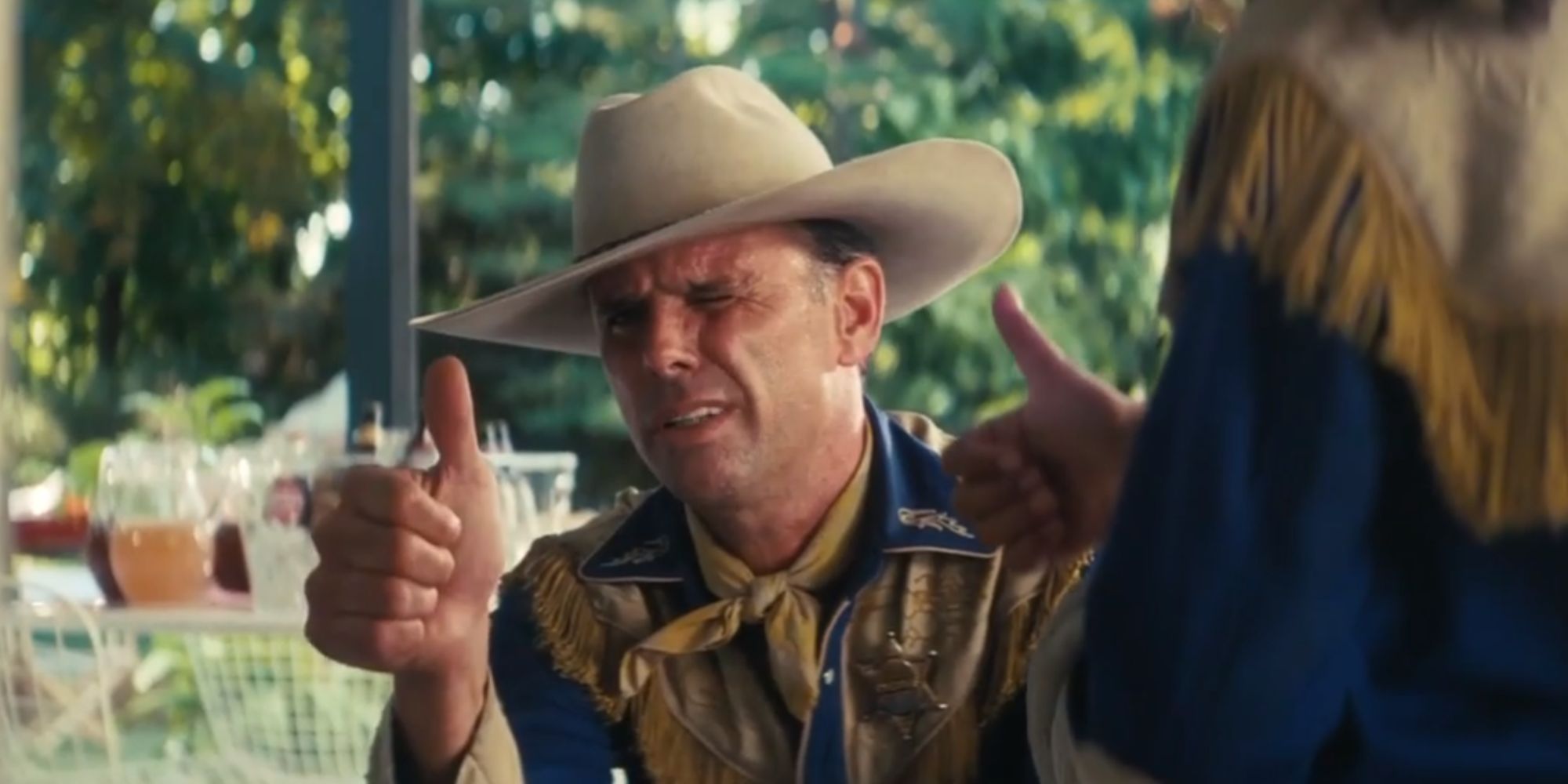
I’m not saying the theory isn't popular—it’s everywhere. It even showed up in the first season of the Fallout TV show on Amazon Prime, where Cooper Howard (played by Walton Goggins) explains the concept to his daughter. Because it appeared in the show, a lot of people now accept it as "canon."
But here’s the reality check. Brian Menze, the artist who has drawn Vault Boy for years, has explicitly stated that he just wanted the character to be giving a positive thumbs up. There was no secret "nuclear measurement" intent when the art was created. Furthermore, real-world nuclear safety experts and historians have pointed out that the "Rule of Thumb" was never actual civil defense policy. If you see a mushroom cloud on the horizon, the size of your thumb is the least of your worries. You’re dealing with thermal radiation, prompt gamma rays, and impending fallout. A thumb isn't a Geiger counter.
Yet, the myth persists. Why? Because we love the idea that even the mascot's smile is a lie.
The Evolution of an Icon
Vault Boy didn't start out as a global superstar. In the original Fallout, he was mostly there to illustrate your perks and skills. If you took the "Small Frame" trait, he’d look skinny. If you were "Radiated," he’d be glowing.
As the series moved from the isometric roots of Black Isle Studios to the massive 3D worlds of Bethesda Game Studios, the Fallout thumbs up guy became the glue holding the franchise together. In Fallout 3, he became a collectible in the form of Bobbleheads. Suddenly, players weren't just looking at him in menus; they were hunting for him in the ruins of Washington D.C.
He’s the ultimate marketing tool because he can represent anything.
- Need to show a player they've been crippled? Draw Vault Boy with a broken leg and a smile.
- Need to explain a complex "V.A.T.S." combat system? Use a cartoon animation of him aiming at a raider’s head.
- Want to sell a $200 special edition of the game? Stick a plastic version of him in the box.
His design is actually quite complex in its simplicity. The thick linework and the specific shade of yellow (often cited as HEX #FFDE00 or similar) make him instantly recognizable even from a distance. He is a masterclass in branding. He represents the "Golden Age" of the pre-war Fallout world—a world that was actually a corporate nightmare disguised as a suburban dream.
Why We Are Still Obsessed
The Fallout thumbs up guy taps into something deeply human: the absurdity of maintaining a "brave face" during a disaster.
Think about the "This is Fine" dog meme. Vault Boy is basically the 1990s precursor to that. He is the original "everything is going wrong but I’m going to keep smiling" guy. In a world where we are constantly bombarded by news of real-world tension, environmental collapse, and economic shifts, a character that stares into the void with a wink and a thumbs up feels strangely relatable.
He also represents a specific kind of "retro-futurism." He’s what people in 1955 thought the year 2077 would look like. He’s the ghost of a future that never happened.
When the Fallout TV show dropped in 2024, interest in the mascot spiked to levels we haven't seen since Fallout 4 launched in 2015. New fans were asking: "Who is the guy in the blue suit?" "Why is he happy about the bombs?" The show leaned into this by giving the pose an origin story tied to Cooper Howard’s career as a Hollywood actor. It gave the mascot a soul, or at least a history of how his soul was sold to Vault-Tec.
Actionable Tips for Fallout Fans and Collectors
If you're looking to dive deeper into the world of the Fallout thumbs up guy, or if you're looking to start a collection, you need to know what's actually worth your time. The market is flooded with merchandise, but not all of it holds its value or captures the "true" spirit of the character.
- Check the Bobbleheads: If you are buying Vault Boy Bobbleheads, look for the "Vault-Tec" branding on the base. The ones released during the Fallout 3 and Fallout 4 eras are generally more sought after than the generic mass-produced ones found in bargain bins today.
- Understand the Perks: If you see a piece of art with Vault Boy doing something specific—like holding a magnifying glass or a chainsaw—that’s usually a "Perk" icon. There are hundreds of these. Collectors often look for specific perks like "Bloody Mess" or "Grim Reaper's Sprint."
- Separate Show Canon from Game Canon: Enjoy the "Rule of Thumb" story from the TV show because it’s great writing, but don't use it to win a lore argument with a hardcore fan of the original 1997 game. They will cite the Brian Menze interviews, and you will lose.
- Watch the Fingers: A common way to spot "off-brand" or AI-generated Fallout art is the hands. Vault Boy is traditionally drawn with four fingers (three fingers and a thumb), a classic animation trope. If you see him with five fingers, it usually means the artist didn't quite catch the vintage cartoon aesthetic.
The Fallout thumbs up guy is more than just a logo. He is a satirical take on corporate America, a reminder of the Cold War's lingering influence on our culture, and a legitimately great piece of character design. Whether he’s telling you that you’ve gained a level or simply watching as the world burns, he remains the most resilient survivor of the wasteland.
Next time you see him, just remember: he’s not telling you things are going to be okay. He’s just a drawing made by a company that already got your money before the bombs fell.
And honestly? That’s the most Fallout thing ever.
To get the most out of your Fallout experience, start by ignoring the "safe distance" myths and focus on the actual gameplay mechanics the mascot represents. Learn the "S.P.E.C.I.A.L." system—Strength, Perception, Endurance, Charisma, Intelligence, Agility, and Luck. Each of these is represented by a unique Vault Boy animation. Understanding these is the real key to surviving the wasteland, not measuring mushroom clouds with your thumb. Focus on building a character that can handle the radiation, rather than one that just smiles through it.