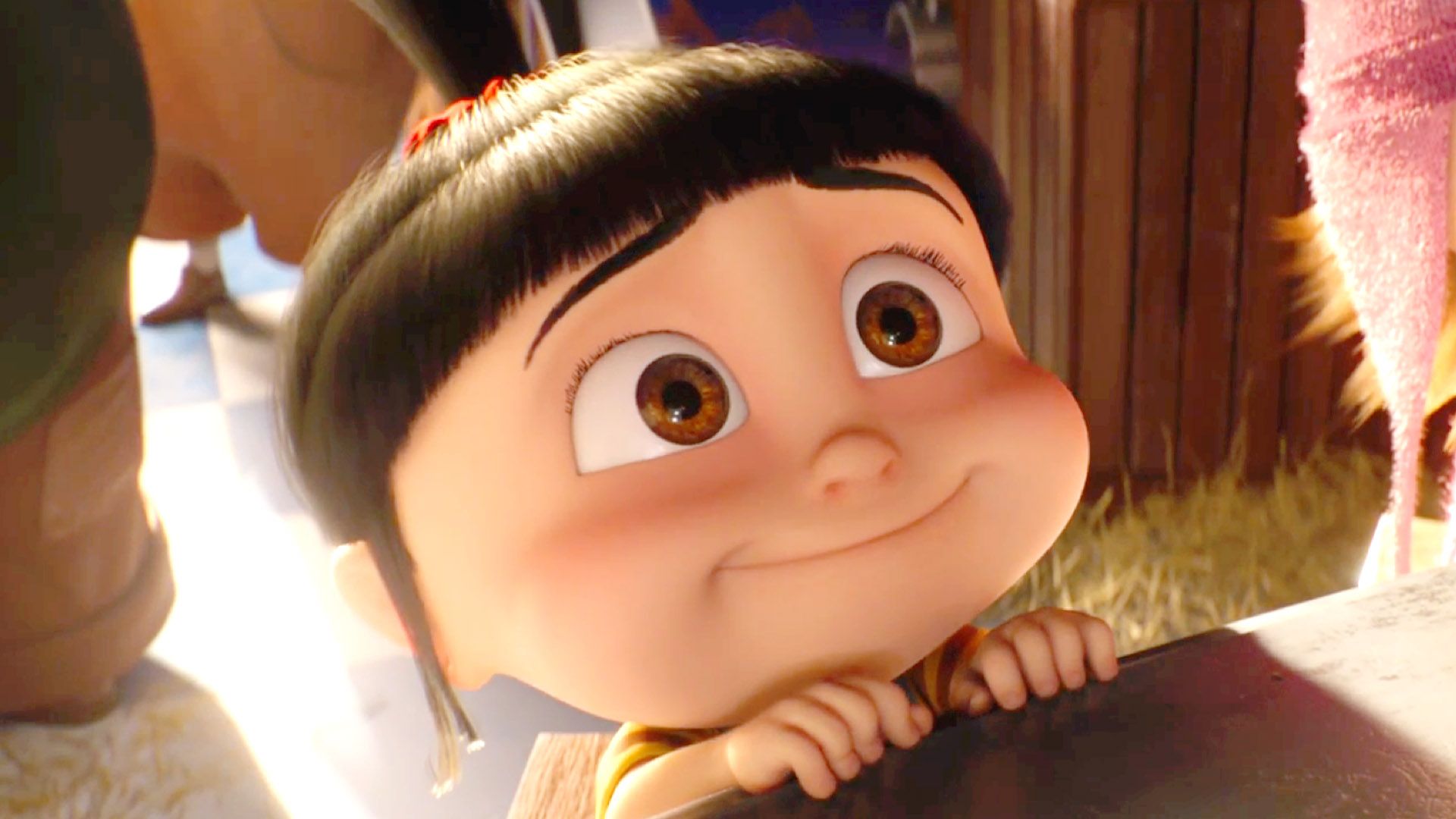
"It’s so fluffy, I’m gonna die!"
If you can hear those words in your head right now, you aren't alone. That single line, delivered with high-pitched, breathless enthusiasm, turned a small animated character into a global icon. Agnes, the youngest of the three sisters adopted by Gru, is arguably the emotional glue of the entire Despicable Me franchise. She represents the innocence that eventually melts a supervillain’s frozen heart. But when you look at the Despicable Me cast Agnes history, things get a bit more complicated than just one person standing behind a microphone for fifteen years.
Animated characters don't age, but child actors do. That’s the central tension of this franchise.
The original voice: Elsie Fisher’s lightning in a bottle
When the first Despicable Me hit theaters in 2010, Elsie Fisher was just seven years old. Honestly, it’s rare to find a performance that feels so unscripted in a big-budget studio movie. Usually, child actors are trained to hit their marks with a certain "theatrical" polish. Fisher was different. Her delivery felt like a real kid just talking.
Illumination Entertainment’s CEO Chris Meledandri has often spoken about how they recorded Fisher. Instead of making her read lines off a page in a sterile booth, the directors often let her ad-lib or recorded her while she was playing. This captured those tiny vocal imperfections—the gasps, the giggles, and the slightly rushed phrasing—that made Agnes feel authentic.
Fisher voiced Agnes in both the original film and Despicable Me 2 (2013). By the time the second movie rolled around, her voice was starting to change slightly, but she could still hit those "unicorn-obsessed" registers. However, by the time production for the third installment began, nature had taken its course. Fisher had simply outgrown the role.
Why the Despicable Me cast Agnes change happened for the third movie
Puberty is the enemy of the long-running animated franchise. By 2017, Elsie Fisher was a teenager. Her voice had deepened, and the "babyish" quality required for a character who remains permanently six years old was gone.
Enter Nev Scharrel.
Replacing a beloved voice is a massive risk. Fans are protective. If the pitch is slightly off or the cadence doesn't match, the character feels like a hollow imitation. Scharrel took over the role for Despicable Me 3 and continued through several shorts and promotional materials. She did a remarkable job mimicking the specific "airy" quality Fisher had established. Most casual viewers didn't even realize the Despicable Me cast Agnes credit had changed hands.
It’s a weird job, honestly. You aren't just acting; you're performing a tribute to a previous actor’s vocal tics. Scharrel had to maintain that specific level of hyper-fixation on mythical creatures while ensuring Agnes didn't just become a caricature of herself.
The newest voice in Despicable Me 4
As the franchise moved into its fourth main entry in 2024, the cycle repeated. Nev Scharrel had grown up. To keep Agnes sounding like the youngest child, the production brought in Madison Polan.
This isn't just about finding a kid who sounds high-pitched. It’s about "acting age." When you listen to Polan in Despicable Me 4, there’s a subtle shift back to that raw, unpolished energy of the first film. The producers seem to have realized that the closer the actor's real age is to the character, the more "human" the animation feels.
A quick breakdown of the Agnes lineage:
- Elsie Fisher: Despicable Me, Despicable Me 2. She later went on to star in the critically acclaimed Eighth Grade, proving her vocal talent was just the tip of the iceberg.
- Nev Scharrel: Despicable Me 3, Minion Scouts. She carried the torch during the mid-franchise expansion.
- Madison Polan: Despicable Me 4. The current voice, bringing back that toddler-esque spontaneity.
The "Fluffy Unicorn" effect on pop culture
Why does it matter who voices her? Because Agnes is a marketing powerhouse. The "It's so fluffy" scene wasn't just a funny moment; it became a viral meme before memes were even the primary way we consumed movies.
The character’s obsession with unicorns actually predicted (or perhaps fueled) the massive unicorn trend of the 2010s. From Starbucks Frappuccinos to Target onesies, the Agnes aesthetic was everywhere. If the voice hadn't worked—if it had felt forced or "Hollywood"—the character wouldn't have resonated. We root for Gru because Agnes believes in him. If her voice sounds fake, his redemption feels fake.
Technical challenges of recording child actors
Voice acting is grueling work. It’s not just talking. It’s screaming, crying, and laughing on command for four-hour sessions. For the Despicable Me cast Agnes performers, there’s an added layer of difficulty: the directors often use "line-reading" techniques where they say the line and have the child repeat it to get the exact inflection.
However, over-directing can kill the magic. The best moments in the Despicable Me series come from the "breathiness" of the kids. If you listen closely to the audio tracks, you can hear the kids running in place to get that out-of-breath sound for a scene where Agnes is excited. It’s a physical performance even though you never see the actor.
Dealing with the "Permanent Age" problem
One of the biggest debates among fans is whether the Despicable Me universe should let the characters age. In the Toy Story franchise, Andy grows up and goes to college. It’s a gut-punch. In Despicable Me, the girls stay roughly the same age while Gru’s life moves forward (he gets married, he has a biological son).
Keeping Agnes young means the Despicable Me cast Agnes will likely continue to be a rotating door of talent. Every 4-5 years, a new young actress will step into those overalls and ponytail. It’s a bit like James Bond or Doctor Who, but for the preschool set.
What to look for in future installments
As the franchise continues to expand—including theme park attractions and endless Minion-centric spin-offs—the role of Agnes remains the moral compass. While the Minions provide the slapstick, Agnes provides the stakes.
If you’re watching the films back-to-back, pay attention to the "S" sounds and the way the actresses handle the word "Unicorn." Each one brings a slightly different flavor. Fisher was the most naturalistic, Scharrel was the most "professional" sounding, and Polan brings a modern, energetic spark.
Actionable insights for fans and creators:
- Listen for the "Vocal Fry": As child actors get older, their voices naturally develop more "fry" or rasp. This is usually the first sign that a recasting is imminent in animation.
- The "Play" Method: If you're a creator working with child VO talent, mimic the Despicable Me style. Don't sit them in a chair. Let them move. The microphone picks up the energy, not just the sound.
- Character Continuity: Notice how the character's design hasn't changed a single pixel since 2010. The consistency of the visual allows the audience to accept the change in voice much more easily.
- Check the Credits: Always look for the "Additional Voices" or "Shorts" credits. Often, a new Agnes is tested in a 3-minute mini-movie before being given the reins for a full feature film.
The evolution of the Agnes role is a masterclass in how Hollywood manages the reality of human growth against the immortality of animation. It’s a bittersweet process, but it ensures that Agnes stays exactly who she needs to be: the little girl with the lopsided ponytail who reminds us that even the worst villains are capable of love. Or at least capable of buying a very large, very fluffy unicorn at a carnival.