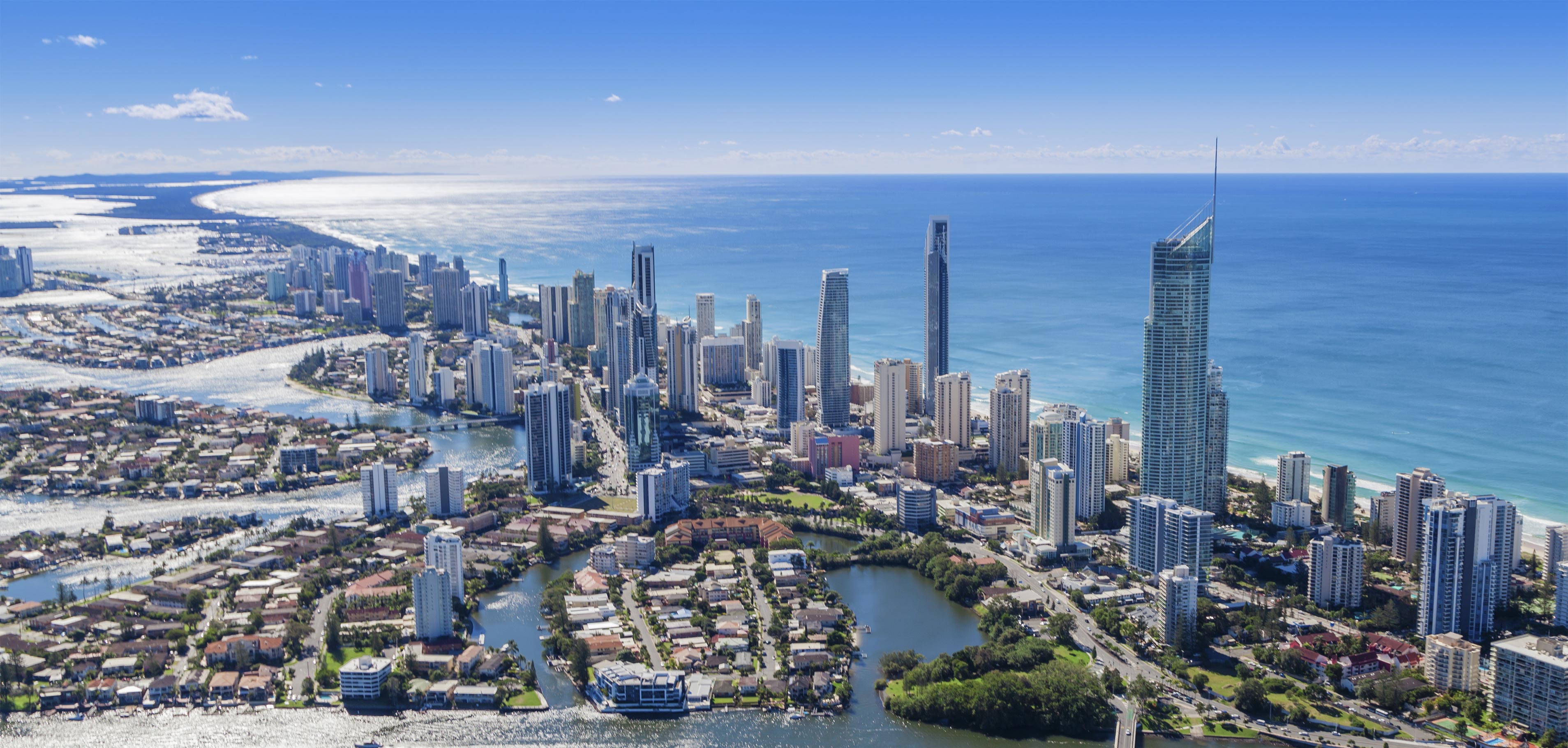
You’ve seen the postcards. The high-rises of Surfers Paradise kissing the edge of a turquoise ocean, the golden sand stretching into infinity, and maybe a stray kangaroo hopping near a golf course. It’s iconic. It’s also, if we’re being totally honest, a bit misunderstood by people who think it’s just "Australia’s Miami" or a place where retirees go to bake in the sun. Gold Coast Queensland Australia is a massive, complex, and surprisingly deep region that stretches from the New South Wales border at Coolangatta all the way up to the southern edges of Brisbane.
It’s big.
It’s loud.
And yet, if you drive twenty minutes inland, it’s whisper-quiet in a rainforest that’s been around since dinosaurs were a thing.
Most people make the mistake of staying in the "Glitter Strip" and wondering why they feel like they’re in a theme park. But if you actually want to understand this place, you have to look at the geology, the shifting tides of the property market, and the literal sand beneath your feet. The Gold Coast isn't just a city; it's a 57-kilometer stretch of coastline that serves as a case study in how humans try to tame the Pacific Ocean—and how the ocean usually wins anyway.
The Reality of Gold Coast Queensland Australia and its Shifting Sands
Most visitors think the beaches are permanent. They aren't. Not even close. The entire coastline is a massive sand-moving machine. Because of the longshore drift, sand is constantly being pushed north. If the local government didn't spend millions on sand pumping and nourishment, places like Palm Beach would basically disappear within a decade.
Surfers know this better than anyone.
The famous "Superbank"—the legendary wave that runs from Snapper Rocks through Rainbow Bay and Greenmount—is actually a man-made miracle. It exists because of the Tweed River Entrance Sand Bypassing Project. They pump sand from the mouth of the Tweed River under the seabed and dump it at Snapper Rocks. This creates that perfect, long, peeling right-hand break that professional surfers like Mick Fanning and Joel Parkinson have used as their personal playground for decades.
It's sorta wild when you think about it. One of the world’s most famous "natural" wonders is partially powered by a giant underwater vacuum cleaner.
Beyond the Surfers Paradise Hype
If you want the soul of the coast, you don't go to Cavill Avenue. You head south.
Burleigh Heads is where the locals actually hang out. It’s got this basalt headland that juts out into the sea, providing a natural amphitheater for watching the sunset. The "Burleigh Hill" ritual is real—hundreds of people sitting on the grass with fish and chips, watching the lights of Surfers Paradise flicker on in the distance. It’s a different vibe. It’s slower.
Then there’s Currumbin. While tourists flock to the big theme parks like Movie World or Dreamworld, locals are often found at the Currumbin Rock Pools or paddleboarding through the creek. The city is a series of interconnected waterways. In fact, the Gold Coast has more canals than Venice and Amsterdam combined. We’re talking over 400 kilometers of man-made canals.
This isn't just a fun fact; it defines the geography. It means thousands of homes have backyard jetties, and it also means the city faces significant challenges with rising sea levels and flood management. Living here means being intimately connected to the water, whether you like it or not.
The Green Behind the Gold: The Hinterland Secret
People forget the mountains. They really do.
The Lamington and Springbrook National Parks are part of the Gondwana Rainforests of Australia World Heritage Area. This is ancient stuff. We’re talking about Antarctic Beech trees that have genetic lineages dating back millions of years. When you stand at "Best of All Lookout" in Springbrook, you’re looking across a massive ancient caldera—the remains of the Tweed Volcano.
The contrast is jarring. You can spend your morning surfing a world-class break and your afternoon walking through a misty, temperate rainforest where the temperature drops by ten degrees.
- Purling Brook Falls: A massive 100-meter drop that looks like something out of a fantasy novel.
- O'Reilly's Rainforest Retreat: Historically significant, famous for the 1937 Stinson plane crash rescue by Bernard O'Reilly.
- Binna Burra: A gateway to some of the most rugged hiking trails in the country.
There is a tension here between development and conservation. The Gold Coast is one of the fastest-growing regions in Australia. According to the Australian Bureau of Statistics, the population is consistently booming, which puts immense pressure on these natural fringes. How do you house another 200,000 people without destroying the very "green" that makes the "gold" worth visiting? It’s a question the City of Gold Coast council wrestles with every single budget cycle.
A Sports Culture Built on Saltwater
You can't talk about Gold Coast Queensland Australia without mentioning the sporting DNA. This isn't just a place where people exercise; it's a place where professional careers are forged in the surf. The Nutri-Grain IronMan and IronWoman Series is a religion here.
Look at the history of the surf lifesaving clubs.
Clubs like Northcliffe, BMD North City, and Currumbin aren't just social hubs; they are high-performance training centers. They’ve produced more Olympic swimmers and elite watermen than many entire countries.
But it’s not all sunshine and podiums. The city has struggled to maintain professional teams in the national "big leagues" for a long time. The Gold Coast Suns (AFL) and the Gold Coast Titans (NRL) have faced massive uphill battles to capture a transient population that often cares more about being at the beach than sitting in a stadium. It’s a unique cultural hurdle. When the weather is 25°C and sunny 300 days a year, convincing someone to sit in a plastic chair for three hours is a tough sell.
The Real Cost of Living in Paradise
Let’s be real for a second. The Gold Coast has become expensive. Honestly, the days of it being a cheap getaway or a low-cost retirement haven are long gone. The real estate market here has exploded, driven by interstate migration from Sydney and Melbourne.
Suburbs like Mermaid Beach—specifically Hedges Avenue, known as "Millionaire’s Row"—now see property prices that rival the most exclusive parts of Sydney. This has pushed the "real" Gold Coast—the artists, the hospitality workers, the surfers—further inland or down across the border into New South Wales.
There’s a genuine concern about the "gentrification" of surf culture. When a beach shack that used to house five grommets is torn down to build a luxury penthouse, the vibe changes. You lose that raw, salty edge that made the coast famous in the 70s and 80s.
Technical Considerations: Navigation and Infrastructure
Getting around isn't as simple as it looks on a map. The Gold Coast Highway is the main artery, and it’s often clogged. The introduction of the G:link light rail was a game-changer. It’s a modern tram system that connects Broadbeach to Helensvale.
If you’re visiting or planning to move, here’s a breakdown of the transit reality:
- The Light Rail: Brilliant for moving between the major hubs like Surfers, Main Beach, and Southport. It’s frequent and clean.
- The M1 Motorway: It’s basically a parking lot during peak hours. If you’re commuting to Brisbane, expect a 60 to 90-minute crawl.
- Heavy Rail: The train line doesn't actually go to the beach. It stays inland. To get from the train station (like Nerang or Robina) to the ocean, you need a bus or a ride-share.
This infrastructure gap is one of the biggest complaints from locals. The city was designed for cars, but it’s outgrown them. The next decade will be defined by how well the light rail extension reaches the Gold Coast Airport in Coolangatta.
Common Misconceptions Debunked
"The Gold Coast has no culture." This is a lazy take. It’s true that it doesn't have the 19th-century bluestone architecture of Melbourne, but it has a massive burgeoning arts scene. The HOTA (Home of the Arts) precinct is world-class. Its colorful, Voronoi-inspired architecture is a statement that the city is more than just surfboards. The gallery there holds one of the best collections of regional art in the country.
"It’s always hot."
Nope. Winter mornings on the coast can be crisp. It might drop to 5°C or 8°C inland. You’ll see locals in Ugg boots and heavy puffers the moment it hits 18°C. We’re a bit soft like that.
"The water is full of sharks."
Technically, yes, it’s the ocean. But the Gold Coast has a very active (and sometimes controversial) shark control program involving nets and drumlines. While no system is foolproof, unprovoked attacks are statistically very rare given the millions of people who enter the water every year.
Actionable Steps for a Better Gold Coast Experience
If you're heading to the Gold Coast, stop doing the "tourist" things and start doing the "resident" things.
First, get a Go Card. It works for all public transport in Southeast Queensland, including the ferries in Brisbane and the trains. Don't rely on Uber; it gets expensive fast.
Second, check the swell and wind reports. Use sites like Coastalwatch or Swellnet. If the wind is from the Southeast, you want to be at a protected point break like Kirra or Burleigh. If it’s a Westerly, the beach breaks will be "offshore" and perfect.
Third, eat at the Surf Clubs. This is the ultimate local hack. Every major beach has a Surf Life Saving Club (SLSC). They are non-profits that support the lifeguards. The food is decent, the beer is cold, and they have the absolute best beachfront views in the city for a fraction of the price of a fancy restaurant.
Fourth, head to the Village Markets (TVM) at Burleigh Heads State School on Sunday mornings. This is where you find the local designers, the vintage gear, and the actual creative heartbeat of the coast.
Fifth, if you’re hiking the hinterland, always pack a raincoat and leech socks. I’m serious about the leeches. After rain, the Lamington National Park trails are crawling with them. They’re harmless but definitely ruin the "influencer" vibe of your photos.
The Gold Coast is a place of intense contrast. It’s a city built on a swamp that became a playground for the world. It’s where the ancient rainforest meets the modern skyscraper. If you only look at the surface, you’ll see a neon-lit strip of bars. But if you look at the tides, the history of the sand, and the communities tucked away in the valleys, you’ll find a region that is surprisingly resilient and endlessly fascinating. It’s not just a stop on a map; it’s a living, breathing ecosystem that somehow manages to balance glitz with grit.