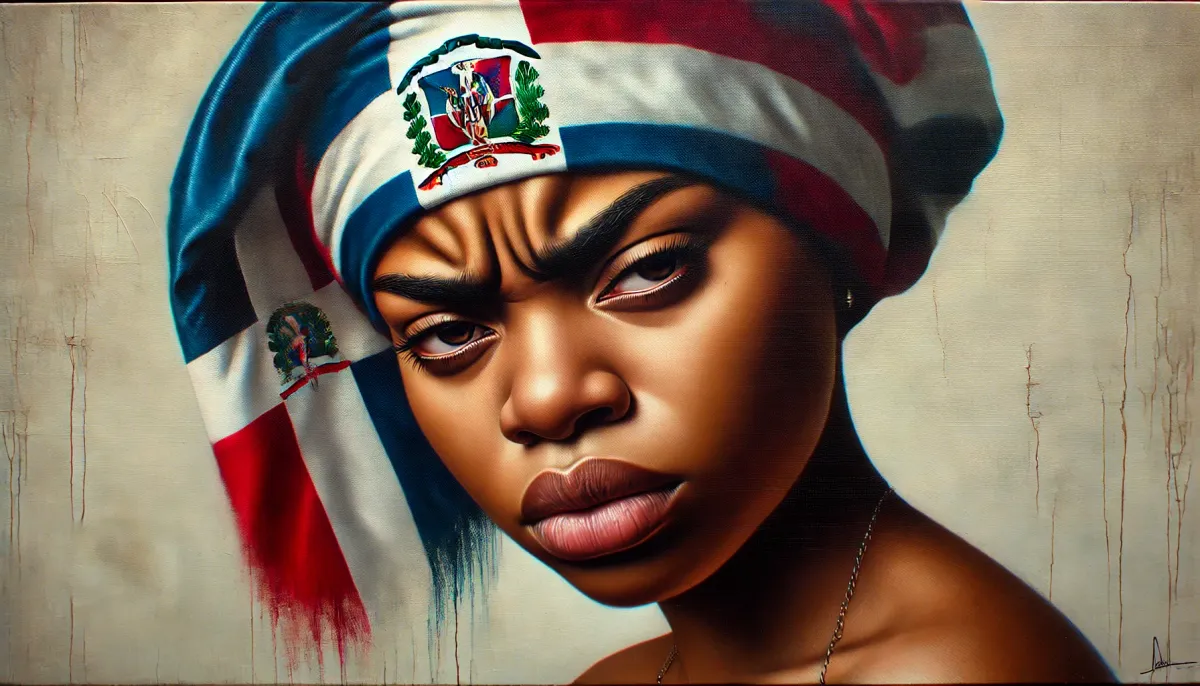
You’ve probably seen the clip. It’s been a meme for years, circulating on TikTok and Twitter whenever someone wants to poke fun at the complexities of Caribbean identity. A man looks into the camera and utters those famous words: me no black me dominican. It’s catchy. It’s funny to some. But honestly, it’s one of those phrases that carries about five hundred years of heavy lifting on its back.
Identity is messy.
If you ask a Dominican person about their race, you aren't going to get a simple checkbox answer like you might in a census office in Chicago or Atlanta. It’s just not how things work on the island. The phrase isn't just a grammatical quirk or a funny video; it is a gateway into how the Dominican Republic views itself, its history, and its neighbor, Haiti.
The History Behind Me No Black Me Dominican
To understand why someone would say me no black me dominican, you have to look at the Trujillo era. Rafael Trujillo ruled the Dominican Republic with an iron fist from 1930 to 1961. He was obsessed with "whitening" the country. He promoted a concept called Hispanidad, which basically argued that Dominicans were Spanish, Catholic, and "white-adjacent," while Haitians were African and "black."
It was a branding project. A deadly one.
Trujillo literally used makeup to appear lighter in photos. He pushed the idea that being Dominican meant being "Indio"—a term used to describe a wide range of skin tones that basically means "anything but Black." This wasn't just about vanity; it was about distance. Distance from the slave trade, distance from the revolution next door, and distance from the perceived "threat" of Blackness.
The Indio Identity
Most Dominicans today will describe themselves as Indio claro (light Indian) or Indio oscuro (dark Indian). It’s a colorist hierarchy that feels normal if you grew up in it.
When that man in the video says me no black me dominican, he is repeating a script that has been taught for generations. In his mind, "Black" is a nationality (Haitian) or a specific political identity that doesn't apply to him because he is Dominican. It’s a refusal to acknowledge African ancestry because, in the Dominican context, that ancestry has been systematically erased from the national narrative.
Why This Viral Moment Still Matters in 2026
We are seeing a massive shift right now. Younger Dominicans, especially those in the diaspora in New York, Miami, and Madrid, are pushing back. They’re looking at the phrase me no black me dominican and seeing the trauma inside the joke.
Social media has a way of stripping context away. We see a meme, we laugh, and we move on. But for Afro-Dominican activists like those at Reconoci.do, this isn't a joke. It’s a daily struggle against a system that denies their existence. When you say "I'm not Black, I'm Dominican," you are inadvertently saying that Blackness and Dominican-ness are mutually exclusive.
They aren't.
According to various genetic studies, including those published in the American Journal of Physical Anthropology, the average Dominican person carries a significant percentage of West African DNA. The history of the sugar plantations and the transatlantic slave trade didn't just vanish because a dictator wanted to look more European.
The Language Barrier
The broken English in the phrase adds another layer. It makes the speaker look uneducated or "clueless" to an English-speaking audience. This creates a weird dynamic where Americans—who have their own very specific and often rigid views on race—mock a person who is operating under an entirely different cultural framework.
Basically, it's a collision of two different ways of seeing the world.
In the United States, if you look Black, you are Black. The "one-drop rule" is still a ghost that haunts American sociology. In the Dominican Republic, race is a spectrum. You can be moreno, trigueño, jabao, or blanco. It is fluid, based on hair texture, nose shape, and socioeconomic status. Money whitens. Education whitens.
The Global Impact of the Meme
It’s interesting how me no black me dominican became a shorthand for any person of color who seems to be "denying" their roots. You see it used against Brazilians, Colombians, and even some Black Americans who claim they are "just human."
But it’s most biting when used against Dominicans.
There is a specific tension between the African American community and the Dominican community that this meme exploits. It touches on the "Black vs. Latino" divide that shouldn't exist but definitely does. When the video goes viral, the comments section usually turns into a battlefield. You have people screaming about "self-hatred" while others are trying to explain that "Latino is not a race."
Both sides are usually talking past each other.
Moving Past the Meme
So, what do we do with this? We can keep laughing at the TikToks, sure. But there’s a real opportunity here to talk about the legacy of colonialism in the Caribbean.
The phrase me no black me dominican is a symptom of a very old wound. It’s the sound of a person trying to navigate a world that told them their features were a problem. If you look at the rise of the natural hair movement in Santo Domingo—the pajón—you see the counter-narrative forming. More and more people are saying, "I am Black AND I am Dominican."
It’s not an either-or situation.
What to Keep in Mind
If you're ever in a conversation about this, remember that identity is deeply personal and historically constructed. A person saying they aren't Black isn't always a sign of malice. Sometimes it’s just the only vocabulary they were ever given.
Nuance is hard. Memes are easy.
The reality of the me no black me dominican sentiment is that it's fading, but slowly. As long as the education system in the DR continues to minimize the role of African slaves in the country’s founding, these ideas will persist.
Actionable Insights for Navigating Caribbean Identity
Understanding the weight of this topic requires more than just watching a six-second video. If you want to actually engage with this culture without falling into the traps of the meme, here is how you handle it.
- Acknowledge the Spectrum: Understand that race in the Dominican Republic is viewed as a continuum. Do not try to force American racial categories onto people who don't use them; instead, ask how they personally identify and why.
- Research the History: Read about the 1937 Parsley Massacre. It provides the necessary, albeit grim, context for why the distinction between "Dominican" and "Black" (Haitian) was enforced with such violence.
- Support Afro-Latinx Creators: Follow people who are actively deconstructing these tropes. Look for voices that celebrate the African roots of bachata, merengue, and Dominican food.
- Differentiate between Race and Ethnicity: This is the big one. Being Dominican is an ethnicity and a nationality. Black is a race. You can be both. You can be one and not the other (in the case of white Dominicans). Using the terms correctly helps clear up the "denial" argument.
- Listen More, Meme Less: Before sharing a video that mocks someone's identity, think about the systemic reasons why they might feel that way. Empathy usually beats a punchline in the long run.
The conversation is shifting. The joke is getting old. People are starting to realize that being Dominican is a beautiful, complex tapestry that includes Africa, Europe, and the indigenous Taíno people. You don't have to choose one and throw away the rest.
The man in the video might have given us a catchphrase, but the people living the reality are giving us a much deeper story about survival and reclamation.
Next Steps for Deepening Your Understanding
- Read "The Brief Wondrous Life of Oscar Wao" by Junot Díaz. It captures the "fukú" (curse) of the Trujillo era and the identity struggle of the diaspora perfectly.
- Watch the documentary "Afro-Latinos: An Untaught History." It expands the conversation beyond just the Dominican Republic to the entire region.
- Explore the "Black in Latin America" series by Henry Louis Gates Jr. The episode on the Dominican Republic and Haiti is essential viewing for anyone trying to understand the me no black me dominican phenomenon.
By looking at the roots of the phrase, we stop seeing it as a funny mistake and start seeing it as a reflection of a complicated history that is still being written. It’s about more than just a video; it’s about who gets to define themselves and on what terms.