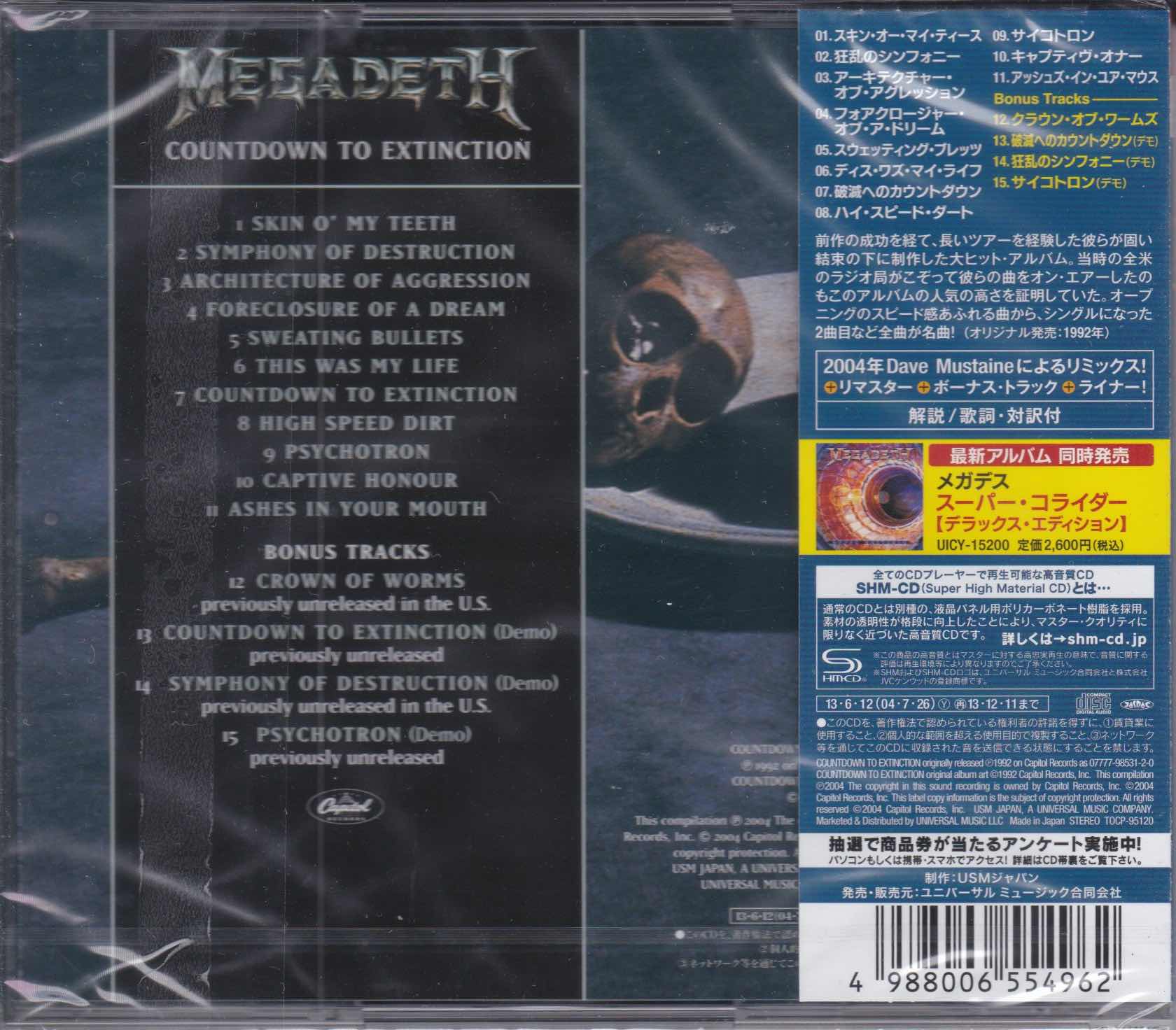
Dave Mustaine was angry. Honestly, when isn’t he? But in 1992, that anger had a very specific target: Metallica’s "Black Album." While his former bandmates were busy becoming the biggest rock band on the planet with a stripped-back, radio-friendly sound, Mustaine was hunkered down at Music Grinder Studios in Burbank. He wanted blood. He wanted a number one record. What he got was Megadeth Countdown to Extinction, an album that didn't just move units—it redefined what technical thrash metal could look like when it actually had a budget and a sense of melody.
It’s weird to think about now, but metal was in a strange spot in the early nineties. Grunge was already starting to suffocate the hair metal scene in Los Angeles. If you were a thrasher, you were either doubling down on speed or trying to find a way to survive. Mustaine, along with the "classic" lineup of Marty Friedman, David Ellefson, and Nick Menza, chose survival through precision. They slowed down. Just a little. They let the riffs breathe.
The result? A double-platinum powerhouse that debuted at number two on the Billboard 200. It only stayed off the top spot because of Billy Ray Cyrus and "Achy Breaky Heart." Imagine that for a second. The pinnacle of technical speed metal held back by a mullet and a line dance.
The Shift from Rust in Peace to Megadeth Countdown to Extinction
If Rust in Peace was a frantic, cocaine-fueled sprint through a minefield, Megadeth Countdown to Extinction was a calculated, heavy-booted march. Max Norman, the producer who had already worked with Ozzy Osbourne, brought a clinical, punchy sound to the sessions. He was notorious for being a perfectionist. He made the band play parts over and over until the timing was microscopic.
You can hear it in the opening chug of "Skin o' My Teeth." It’s not messy. It’s not "garage." It’s expensive-sounding metal.
Most people assume that "going commercial" means selling out. For Megadeth, it actually meant getting more complex in the ways that mattered. Sure, the songs were shorter. The structures were more traditional. But listen to the mid-section of "Five Magics" from the previous record and compare it to the rhythmic tightness of "Symphony of Destruction." The latter is a masterclass in restraint. It’s a simple riff, maybe the most famous one Mustaine ever wrote, but it’s played with such mechanical venom that it sticks in your brain forever.
Marty Friedman’s influence here cannot be overstated. Coming from a background in Shrapnel Records shredding and exotic scales, Marty brought a "foreign" flavor to the solos. He wasn't just playing blues-based pentatonic licks like every other guy in a denim vest. He was using half-step bends and Japanese-inspired phrasing that made songs like "Lucretia" (from the previous era) and the title track of Countdown sound sophisticated. He was the sophisticated foil to Mustaine’s jagged, punk-infused rhythm style.
Political Paranoia and the Lyrics of the Early 90s
Mustaine has always been a political junkie. In 1992, the world was shifting. The Cold War was technically over, but the Gulf War had just happened, and there was a general sense of unease about the "New World Order."
"Foreclosure of a Dream" is a great example of this. It wasn't about some fantasy dragon or a generic devil. It was about David Ellefson’s family farm in Minnesota. It was about the Reagan-era policies that hit the American heartland. It was real. It was gritty.
Then you have "Architecture of Aggression." It deals with the nature of modern warfare. Mustaine’s vocals on this track aren't his usual snarl; they feel more like a news report from a bunker. He was tapping into a collective anxiety.
- "Symphony of Destruction" looked at political puppets.
- "Architecture of Aggression" explored the "business" of war.
- "Captive Honour" took a weird, theatrical turn into the prison system.
The title track, "Countdown to Extinction," actually won the band a Genesis Award from the Humane Society. Why? Because it dealt with canned hunting and the extinction of species. It’s probably the only time a thrash metal band has been honored for being "kind to animals" while simultaneously sounding like they wanted to burn a building down.
That "Big Four" Pressure
You can't talk about Megadeth Countdown to Extinction without talking about the rivalry. By 1992, the "Big Four" (Metallica, Megadeth, Slayer, Anthrax) were all at turning points.
- Metallica had gone full mainstream.
- Slayer was sticking to their guns with South of Heaven and Seasons in the Abyss.
- Anthrax was about to swap singers.
- Megadeth was the only one trying to bridge the gap between "technical wizardry" and "stadium anthems."
Mustaine wanted the crown. He’s been vocal for decades about how being kicked out of Metallica fueled his entire career. In the Countdown era, you see him at his most focused. He stopped the heavy drug use that plagued the So Far, So Good... So What! sessions. He was healthy. He was sharp.
The production reflects that. If you listen to the original 1992 mix (not necessarily the 2004 remasters, which some purists find too compressed), the bass guitar is actually audible. David Ellefson’s plectrum-heavy attack provides a metallic "clank" that sits perfectly under the guitars. It’s a very "clean" heavy.
Why the "Classic Lineup" Worked
There’s a reason fans call the Mustaine/Ellefson/Friedman/Menza era the "Classic Lineup." It was the perfect balance of personalities.
Nick Menza was a jazz-influenced powerhouse. He didn't just play 4/4 beats; he added fills that felt like they were tumbling down stairs but always landed on their feet. His work on "Ashes in Your Mouth"—the final track on the album—is incredible. That song is essentially a peace offering to the fans who thought the band had gone too "pop." It’s six minutes of frantic riffing and dual-guitar harmonies that prove they hadn't lost their edge.
Mustaine was the leader.
Ellefson was the anchor.
Friedman was the artist.
Menza was the engine.
When they entered the studio for Countdown, they weren't just a band; they were a brand. They had the videos on MTV. They had the "Vic Rattlehead" mascot looking sharp on the covers. They were polished.
Surprising Facts and Misconceptions
A lot of people think Megadeth Countdown to Extinction was recorded in one go. Actually, the band was under immense pressure from Capitol Records to deliver something that could compete with the rising tide of alternative rock.
There's a common misconception that Marty Friedman wrote most of the melodic parts. While he definitely brought the "flavor," Mustaine wrote the lion's share of the riffs. Dave's rhythm playing is often cited by guitarists as some of the hardest to emulate because of his "spider riff" technique—using all four fingers to chord quickly across the frets to minimize string noise and maximize speed.
Also, the intro to "Symphony of Destruction"? That wasn't a synth. It was a sample of a choir, but the way it’s layered with the cracking of a whip and that iconic "thump-thump" drum beat made it sound like a literal call to arms.
Another fun detail: The "Captive Honour" spoken word section. Those aren't just random voices. The band actually had fun with the "jailhouse" dialogue. It shows a side of Megadeth that people often miss—the campy, almost cinematic theatricality. They weren't just tough guys; they were storytellers.
The Legacy of the Album in 2026
Looking back from today's perspective, this album acts as the blueprint for "Modern Metal." Every band from Avenged Sevenfold to Trivium owes a debt to the production style of this record. It proved that you could have high fidelity and high aggression at the same time.
It didn't "kill" thrash. It just gave it a tuxedo.
The album's themes of environmental collapse, political corruption, and psychological breaks ("Sweating Bullets," anyone?) are arguably more relevant now than they were in 1992. "Sweating Bullets" is essentially a four-minute song about a panic attack and schizophrenia. In a world that finally prioritizes mental health, Mustaine's lyrics about "feeling paranoid" and "talking to himself" seem almost prophetic.
How to Experience the Album Today
If you're just getting into Megadeth or you're a long-time fan looking to revisit this era, don't just shuffle it on Spotify. There’s a flow here that matters.
- Listen to the original mix first. Seek out a 1992 CD or a vinyl pressing if you can. The 2004 remasters have re-recorded parts and different vocal takes in some places because the original master tapes were damaged or lost. To hear what people actually heard in '92, you need the original.
- Watch the "Evolver" documentary. It’s a behind-the-scenes look at the making of the album. You see the tension. You see Max Norman being a drill sergeant. You see the band at their peak.
- Pay attention to the lyrics of "Ashes in Your Mouth." It’s often overshadowed by the hits, but it’s the most "Megadeth" song on the record. It bridges the gap between their 80s chaos and their 90s precision.
Megadeth Countdown to Extinction wasn't an ending for the band. It was the moment they became icons. They proved that thrash could grow up without losing its teeth. It’s a record that sounds just as sharp, just as angry, and just as polished today as it did when it was fighting Billy Ray Cyrus for the top of the charts.
What to do next
To truly understand the technical shift Megadeth made, listen to "Hangar 18" from Rust in Peace and then immediately play "Symphony of Destruction." Notice the space between the notes. That space is where the "Countdown" magic happens. If you're a musician, try learning the riff to "Psychotron"—it’s a masterclass in palm-muting and rhythmic displacement that looks easy on paper but is a nightmare to play with the same "swing" that Nick Menza and Dave Mustaine achieved.
Finally, check out the live footage from the 1992/1993 world tour. The band was a well-oiled machine, and seeing Marty Friedman play those solos live is a reminder that some things simply can't be faked by AI or modern pitch correction. It was pure, raw talent meets obsessive practice.