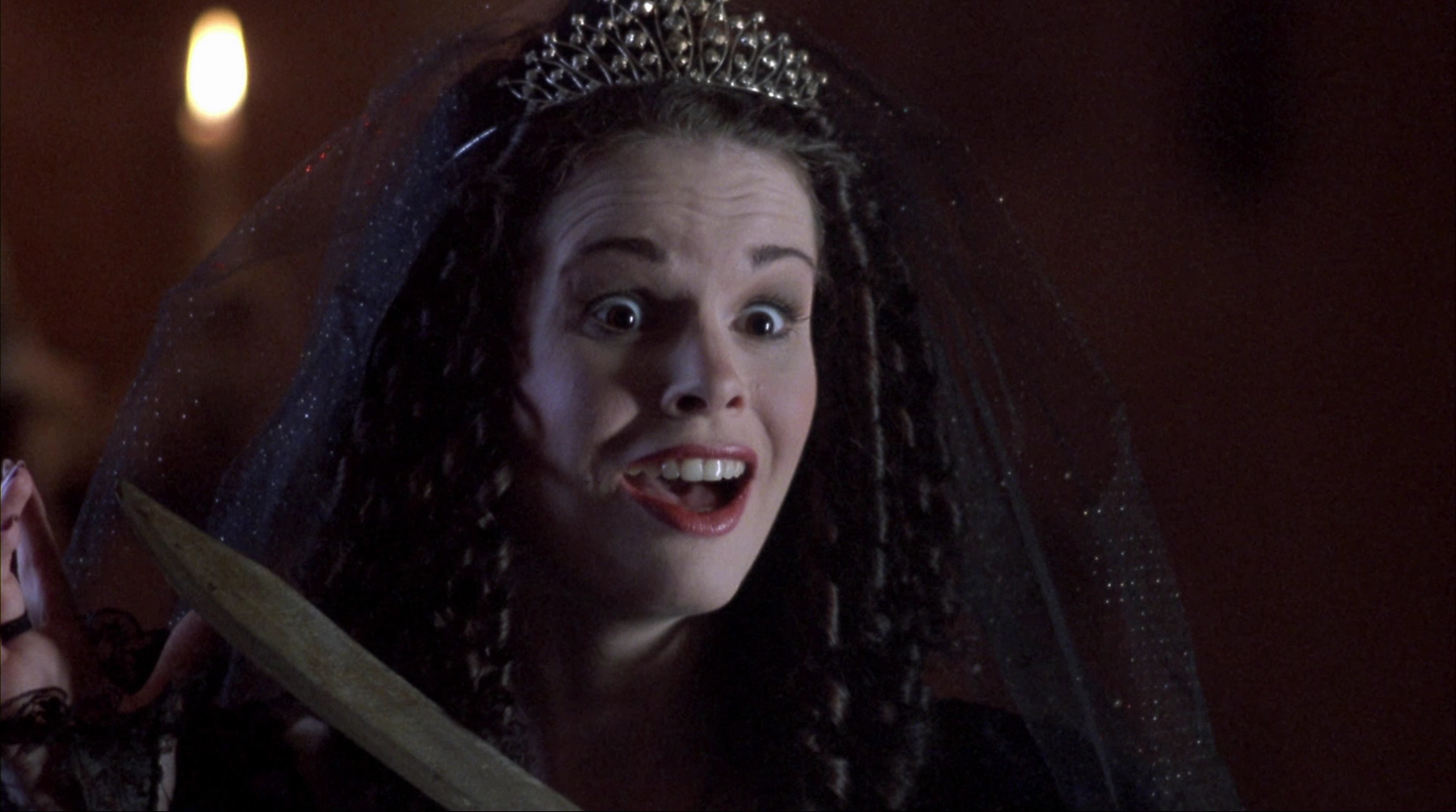
She isn't just a final girl. Honestly, she isn't even a "girl" for most of the movie. Amelia Kinkade’s portrayal of Night of the Demons Angela Franklin changed the way we look at possessed antagonists because she brought a strange, seductive grace to a genre that was usually just about gore and grunting. Most 80s slashers relied on silent hulks in masks. Then came Angela. She wore black lace. She danced to Bauhaus. She made being a demon look, well, kind of cool.
It’s been decades since the 1988 original hit theaters, but the character remains a fixture at horror conventions and in the nightmares of anyone who grew up with a VCR. Kevin Tenney, the director, lucked out when he cast Kinkade. She was a professional dancer, not just a scream queen, and that physicality is why the character works. When you watch her move, it’s uncanny. It’s not just a person in makeup; it’s something mimicking a human body with unsettling precision.
The Dance That Defined an Era
You know the scene. Strobe lights. "Stigmata Martyr" by Bauhaus blasting through the Hull House living room. Angela starts to sway. It’s easily the most famous moment in the entire franchise. While most horror movies of that era were trying to outdo Friday the 13th with creative kills, Night of the Demons took a breather to let its lead villain perform a goth-rock interpretive dance.
Kinkade’s background in dance is the secret sauce here. She didn't just flail around. Every movement was sharp, intentional, and increasingly inhuman. Fans often forget that the dance wasn't just for show; it was the literal manifestation of the demon taking hold of her soul. It marks the transition from the "weird goth girl" to the mistress of the house. If you haven't seen it in a while, go back and watch her hands. The way she contorts her fingers while staring dead into the camera is still more effective than 90% of the CGI we see in modern possession films.
Hull House and the Logic of Possession
Let’s talk about the setting. Hull House wasn't just a spooky mansion; it was a character in itself. Built on an old funeral parlor? Check. Surrounded by an impenetrable wall? Check. It’s the perfect pressure cooker for a Halloween party gone wrong.
The lore of Night of the Demons Angela is actually pretty straightforward, which is why it works. They have a seance. They look into a mirror. Something looks back. It’s the classic "don't mess with the occult" trope, but executed with a nasty, mean-spirited streak that felt different from the campy fun of Evil Dead. In this universe, the demons aren't just looking to kill you; they want to humiliate you. They use your own friends' bodies to mock you.
Angela becomes the vessel because she's the one who initiated the ritual. There's a certain irony in her character arc. She starts as the social outcast, the girl who wants to be dark and edgy, and she ends up getting exactly what she wished for—just in the most horrific way possible.
Why Amelia Kinkade is Irreplaceable
There was a remake in 2009. Shannon Elizabeth played the role. She’s a great actress, but the vibe was totally different. It lacked that specific, jagged energy that Kinkade brought to the first three films. Yes, Amelia Kinkade returned for Night of the Demons 2 and Night of the Demons 3, making her one of the few horror icons to play the same villain across multiple sequels during that era.
In the second film, the character leans more into the "Freddy Krueger" style of quips and dark humor. By the third, she’s almost a supernatural anti-hero. But through it all, Kinkade kept that specific physical language. Even when the scripts got a little sillier, her screen presence remained genuinely intimidating. She understood that a demon shouldn't walk like a person. It should glide. Or twitch.
The Makeup and Practical Effects
The 80s was the golden age of practical effects, and Steve Johnson’s work on Night of the Demons Angela is a masterclass in latex and fake blood. The transformation is gnarly. The elongated fingers, the gray, rotted skin, and those haunting eyes—it was all achieved without a single line of code.
One of the most infamous scenes involves a tube of lipstick. If you’ve seen it, you know. If you haven't, brace yourself. It’s a moment that perfectly encapsulates the "gross-out" era of horror. It pushes the boundaries of body horror while maintaining that dark, twisted sense of humor the franchise is known for. The makeup allowed Kinkade to still emote, which is why Angela feels more "alive" than many other horror villains. You can see the malice in her expression even under layers of prosthetics.
The Cultural Legacy of the Goth Queen
Before The Craft or Beetlejuice made the "goth girl" aesthetic mainstream, Angela was there. She was the original dark alternative girl of horror. Her influence can be seen in countless characters that followed, from the possession victims in The Conjuring universe to the stylized villains of modern indie horror.
The film wasn't a massive hit when it first came out. It found its life on video. It was the quintessential "sleepover movie." You’d go to the local rental shop, see that iconic cover art of the demon peeking over the wall, and know you were in for something crazy. It felt forbidden.
Practical Takeaways for Horror Fans
If you're looking to revisit this classic or dive in for the first time, here is how to get the most out of the experience:
- Watch the Unrated Version: The theatrical cuts often trim the best practical effects. To truly appreciate Steve Johnson’s work, you need the gore in all its glory.
- Context Matters: Watch it alongside other 1988 releases like Halloween 4 or Child's Play. You'll notice how much more "punk rock" Night of the Demons feels in comparison.
- The Soundtrack is Key: Track down the soundtrack. The mix of 80s synth and Bauhaus is a vibe that modern films struggle to replicate.
- Look for the Shout! Factory Blu-rays: They did a massive restoration of the trilogy with tons of behind-the-scenes info on how they brought Angela to life.
The character of Angela works because she taps into a very specific fear: the idea that the person you know—your friend, the girl next door, the host of the party—could suddenly become something completely alien. It’s about the loss of identity. And while the sequels leaned into the fun, that first film remains a genuinely creepy exploration of a Halloween night that never ends.
Angela isn't just a demon. She's the reason we're still afraid of mirrors in the dark.
Actionable Insights for Your Next Horror Binge
- Analyze the Physicality: Next time you watch a possession movie, compare the actor's movements to Amelia Kinkade's. Notice how she uses her background in dance to create a character that feels "off" even when she's standing still.
- Explore the 80s Goth Subculture: If you enjoyed the aesthetic of the film, look into the 1980s "Batcave" scene. The movie is a perfect time capsule of that specific subculture's crossover into mainstream horror.
- Support Practical Effects: Follow artists like Steve Johnson on social media or look into his books. Understanding the "how" behind the makeup makes the viewing experience of Night of the Demons much more rewarding.
- Host a Themed Viewing: This is the ultimate October movie. Pair it with a double feature of The Return of the Living Dead for the perfect 80s "party horror" vibe.