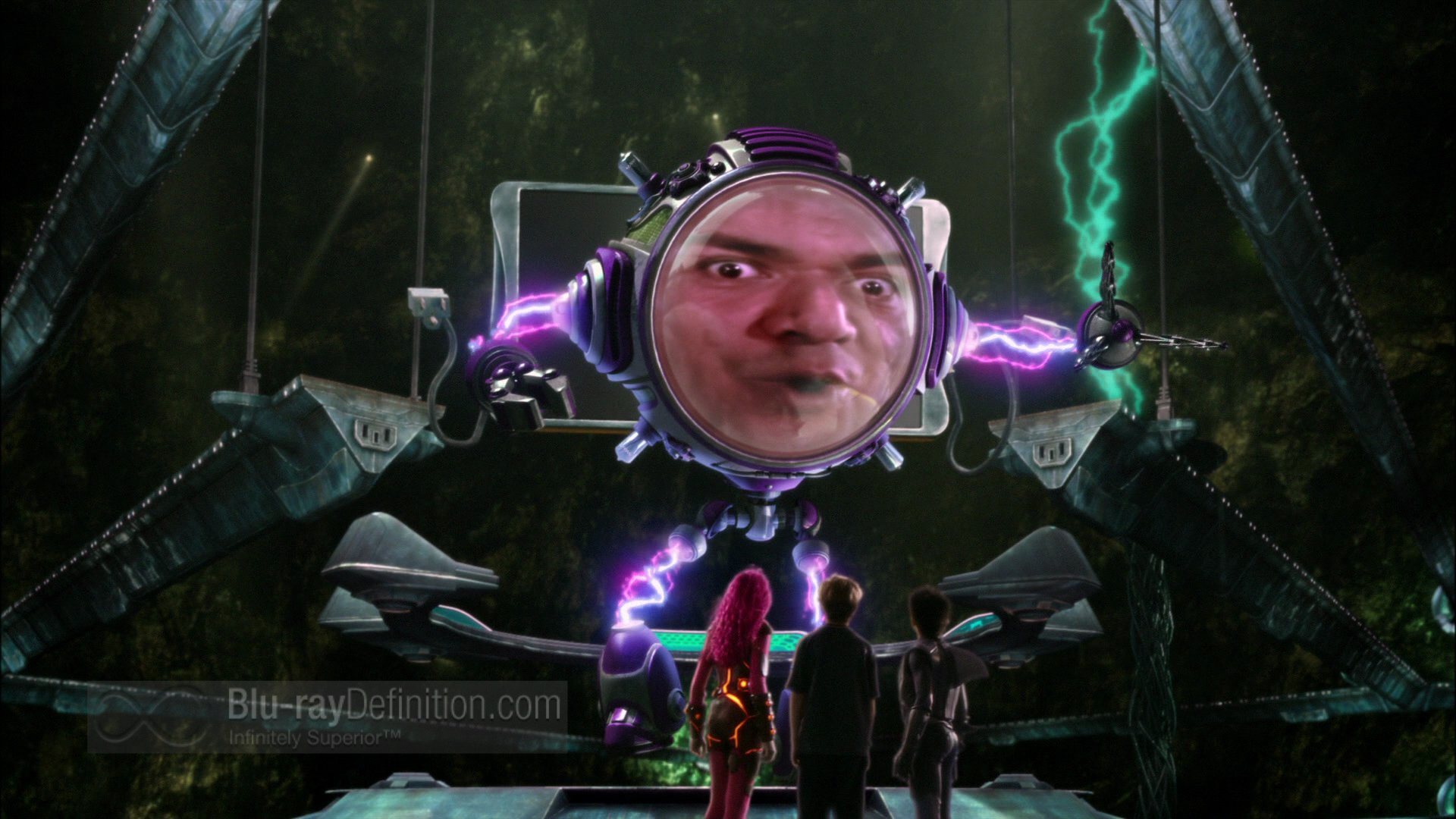
If you grew up in the mid-2000s, you remember the glasses. Those flimsy, cardboard red-and-blue spectacles that promised a portal into Planet Drool. But when you look back at Sharkboy and Lavagirl CGI today, it hits different. It’s loud. It’s bright. It looks like a fever dream rendered on a Nintendo 64 that’s about to overheat. Honestly, it’s one of the most polarizing visual styles in the history of family cinema. People call it "bad," but that’s a bit of a lazy take.
The reality of how Robert Rodriguez built that world is actually a wild case study in independent filmmaking and early digital experimentation. It wasn't just a lack of budget. It was a specific, frantic choice.
The "Garage" Philosophy of Planet Drool
Robert Rodriguez is famous for his "Ten Minute Film School" segments. He loves doing everything himself. For The Adventures of Sharkboy and Lavagirl in 3-D, he didn't go to a massive VFX house like ILM and hand over a hundred million dollars. Instead, he basically turned his Troublemaker Studios in Austin into a digital sweatshop—in the most creative way possible.
The movie was shot almost entirely on green screen. This was 2005. The technology was there, but it wasn't there yet.
Think about the sheer volume of digital assets required. Every floor, every sky, every piece of "Train of Thought" track had to be built from scratch. Because the movie was based on the dreams of his seven-year-old son, Racer Max, Rodriguez wanted it to look like a kid's drawing. That’s the nuance people miss. It’s meant to be surreal. However, when you mix high-definition (for the time) digital cameras with low-fidelity digital backgrounds, you get that "floating head" syndrome that defines the Sharkboy and Lavagirl CGI experience.
Why the 3D Gimmick Messed Everything Up
We have to talk about the Anaglyph 3D. Those red-and-blue lenses are a nightmare for color graders.
When you’re designing a movie specifically for those glasses, you have to pump the saturation through the roof. If you don't, the image looks muddy and gray once the viewer puts the glasses on. This is why Lavagirl’s pink hair looks like neon radioactive waste and the Land of Milk and Cookies looks so jarring. The Sharkboy and Lavagirl CGI wasn't just battling 2005 processing power; it was battling a 1950s viewing technology that Rodriguez insisted on reviving.
By the time the movie hit DVD and eventually streaming, the 3D was mostly stripped away. Now, we’re left looking at the raw, oversaturated assets without the filtering effect of the glasses. It's like looking at a stage play with the work lights turned on. You see the seams. You see where Taylor Lautner’s feet don't quite touch the digital ground.
The VFX Houses Involved
It wasn't just one guy in a basement, though it felt like it. Several boutiques worked on this:
- Hybride Technologies: These guys are legends now (they work on The Mandalorian), but back then, they were grinding out hundreds of shots for Rodriguez.
- CafeFX: They handled some of the more complex environmental stuff.
- The Orphanage: A defunct but brilliant studio that tried to bring some sense of physics to the madness.
Even with these pros, the timeline was tight. Rodriguez works fast. Scary fast. This isn't a Pixar production where they spend four years tweaking a single strand of hair. This was "run and gun" digital filmmaking.
The Uncanny Valley of 2005
There's a specific scene that everyone brings up: the Giant Ice Cream. It looks... oily? Smooth? It lacks texture.
In 2005, "subsurface scattering"—the way light hits skin or wax and bounces around inside it—was incredibly expensive to calculate. If you look at the Sharkboy and Lavagirl CGI today, everything has this weird, plastic sheen. It’s because the computers couldn't handle complex textures without crashing. So, the artists just used flat shaders. It’s the same reason why the "Linus" character’s Minus transformation looks so terrifyingly artificial. It’s basically a PS2 cutscene expanded to a 40-foot theater screen.
It Wasn't a Failure, It Was a Pivot
Is it "good" CGI? Technically, no. Even by 2005 standards—the same year King Kong and Star Wars: Episode III came out—it was behind the curve.
But it was a pivot toward "Digital Backlot" filmmaking. Rodriguez was proving he could make a massive, sprawling epic inside a small building in Texas. He was obsessed with the idea that a single creator could control every pixel. While the visuals in Sin City (released the same year) worked because they were moody and black-and-white, the Sharkboy and Lavagirl CGI suffered because it tried to be everything, everywhere, all at once in neon.
Interestingly, this "low-fi" aesthetic has become a vibe of its own. Gen Z has embraced the "dreamcore" or "weirdcore" aesthetic, and this movie is basically the blueprint for that movement. The artificiality is the point now. It feels like a digital memory.
Real-World Constraints
Budget: $50 million.
That sounds like a lot, but for a movie that is 90% visual effects, it’s peanuts. Spider-Man 2 had a budget of $200 million just a year prior. When you’re working with 25% of the budget and trying to create an entire planet, something has to give. Usually, that’s the "polish" phase. You get the models built, you get them moving, and you ship it.
Moving Toward a New Perspective
If you’re looking to understand the legacy of this visual style, stop comparing it to Marvel. It’s not trying to be real. It’s digital folk art.
To really grasp how far we’ve come—or how much we’ve lost—compare this to the 2020 "sequel" We Can Be Heroes. The CGI there is "better" in a technical sense. The lighting is more realistic. The textures are sharper. Yet, somehow, it’s less memorable. There’s something about the jagged, raw, and frankly bizarre Sharkboy and Lavagirl CGI that sticks in your brain. It feels like a fever dream because it was made with the logic of one.
What You Can Do Next
To truly see the evolution of this tech, watch Spy Kids 3-D and then Sharkboy and Lavagirl back-to-back. You can see Rodriguez refining the "Austin Style" of VFX. If you're a filmmaker, study the lighting. Notice how the actors are lit with high-contrast rigs to try and match the digital backgrounds—and how often they miss the mark. It’s the best lesson in why "lighting the plate" matters more than the pixels themselves.
Check out the "Making Of" featurettes on the physical Blu-ray if you can find it. Seeing the actors standing in a literal sea of green fabric puts the entire production into perspective. It wasn't just a movie; it was a $50 million experiment in digital sovereignty.