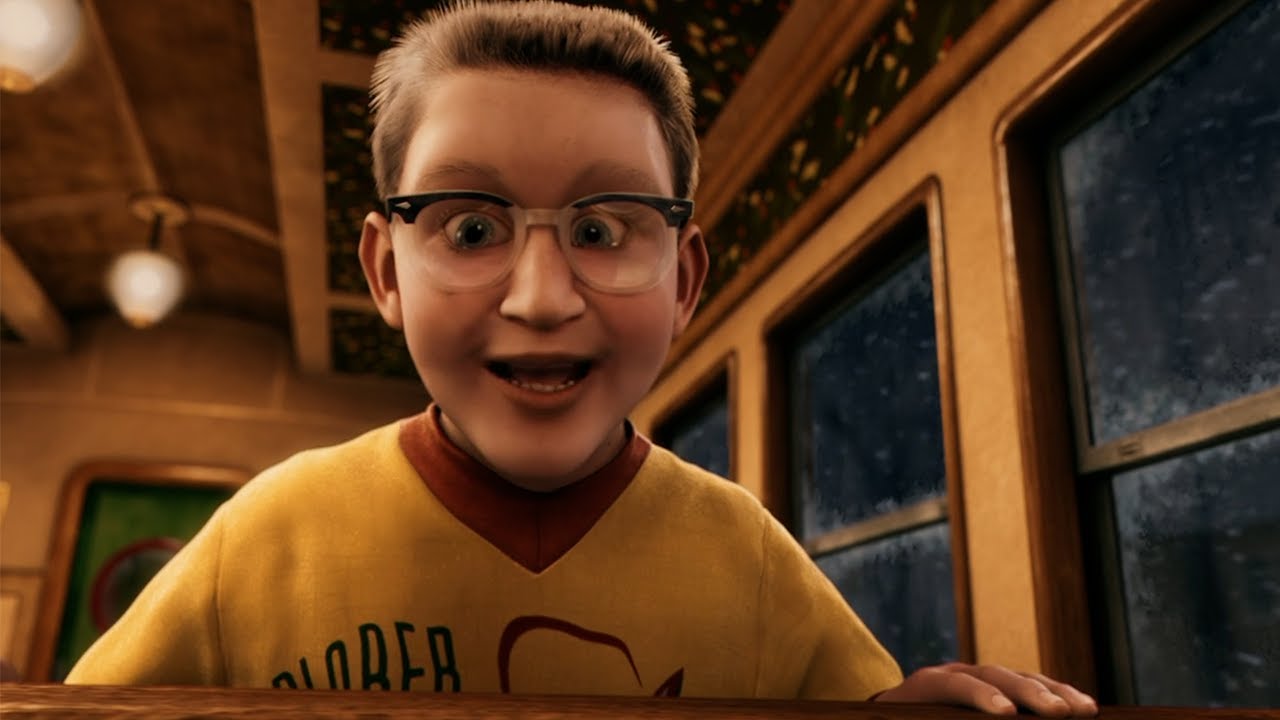
He’s the kid we all love to hate. You know the one. He’s wearing those yellow pajamas, sporting thick-rimmed glasses that seem a size too big, and he absolutely will not stop talking about the specs of a Baldwin 2-8-4 S-3 class steam locomotive. When most people think of the know it all kid polar express fans usually groan. He’s the personification of that one cousin who corrects your grammar at Thanksgiving dinner.
But honestly? There’s a lot more to this unnamed character than just being a walking encyclopedia of train facts and a general nuisance to the Hero Boy.
If you sit down and actually watch the 2004 Robert Zemeckis film—which, let's be real, is a technical marvel that occasionally dips into the "uncanny valley"—you start to realize that the know it all kid polar express isn't just there for comic relief or to be a foil. He represents a very specific type of childhood transition. He’s the kid who has replaced wonder with cold, hard facts because facts feel safer than the unknown.
The Performance Behind the "Know It All" Persona
Most people don’t realize that the know it all kid polar express was brought to life by Eddie Deezen. If that name sounds familiar, it should. Deezen is the quintessential "nerd" actor of Hollywood history. He played Mandark in Dexter's Laboratory and Eugene in Grease.
Zemeckis chose him for a reason.
Deezen has this specific, high-pitched nasal quality that makes every sentence sound like a challenge. But here’s the thing: in the motion-capture suits on set, Deezen wasn't just recording lines. He was providing the physical blueprint for the character's stiff, eager-to-please movements. The way he leans in too close to people’s faces? That’s intentional. It’s a physical manifestation of a kid who desperately wants to be seen as an authority because he doesn't know how to just be a friend.
Interestingly, while Deezen provided the voice and the performance, the character's facial structure was modeled after a different source to fit the stylized look of the Chris Van Allsburg book. This layering of performances is what gives the character that oddly specific, lingering energy. He isn't just a cartoon. He feels like a kid you actually went to school with in third grade.
Why Everyone Remembers the "Sicko Mode" Meme
You can’t talk about the know it all kid polar express in 2026 without mentioning his bizarre second life as an internet meme. A few years back, the internet decided that this kid was the perfect vessel for "Sicko Mode" mashups and ironic edits. Why?
Because he is so intensely earnest that it becomes funny.
There is a scene where he’s shouting about the train's brake system, and the sheer volume of his voice compared to the quiet, snowy atmosphere of the movie is jarring. It creates this perfect comedic friction. People started editing him into horror movies or putting heavy bass-boosted trap music over his nerdy ramblings. It kept the movie relevant for a whole new generation who maybe hadn't seen the film since they were toddlers.
But memes aside, the character serves a structural purpose in the story. He is the "logic" to the Hero Boy's "doubt." While the Hero Boy is struggling with the existence of Santa, the know it all kid polar express is obsessed with the mechanics of the trip. He’s a distraction. He’s what happens when you focus so much on the "how" that you completely miss the "why."
The Tragedy of the Yellow Pajamas
Let’s look at the "Know It All" from a different angle. Is he actually a brat? Or is he just lonely?
There’s a telling moment on the train where he gets excited about the hot chocolate. He knows the songs, he knows the routine, and he wants to be part of the group. But he doesn't know how to socialize without showing off. Every time he opens his mouth to share a fact, he’s actually saying, "Hey, look at me, I'm smart, please value me."
He doesn't have a name. In the credits, he's literally listed as "Know-It-All." Unlike Billy (the Lonely Boy) or the Hero Girl, he doesn't get a moment of deep emotional connection with the conductor until the very end. He’s the kid who gets left out of the group huddles.
When you rewatch it as an adult, you kinda feel bad for him.
He’s the only kid who seems to have done his "homework" for the North Pole. He mentions that the "First Gift of Christmas" is usually something significant. He’s prepared. But preparation is the enemy of faith in this movie. The whole point of the Polar Express is to let go of the need for proof. The know it all kid polar express is the person who would try to carbon-date the reindeer's antlers instead of just enjoying the flight.
Technical Specs: Was He Actually Right?
One of the funniest things about the know it all kid polar express is that his facts are actually mostly correct. When he starts shouting about the "Baldwin 2-8-4 S-3 class" steam engine built in 1941 at the Lima Locomotive Works, he isn't making it up.
The Pere Marquette 1225 is the real-life locomotive that the film's train was modeled after.
The sounds you hear in the movie?
The crew actually recorded the real 1225.
So, while the kid is annoying, he’s technically a genius. He’s a railfan. In the world of the movie, he represents the literal, physical world. He’s the anchor to reality. Without him, the movie might feel too ethereal, too dreamlike. You need that one kid screaming about "shearing a pin" or the "water brake" to remind you that this is a giant, heavy, dangerous machine hurtling through the mountains.
The Lesson the Conductor Teaches Him
At the end of the film, the Conductor (played by Tom Hanks, who played basically everyone else too) punches the kids' tickets. Each ticket has a word that represents what that child needs to learn.
For the know it all kid polar express, his ticket initially has two letters. By the time it’s finished, it spells out "LEAN."
This is a subtle, beautiful bit of writing. The Conductor tells him something along the lines of, "Lean is a good word. You can lean on people, or you can lean toward the truth."
Basically, the kid needs to stop standing so stiffly on his own island of facts. He needs to learn to depend on others. He needs to "lean" into the experience rather than trying to control it with his intellect. It’s a pivot from being an observer to being a participant.
How to Spot a "Know It All Kid" in Real Life
We all have a bit of this character in us. It’s that urge to correct someone when they say "ironic" but mean "coincidental." It’s the need to be the smartest person in the room because we’re afraid of being the most vulnerable person in the room.
If you’re watching the movie this year, keep an eye on his facial expressions when he isn't talking.
He’s often looking around for approval.
He wants the Hero Girl to be impressed by him.
He wants the Conductor to validate his knowledge.
When he finally gets to the North Pole and sees the elves, his reaction is one of pure, silent shock. For the first time in the movie, he’s speechless. And that’s his real arc. He moves from a place where he has all the answers to a place where he’s willing to just stand there in awe.
The Legacy of the Character
The know it all kid polar express has become a staple of holiday cinema. He isn't a villain. He’s just... a lot. But in a story about the "Spirit of Christmas," he represents the intellectual challenge of belief. He is the part of our brain that demands a spreadsheet before we’re willing to feel joy.
His presence makes the "Believe" message stronger. Because if even the kid who knows the exact boiler pressure of a 1940s steam engine can find the magic, then anyone can.
What to Do Next Time You Watch
To truly appreciate the nuance of this character, try these three things during your next viewing:
- Listen to the background audio: During the "Hot Chocolate" scene, try to pick out his voice. He’s often trying to coordinate the dancers or commenting on the service speed.
- Watch the "Ticket Punching" scene closely: Look at his face when the Conductor hands him the ticket. It’s one of the few times he looks genuinely humble.
- Check the real-life 1225 locomotive: Google the Pere Marquette 1225. It’s a real train in Owosso, Michigan. Seeing the real-life version of what he’s describing makes his obsession much more relatable. It’s a beautiful piece of engineering.
If you find yourself relating to him a little too much, don't worry. It just means you appreciate the details. Just remember the Conductor's advice: sometimes, you just need to lean into the ride and stop worrying about the shearing pins.
The movie is more than just a ride to the North Pole; it’s a lesson in how different people process the world. Some people need a song, some need a friend, and some—like our guy in the yellow pajamas—just need to know how the brakes work before they can relax.