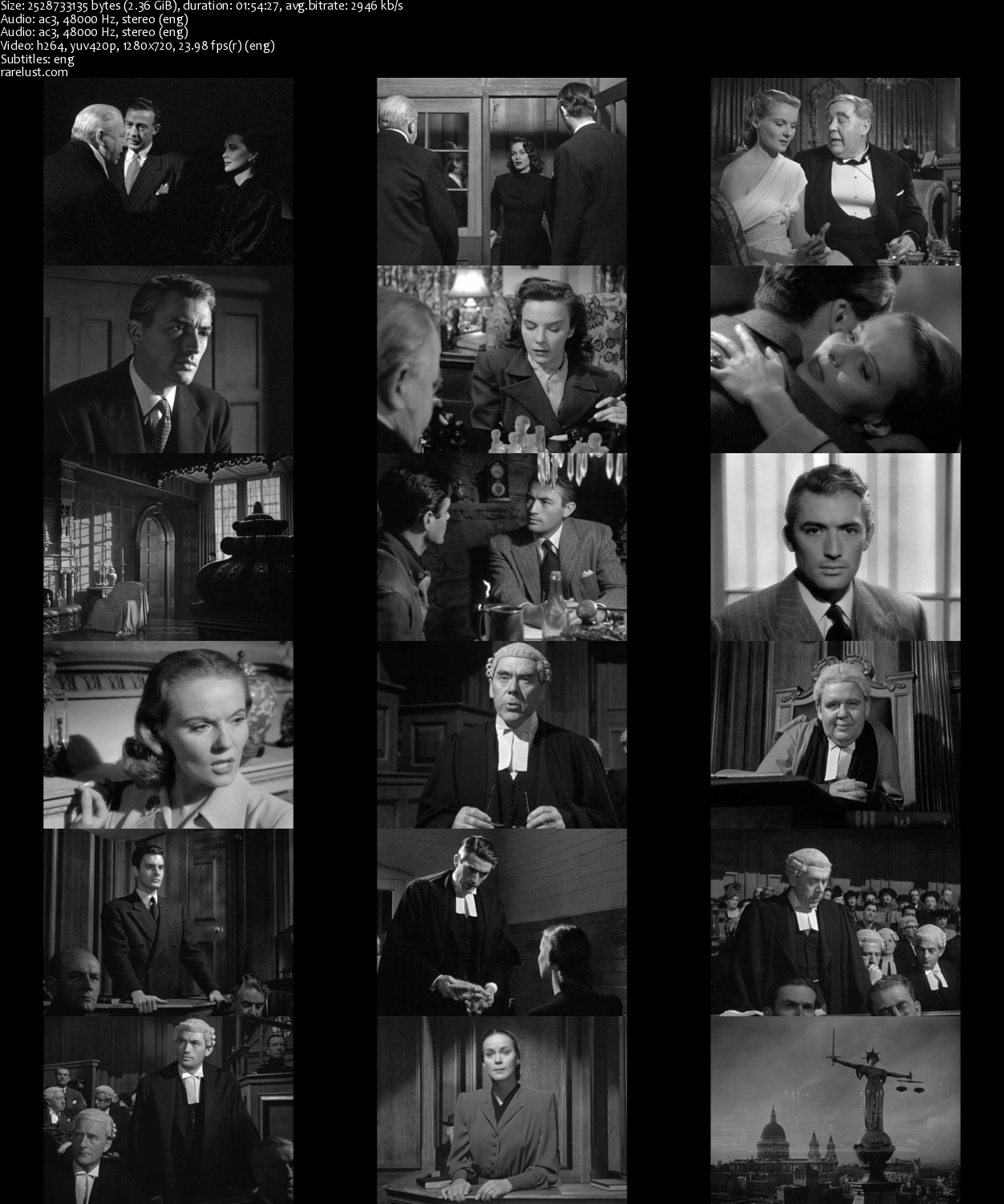
Alfred Hitchcock was annoyed. It was 1947, and he was stuck in a contract with David O. Selznick that felt more like a prison sentence than a creative partnership. Most people look back at The Paradine Case 1947 as a bit of a stumble for the Master of Suspense. It’s often called "stodgy" or "over-long." But if you actually sit down and watch it—really look at the weird, psychosexual tension humming under the courtroom drama—it’s clear something much more interesting was happening.
It wasn't just a legal thriller. It was a mess of ego, casting blunders, and a director trying to claw back control from a producer who insisted on rewriting every single line of dialogue.
The Plot That Everyone Forgets
Basically, the story follows Alida Valli (billed simply as Valli) who plays Mrs. Paradine. She’s accused of poisoning her blind husband. Enter Anthony Keane, played by Gregory Peck. He’s a high-society lawyer, happily married, or so he thinks. He takes the case and immediately falls into a weird, obsessive kind of love with his client. He becomes convinced she’s an innocent victim. He starts lashing out at anyone who suggests otherwise, especially the family’s enigmatic groom, André Latour.
Louis Jourdan played Latour. It was his first Hollywood gig. Hitchcock wanted someone earthy, someone who looked like he smelled of manure and horses—a raw, sexual threat. Selznick, being Selznick, cast Jourdan, who was way too pretty and polished for the role. This choice fundamentally broke the logic of the movie.
If you're wondering why the tension feels slightly "off" in the middle act, that’s why. The class dynamics are skewed.
A Production Nightmare in Plain Sight
The set was a literal recreation of the Old Bailey. Selznick spent a fortune on it. We’re talking $80,000 just for the courtroom set, which was insane money back then. Hitchcock, ever the technician, used a multi-camera setup that was way ahead of its time. He had cameras moving on long tracks to capture the reactions of the judge, the defendant, and the lawyer in single, sweeping takes.
But the script was a moving target. Selznick was sending memos daily. He wanted more melodrama. Hitchcock wanted more subtext. The result is a film that feels heavy. It’s a 131-minute movie that probably could have been a tight 90 minutes if they’d just focused on the obsession rather than the legal procedure.
Gregory Peck later admitted he felt miscast. He was too young, too American, and maybe a bit too "noble" for a guy who is essentially ruining his life over a woman he barely knows. You see it in his performance. There’s a stiffness there that isn't just "British reserve"—it’s an actor struggling with a character whose motivations are, frankly, a bit pathetic.
The Weird Brilliance of Charles Laughton
If there’s one reason to watch The Paradine Case 1947 today, it’s Charles Laughton. He plays Judge Horfield. He is gross. He’s a predatory, sadistic man who eats grapes while watching people's lives fall apart. Laughton brings this greasy, uncomfortable energy to the screen that makes the rest of the movie feel dangerous.
There’s a scene where he hits on Keane’s wife (played by Ann Todd) at a dinner party. It’s genuinely skin-crawling. It highlights the movie's real theme: the hypocrisy of the "respectable" upper class. The judge is a monster, the lawyer is an adulterer in his heart, and the only "honest" people are the ones sitting in the dock or working in the stables.
Why It Failed (And Why That Matters Now)
Critics at the time hated it. They expected Rebecca or Notorious. Instead, they got a talky, claustrophobic drama that didn't have a single "action" set piece. It made about $2 million on a $4 million budget. That’s a disaster in any era.
But history has been a little kinder. When you look at Hitchcock's filmography, this is the bridge. It’s where he started experimenting with the long takes he would later perfect in Rope. It’s where he explored the "cool blonde" archetype with Valli before moving on to Grace Kelly and Kim Novak.
Honestly, the movie is a masterclass in how not to cast a film, but also how to use a camera to create a sense of entrapment. The way the camera looms over Valli in the witness stand makes her look like a trapped animal, even when she's being icy and controlled.
The Ending That Still Stings
The resolution of the trial isn't a "win" for anyone. Without spoiling too much for those who haven't seen it, the truth comes out in a way that is ugly and humiliating for Peck’s character. He loses his reputation. He loses his dignity. The final shot of the film—Keane walking away, defeated—is one of the most cynical endings Hitchcock ever filmed.
It’s not a "happily ever after." It’s a "you’re lucky your wife is a saint" ending.
How to Appreciate This Film Today
If you're going to watch it, don't go in expecting North by Northwest. It’s not a thrill ride. It’s a psychodrama.
Watch for these specific details:
- The Lighting on Valli: Note how her face is often lit to look like a marble statue—beautiful but cold and unmoving.
- The Sound Design: The way the courtroom falls silent when the verdict is about to be read. It’s heavy.
- The Hands: Hitchcock was obsessed with hands in this movie. The way characters touch objects tells you more about their guilt than the dialogue does.
Moving Forward with Hitchcock
If you want to understand the evolution of the 20th-century thriller, you can't skip the "failures." The Paradine Case 1947 is the essential missing link between Hitchcock’s early British work and his peak Hollywood era.
To get the most out of your viewing, compare the courtroom scenes here to the ones in Witness for the Prosecution. You’ll see how Laughton’s performance influenced the entire genre of legal dramas for the next thirty years. Or, better yet, watch it back-to-back with Vertigo. You’ll see the exact same themes of male obsession and the "constructed" woman, just in a much rawer, less polished form.
Dig into the Selznick memos if you can find them in a library or online archive. They reveal the "war" that happened behind the scenes, proving that sometimes the greatest drama in Hollywood isn't what’s on the screen, but what’s happening in the production office. This film is the tombstone of the Hitchcock-Selznick era, and as a piece of film history, it's absolutely fascinating.