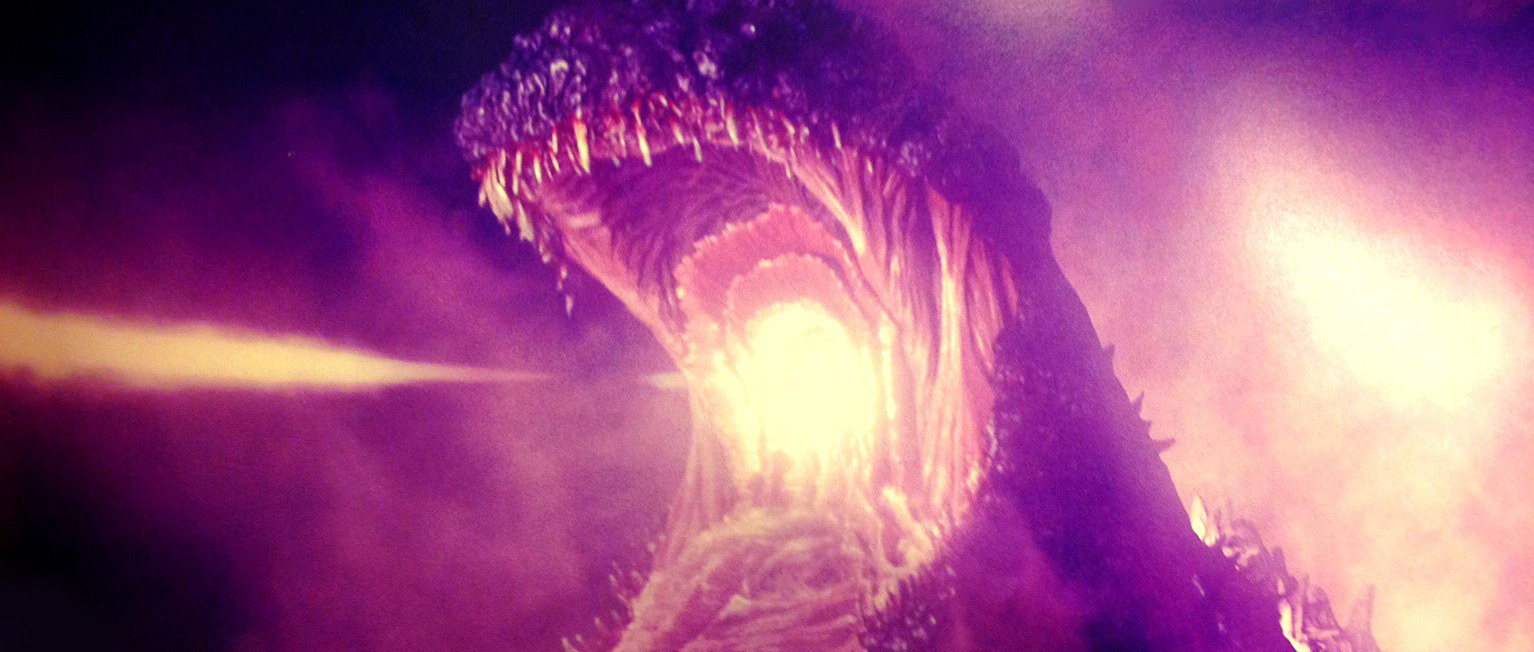
Hideaki Anno didn’t just make another monster movie in 2016. He made a horror film about bureaucracy, radiation, and the sheer, terrifying helplessness of being human in the face of a god. But if you ask anyone what they remember most about Shin Godzilla, it isn't the board meetings. It's the beam. Specifically, that haunting, violet-hued discharge that signaled a total departure from sixty years of Toho tradition.
The purple Shin Godzilla atomic breath isn't just a color swap for the sake of looking "cool." It represents a fundamental shift in how we perceive Godzilla’s power. Usually, he’s a brawler. He breathes fire or a blue laser to knock down a building or toast a rival monster. In Shin Godzilla, the breath is an agonizing biological process. It is a scream of pain.
When the creature first opens its jaw in the ruins of Tokyo, the lower mandible literally splits in two. It’s grotesque. First comes the smoke, then the fire, and finally, that concentrated needle of purple light. It’s a moment of cinematic history that still gets analyzed by VFX artists and lore junkies today because of how it subverts every expectation of the franchise.
The Science of the Purple Glow: Why Not Blue?
Traditionally, Godzilla’s breath is blue. This is a nod to Cherenkov radiation, the eerie blue light emitted when charged particles pass through a dielectric medium at speeds greater than the speed of light in that medium. It’s a real-world phenomenon you can see in nuclear reactor pools. So, why did Anno and co-director Shinji Higuchi pivot to purple?
It comes down to energy frequency. On the electromagnetic spectrum, violet light has a shorter wavelength and higher energy than blue light. By shifting the purple Shin Godzilla atomic breath further toward the ultraviolet end of the scale, the filmmakers were visually communicating that this version of Godzilla is more radioactive and more powerful than anything we’ve seen before. It is the hottest, most concentrated version of the weapon.
There is also the thematic element. Blue is heroic. Blue is the color of the "King of the Monsters" who saves the Earth from Ghidorah. Purple is the color of bruises, of royalty, and of deep, unnatural corruption. In Japanese media, purple is often associated with the "Evil Eye" or malevolent supernatural forces. When that beam slices through the B-2 Spirit bombers like they’re made of wet paper, the color choice reinforces that this isn't a protector. It’s an extinction event.
A Biological Nightmare
Most versions of Godzilla have a "breath" that is essentially a projectile. Shin’s version is more like a pressurized fluid. The sequence begins with a thick, billowing black smoke—a sign of incomplete combustion—which then ignites into a massive flamethrower. Only after the creature focuses its internal energy does it refine that flame into the thin, purple laser.
This isn't just a weapon; it's an exhaust system. Godzilla is overheating. He has to vent that energy or he’ll melt down from the inside out. This adds a layer of biological tragedy to the scene. You aren't just watching a monster attack a city; you're watching a living nuclear reactor suffer a catastrophic failure.
The Total Destruction of Tokyo: Breaking Down the Scene
If you watch the sequence closely, you’ll notice the purple Shin Godzilla atomic breath doesn't just come from the mouth. This was the big "gotcha" moment for long-time fans. As the stealth bombers drop "Bunker Buster" bombs on his back, the creature adapts in real-time. The dorsal fins begin to glow that same ominous violet, and suddenly, he’s firing individual beams from his plates.
He becomes a 360-degree point-defense system.
- The Mouth Beam: A precision tool for long-range targets.
- The Dorsal Beams: Automatic counter-measures against aerial threats.
- The Tail Beam: The final, most shocking reveal, showing that his entire nervous system is capable of channeling this energy.
The destruction isn't explosive in the way Michael Bay movies are. It’s surgical. The purple line touches a skyscraper and the building simply separates. There’s no immediate blast, just a clean cut followed by a slow, heavy collapse. It’s quiet. It’s eerie. It feels more like a natural disaster than an action movie.
Cultural Impact and the "Who Will Know" Factor
You can't talk about the purple Shin Godzilla atomic breath without mentioning the music. Shiro Sagisu’s score for this scene, a track titled "Who Will Know," features a haunting operatic vocal. The lyrics are from Godzilla’s perspective, mourning his own existence.
"If I must die, let it be naturally," the song pleads.
This creates a massive cognitive dissonance for the viewer. You are watching thousands of people die as Tokyo is turned into a sea of fire, yet the music and the visual beauty of the purple light make you feel a strange, twisted sympathy for the monster. It’s a masterclass in tone. It moved Godzilla away from being a "guy in a suit" and back to being a "God Incarnate," which is the literal translation of the film’s title (Shin can mean new, true, or god).
This specific iteration of the breath has since appeared in various forms of media, from the Godzilla vs. Evangelion crossovers to high-end collectibles. The "Atomic Breath Version" statues from companies like X-Plus or Prime 1 Studio are highly sought after precisely because capturing that translucent purple plastic is a challenge for designers.
How Shin Compares to Legendary’s Blue Flame
In the American Monsterverse movies, Godzilla’s breath is a heavy, concussive blast. It’s like a massive fire hose of blue energy. It’s designed to push, burn, and blast through solid rock. It feels physical.
The purple Shin Godzilla atomic breath feels metaphysical. It is so thin it almost looks like it isn't there, yet it cuts through steel more efficiently than a diamond-tipped saw. While the Legendary Godzilla uses his breath as a primary tool in a fight, Shin uses it as a desperate, all-consuming "clear the map" move. Once he uses it, he is drained. He enters a state of cryostasis for weeks to recover. This makes the stakes much higher. If he misses, or if the humans survive that first volley, he’s vulnerable.
It’s a glass cannon strategy on a god-sized scale.
What You Should Look For on Your Next Rewatch
If you’re heading back to watch Shin Godzilla tonight, pay attention to the transition of the jaw. Most people miss the fact that the teeth actually retract slightly to make room for the thermal energy. It's a tiny detail that makes the biology feel real.
Also, look at the ground. The purple light is so intense that it actually ionizes the air around it, creating a "halo" effect in the cinematography. This wasn't a mistake in the CGI; it was a deliberate choice to show the sheer heat of the beam.
To understand the full scope of this monster, you have to look at these three phases:
- The Overheat: Godzilla's skin begins to glow red, showing he can no longer contain the internal reaction.
- The Ignition: The shift from black smoke to orange fire, showing the start of the energy discharge.
- The Refinement: The moment the fire turns into the purple laser, signaling the highest level of concentration.
Actionable Insights for Kaiju Fans
If you're a fan of the lore or a collector, understanding the nuances of the purple Shin Godzilla atomic breath helps you appreciate the 2016 film on a much deeper level.
- For Collectors: When buying figures, check for "translucent" dorsal fins. Some cheaper models just paint them purple, but the high-end ones use clear resin to mimic the glow from the movie.
- For Artists: Notice the color grading. The purple isn't a flat "grape" color. It has a white-hot core with magenta and deep violet edges.
- For Lore Buffs: Remember that Shin is an "evolutionary" creature. The purple breath was a direct response to being hurt by American bombs. It is an adaptation, not just a built-in power.
The move to purple was a gamble that paid off. It redefined Godzilla for a new generation, proving that you can take a 70-year-old icon and still find ways to make him terrifying, beautiful, and completely unpredictable. It remains the most distinctive visual in modern tokusatsu history.