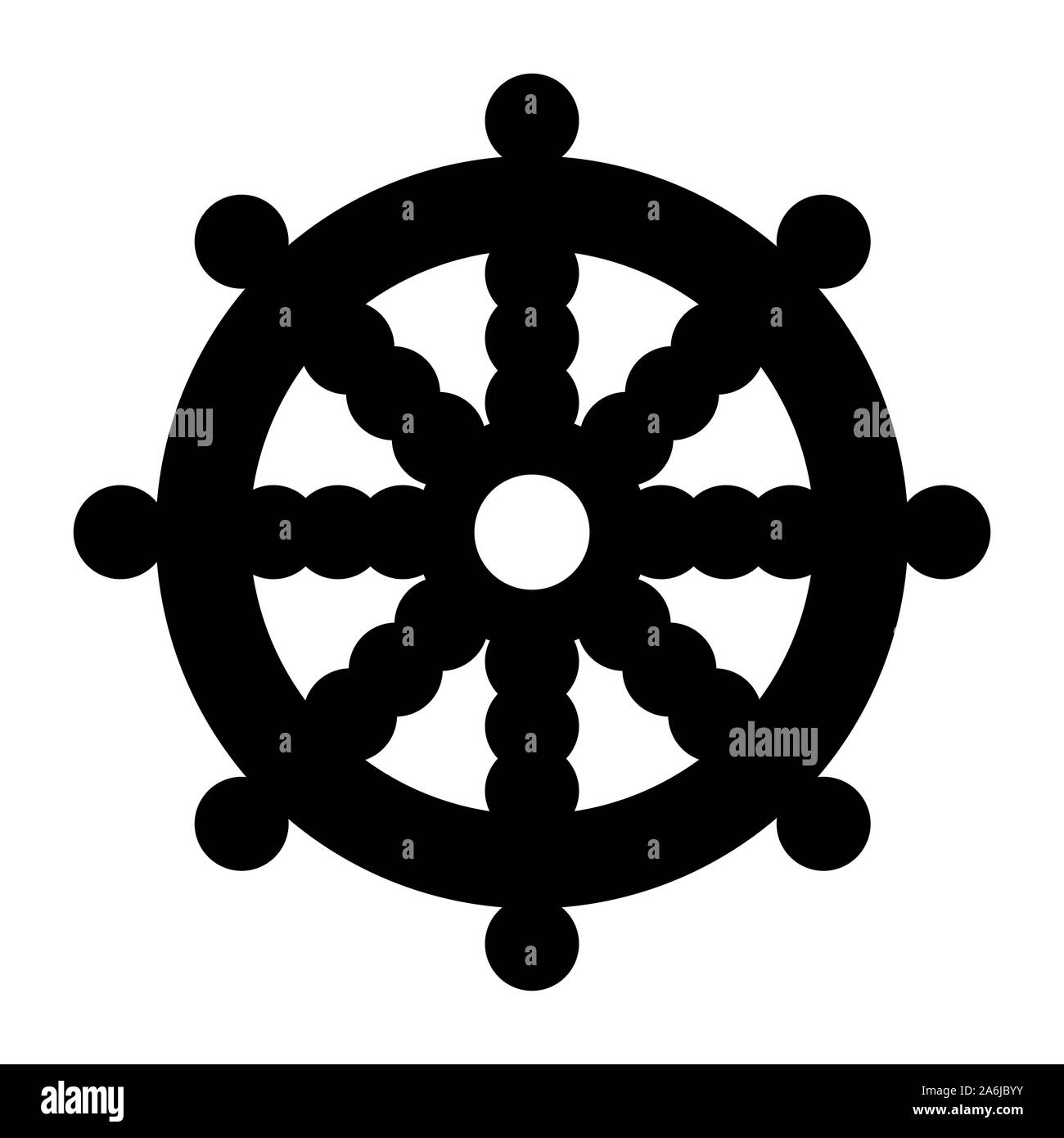
You’ve seen it. That heavy, gold-and-wood wheel clicking above the head of the most terrifying Shikigami in Gege Akutami’s universe. It’s not just for show. Honestly, the wheel of dharma jjk fans obsess over is the single most broken mechanic in the entire Jujutsu Kaisen power system. It’s called the Eight-Handled Sword Divergent Sila Divine General Mahoraga, but everyone just calls him Mahoraga—or the reason Sukuna won.
The wheel is the heart of the beast.
It’s based on the Dharmachakra, a symbol of Buddhist law and the cycle of rebirth. In the context of the series, it represents a cycle of adaptation that effectively makes the user immune to anything that doesn't kill them in one shot. If you hit Mahoraga with a cursed technique and he survives, that wheel spins. Once it clicks, your best move becomes a wet noodle.
How the Wheel of Dharma JJK Actually Functions
Most people think Mahoraga just builds a resistance. That’s a massive oversimplification. It’s not like a vaccine where you get a little bit of the virus and become immune. It is a proactive, aggressive evolution. When the wheel of dharma jjk spins, Mahoraga analyzes the mathematical and cursed energy essence of an attack. He finds the "solution" to the problem you are presenting.
Think about the fight in Shibuya. Sukuna realized this almost immediately. Mahoraga didn’t just stop getting hurt by "Dismantle"; he actually started seeing the invisible slashes. He adapted his own cursed energy to deflect them. It’s a literal cheat code.
- The First Spin: Initial contact. The wheel recognizes the phenomenon.
- The Click: Adaptation complete.
- The Iteration: This is the part people miss. The wheel doesn't stop after one spin. If the battle continues, Mahoraga keeps spinning the wheel to find better ways to counter the same move.
During the "Battle of the Strongest" against Satoru Gojo, we saw the peak of this. Sukuna didn't just use Mahoraga as a shield; he used the wheel of dharma jjk as a blueprint. Because Sukuna was "wearing" the burden of adaptation while hiding in the shadows, he forced the wheel to turn by exposing himself (and Megumi’s soul) to Gojo’s Unlimited Void. It was a risky, almost suicidal play that only a tactical genius like Sukuna could pull off.
Why Gojo Couldn't Just "One-Tap" the Wheel
Gojo is the pinnacle. We know this. But the wheel of dharma jjk works on a timeline that Gojo couldn't outrun. To kill Mahoraga, you need a move so powerful it vaporizes him before the wheel can complete a rotation. Gojo had "Hollow Purple," but Sukuna played the long game. By the time Gojo was ready to fire his big guns, the wheel had already clicked for "Blue" and "Red."
This is where the nuance of the series really shines. The wheel isn't just about defense. In the final stages of the Gojo fight, the wheel turned and gave Mahoraga an offensive buff. It allowed Mahoraga to bypass the Infinity—not by neutralizing it, but by expanding the target of the attack to include the very space Gojo occupied. That is the "World-Cutting Slash."
It’s terrifying.
The Connection to Buddhist Mythology
Gege Akutami loves his religious symbolism. The "Eight-Handled Sword" refers to the Eightfold Path. The wheel itself—the Dharmachakra—represents the turning of the law. In many Buddhist traditions, the turning of the wheel signifies a great change or the teaching of a new truth.
In Jujutsu Kaisen, that "truth" is death for whoever is standing in front of Mahoraga.
The Divergent Sila part of the name is also a hint. Sila refers to ethical conduct or precepts. "Divergent" suggests a breaking away or a variation. Essentially, Mahoraga is the "Divine General" who breaks the established rules of the world to ensure his own survival. When you see that wheel of dharma jjk design, you're looking at the physical manifestation of "I will always find a way to beat you."
Common Misconceptions About the Wheel
A lot of fans argue on Reddit about whether Mahoraga can adapt to "concepts" or just "attacks." Based on the manga's progression, it’s clearly both.
He didn't just adapt to the physical sensation of being cut. He adapted to the concept of the Limitless. This is a crucial distinction. If he only adapted to physical force, Gojo’s Red (which is powered by positive energy) would have still worked after Blue failed. But the wheel is smarter than that. It looks at the source.
Another myth? That the wheel makes him invincible. It doesn't.
If you have two vastly different types of attacks and you hit him with both simultaneously, the wheel has to choose which one to prioritize, or it takes longer to click. This is why Sukuna used "Fire Arrow" (Fuga) in Shibuya. Mahoraga had already adapted to cutting attacks, but he hadn't seen fire yet. The sheer thermal output was enough to incinerate him before the wheel could spin again.
The Burden of Adaptation
The most complex part of the wheel of dharma jjk mechanics is who carries the weight. In the Megumi vs. Sukuna or Sukuna vs. Gojo fights, we see the wheel moving from the Shikigami to the sorcerer.
- The User Shadows: The wheel can be summoned without the full body of Mahoraga.
- The Soul Burden: Sukuna used Megumi's soul to take the hit from Gojo's "Unlimited Void." This allowed the wheel to adapt while Mahoraga stayed safe in the shadows.
- The Summon: Once the adaptation was ready, Sukuna brought Mahoraga out, already pre-loaded with the counter to Gojo’s most dangerous move.
It's a heavy cost. You have to actually take the damage for the wheel to work. You can't just wave it around and hope for the best. You have to bleed for it.
The Wheel's Legacy in the Culling Game
As the series reached its climax, the wheel of dharma jjk became the focal point of the power creep. It forced every character to rethink what "strength" meant. It wasn't about who had the most cursed energy anymore; it was about who could finish a fight the fastest.
The wheel essentially put a timer on the universe.
If you can't win in the first three minutes, you aren't going to win at all. This shifted the stakes of Jujutsu Kaisen from a standard battle shonen into a high-stakes chess match where the wheel was the ultimate queen piece. It’s the reason why the Ten Shadows Technique is considered equal to the Six Eyes and Limitless. Without that wheel, Ten Shadows is just a cool zoo of shadow monsters. With it? It’s a god-slayer.
What to Watch Out For
If you're re-reading the manga or watching the anime, pay close attention to the sound of the click. Gege uses it as a narrative heartbeat. Every time that wheel clicks, the tension shifts. The protagonist (or antagonist) goes from being in control to being hunted. It’s a masterclass in psychological horror within an action setting.
The wheel of dharma jjk represents the ultimate inevitability. It is the "Game Over" screen that slowly crawls toward you while you're still trying to play the level.
To truly understand the power scaling of the late-game JJK, you have to respect the wheel. It isn't just an accessory; it's the logic-defying engine that allowed the King of Curses to rewrite the rules of reality.
Actionable Insights for Fans and Powerscalers:
- Analyze the "Condition": When debating Mahoraga matchups, always ask if the opponent has a "One-Shot" capability. If the character relies on chip damage or repetitive attacks (like Nanami's Ratio or Yuji's Divergent Fist), they lose to the wheel 100% of the time.
- Observe the Visual Cues: In the anime, the number of spokes on the wheel sometimes glows or pulses. This usually indicates how close the adaptation is to completion.
- Study the "Fuga" Precedent: The Shibuya incident proves that elemental variety is the only hard counter to the wheel. To beat a Ten Shadows user, a sorcerer needs a "hidden" secondary technique that doesn't share the same cursed energy signature as their primary one.
- Contextualize Sukuna's Strategy: Remember that Sukuna didn't just "have" Mahoraga; he mastered the wheel's transfer mechanics. In your own fan theories or RPG builds, consider how "carrying the burden" changes the risk-reward ratio of the technique.
The wheel is still turning. Even after the series ends, the impact of this mechanic on how we view "unbeatable" characters is permanent.