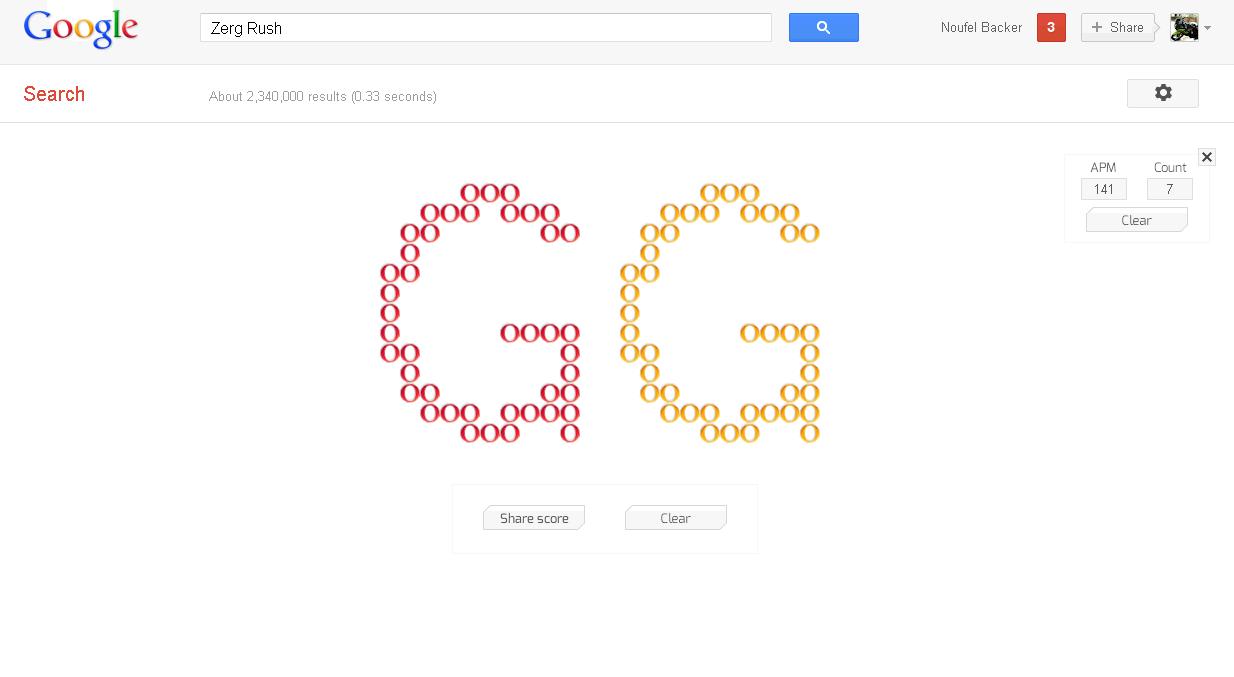
You’re staring at the Google search bar. You type in those two specific words, hit enter, and suddenly, your screen is under siege. Tiny, yellow and red "O" characters start dropping from the top of the browser like paratroopers. They aren't just there for decoration; they are eating your search results. This is the zerg rush easter egg, a piece of digital history that basically defined how a generation viewed Google's personality. It wasn't just a gimmick. It was a bridge between the high-octane world of competitive real-time strategy games and the mundane task of looking up information online.
Most people today probably don't even realize where the term comes from. If you weren't grinding matches in StarCraft back in the late nineties, the phrase "zerg rush" might just sound like weird internet slang. But for the folks at Blizzard Entertainment who created the Zerg race, it was a literal gameplay mechanic. The Zerg were these insectoid aliens. Individually, they were weak. Collectively? They were a nightmare. You’d build dozens of cheap, fast units called Zerglings and flood your opponent's base before they even had a chance to build a single defensive turret. That’s the "rush." It’s dirty. It’s effective. It’s legendary.
Google launched its tribute to this tactic in 2012. Back then, the internet felt a bit more like a playground. Google was known for these "Doodles" and hidden gems that would break the functionality of their site just to make you smile for thirty seconds. It was a flex, honestly. It showed that the engineers had a sense of humor and that they were definitely gamers.
How the Zerg Rush Easter Egg Actually Works
When the game triggers, your cursor turns into a crosshair. You have to click those falling "O"s multiple times to "kill" them. If you’re too slow, they devour the blue links and text snippets on the page, leaving behind a blank white void. It’s surprisingly stressful. Your APM—actions per minute—actually matters here, just like in a real game of StarCraft.
There's a scoreboard on the right side of the screen. It tracks your "Kills" and your "APM." Once the "O"s have successfully wiped out your search results, they all migrate to the center of the screen. They rearrange themselves into two giant "G"s. It stands for "Good Game." It’s the polite way to admit defeat in the gaming world.
The mechanics were built using HTML5. This was a big deal at the time because it showed what browsers could do without needing Adobe Flash. We forget how much of a war there was between open web standards and proprietary plugins. By making the zerg rush easter egg run natively in the browser, Google was subtly pushing the narrative that the web was evolving. It was a technical demonstration disguised as a prank.
The Origin Story: Why StarCraft?
To understand why this specific joke exists, you have to look at the culture of tech companies in the early 2000s. Google’s campus, the Googleplex, was basically a nerd sanctuary. Rumor has it that StarCraft was a staple in the breakrooms. It wasn't just a game; it was a way to sharpen strategic thinking.
The Zerg themselves represent a specific kind of power. They are the "Swarm." In the lore, they don't use technology; they use biological evolution. This contrasts sharply with the Protoss (high-tech aliens) and the Terrans (humans). The "zerg rush" became a cultural phenomenon because it was the ultimate "low skill, high reward" move that drove veteran players insane. By putting this in the search engine, Google was signaling to the nerd elite: "We see you. We are one of you."
Why Can’t I Find It Anymore?
If you go to a standard Google search bar today and type it in, you might be disappointed. Google frequently rotates its easter eggs or moves them to archives to keep the main search page "clean" and fast. The internet has changed. Everything is optimized for mobile speed now, and a bunch of floating "O"s eating your data isn't exactly "user-friendly" for someone trying to find the nearest pharmacy in a hurry.
But it’s not gone.
You can still play it on the "Google Mirror" sites or through the official Google Doodle archive. Sites like elgoog.im have preserved the code. It’s like a digital museum.
- The original version required a mouse for rapid clicking.
- The mobile version—if you can find a working port—is way harder because of touch latency.
- The scoreboard doesn't save your high scores globally anymore, which is a bummer for the competitive types.
The Impact on Modern Easter Eggs
The zerg rush easter egg paved the way for things like the "Thanos Snap" (which erased half your search results) and the "The Last of Us" fungal growth that takes over the screen. It set a precedent: the search results page doesn't have to be static. It can be an interactive canvas.
It also changed how marketing works. Nowadays, every big movie release tries to get a Google easter egg. But the Zerg one felt different because it wasn't a paid promotion. It was just a bunch of developers being fans of a classic game. It felt authentic. It didn't feel like an ad for StarCraft II, even though it certainly didn't hurt Blizzard's sales.
The Strategy Behind the Score
If you’re actually trying to "win" or at least survive a long time, you need a strategy. Don't just click randomly. The "O"s come from the top and the sides. You want to prioritize the ones closest to the text. Each "O" takes about three clicks to destroy.
Focus on the clusters. In StarCraft, we call this "focus fire." If you spread your damage across too many targets, none of them die, and they all keep eating your base—or in this case, your Wikipedia links.
Honestly, the zerg rush easter egg is a perfect metaphor for the internet itself. Information is constantly being "rushed" by noise. If you don't actively defend your "search results" or your attention span, the "O"s of distraction will eventually leave you with nothing but a "GG" on a blank screen.
Technical Evolution and Legacy
Looking back, the code was remarkably simple. It used basic CSS and JavaScript to track coordinates and trigger "destruction" animations for the text elements. But the complexity was in the collision detection. Making sure the "O"s knew where the text was, regardless of your screen resolution or font size, was a clever bit of math.
It’s also worth noting that this easter egg helped popularize the term "zerg" outside of gaming. You’ll hear it in business meetings now. "We’re going to zerg this project," usually means throwing a massive amount of cheap resources at a problem to finish it quickly. It’s become part of the lexicon.
What You Should Do Now
If you’ve never experienced it, go find a mirror site and try it out. It’s a bit of a trip.
- Check your APM. See if you can break 200. Most casual players hover around 50-70.
- Explore other "gaming" eggs. Type "Atari Breakout" into Google Images. Trust me.
- Learn the history. If you’ve never played StarCraft, watch a few tournament clips from the "Brood War" era. It puts the whole "rush" concept into a much more intense perspective.
The zerg rush easter egg reminds us that the internet used to be a lot weirder and a lot more fun. While we move toward a web dominated by AI and hyper-efficiency, these little pockets of "useless" fun are what keep the digital world feeling human. It’s a tribute to a game, a display of coding skill, and a middle finger to productivity, all wrapped in one.
Next time you’re bored, don't just scroll social media. Go defend your search results. Those little "O"s are coming, and they don't care about your deadlines.
Next Steps for the Curious
- Visit the Archive: Head over to the Google Doodle archive or Elgoog to see the original 2012 assets in action.
- Test Your Speed: Use an online clicking test to see if your fingers are actually fast enough to survive a real Zerg attack.
- Deep Dive into StarCraft: Read up on the 1998 release of StarCraft to see how a small team at Blizzard changed the strategy genre forever.